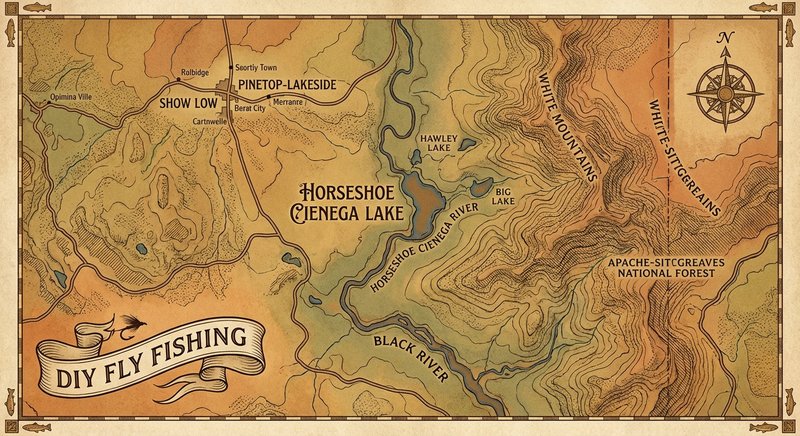
Horseshoe Cienega Lake
Fly fishing in Arizona · intermediate · Best seasons: spring, summer, fall
Target Species
Rainbow Trout, Apache Trout
About This Water
Remote tribal lake with excellent fishing. Scenic meadow setting in White Mountains.
Fishing Recommendations
Welcome to the high country. As your guide, I’m excited to walk you through one of Arizona’s most unique stillwater gems: Horseshoe Cienega Lake.
Located at over 8,000 feet in the White Mountains on the Fort Apache Indian Reservation, "The Shoe" is legendary among Southwest anglers. It is a productive, high-altitude alpine lake known for its trophy potential and its population of Arizona’s state fish, the Apache Trout.
🎣 Location Overview
Horseshoe Cienega is a roughly 120-acre reservoir that feels more like a giant spring pond than a typical lake. "Cienega" is Spanish for marsh or swamp, which perfectly describes the lake's character. It is shallow, incredibly fertile, and dense with aquatic vegetation.
What makes it special is the biomass. Because the water is so rich in nutrients, the trout grow exceptionally fast. This isn't just a "numbers" lake; it’s a "size" lake. The water is often crystal clear, allowing for exciting sight-fishing opportunities, but the heavy weed beds mean you have to be tactical about where and how you present your fly.
🐟 Target Species & Behavior
The lake is managed primarily for two species:
- Apache Trout: These are the crown jewels. They are native to these mountains and recognizable by their golden hue and the "mask" over their eyes. They tend to cruise the edges of weed beds and are often more aggressive than rainbows.
- Rainbow Trout: Often stocked as sub-adults, they grow quickly here. You will find "holdovers" that are thick-bodied and powerful.
Behavior: Because the lake is shallow, the fish are very light-sensitive. They will hold in the deeper channels (10–15 feet) during the midday sun and move into the shallow flats and "pockets" in the weeds during the low-light hours of morning and evening to feast on scuds and damselfly nymphs.
📅 Best Times to Fish
Optimal Seasons
- Spring (May – June): This is prime time. As the ice melts and the water warms, the fish are hungry. The "Ice-Out" period can provide some of the biggest fish of the year.
- Summer (July – August): Fishing remains good due to the altitude, but the afternoon monsoon storms are a factor. Mid-summer is peak season for Damselfly hatches.
- Fall (September – October): As temperatures drop, the weeds begin to die back, making it easier to fish. This is when the trout "bulk up" for winter.
Best Times of Day
- First Light to 10:00 AM: The best time for dry flies and shallow-water stalking.
- Late Afternoon/Dusk: The "magic hour" when the wind dies down and fish begin dimpling the surface for midges and caddis.
🪰 Recommended Flies & Techniques
Top Fly Patterns
- Scuds (Sizes 12–16): Orange, Olive, or Pink. This is the primary food source in the weeds.
- Damselfly Nymphs (Sizes 10–14): Braided butt or marabou tails in olive.
- Simi Seal Leeches (Sizes 8–12): Colors: "Canadian Olive," "Peacock," or "Black/Red." This is the gold standard for Arizona stillwaters.
- Chironomids (Sizes 14–18): Zebra Midges or "Ice Dub" midges under a strike indicator.
- Dry Flies: Parachute Adams (14–18), Elk Hair Caddis (14–16), and occasionally Foam Ants/Beetles in late summer.
Effective Techniques
- The "Naked" Leech: Use an intermediate (slow-sink) clear line. Cast to the edges of weed pockets, let it sink, and use a slow, 3-inch rhythmic strip.
- Indicator Nymphing: Suspend a scud or midge 4–7 feet below a small indicator. This is the most effective way to fish the "holes" in the weeds without getting hung up.
- Sight Casting: On calm days, stand on the bow of a boat or float tube and look for cruising shadows. Lead the fish by 3 feet and give the fly a tiny twitch.
💡 Pro Tips & Local Knowledge
- Bring a Watercraft: While you can fish from the bank near the dam, Horseshoe Cienega is best fished from a float tube, kayak, or pontoon boat. This allows you to reach the offshore weed islands where the biggest fish hide.
- Mind the Weeds: Use a slightly heavier tippet than you might think (3X or 4X). If a 20-inch Apache Trout dives into the weeds, you need the strength to pull him out.
- The "Double Rig": Run a weighted Simi Seal Leech as your lead fly and tie a small unweighted Scud or Midge 18 inches behind it on a dropper.
- The "Damsel" Migration: In June and July, watch for damselfly nymphs swimming toward the shore to hatch. If you see this, strip an olive nymph toward the bank—the strikes are explosive.
⚠️ Important Information
Access & Permits
- Tribal Permit Required: This lake is on the Fort Apache Indian Reservation (WMAT). An Arizona state fishing license is NOT valid here. You must purchase a WMAT fishing permit and a special "Reservation Lake" permit. You can buy these online or at stores in Pinetop-Lakeside.
- Boat Rules: Electric motors only. Internal combustion engines are prohibited.
Regulations
- Check Current Rules: Regulations on Horseshoe Cienega can change (sometimes it is "Catch and Release only," other times there is a bag limit). Always check the latest WMAT Game & Fish proclamations before casting.
- Barbless Hooks: It is highly recommended to pinch your barbs to protect the native Apache Trout.
Special Considerations
- Weather: At 8,000 feet, weather changes fast. Even in July, bring a rain jacket and a warm layer.
- Sun Protection: The UV rays are intense at this altitude. Wear a buff and high-SPF sunscreen.
Tight lines, and enjoy the pursuit of the golden Apache Trout!
Bug Hatches & Matching Flies
| Hatch | Type | Peak months | Time of day | Hook sizes | Matching flies |
|---|---|---|---|---|---|
| Chironomids Chironomidae | midge | May, June, September | All Day | #12-20 | Ice Cream Cone #12-18, Zebra Midge #16-20, Griffith's Gnat #18-22 |
| Speckled Dun Callibaetis | mayfly | June, July, August | Late Morning | #12-16 | Callibaetis Spinner #14-16, Hare's Ear Nymph #12-16, Parachute Adams #14-16 |
| Cinnamon Caddis Limnephilidae | caddis | July, August | Evening | #12-16 | Elk Hair Caddis (Orange/Tan) #12-16, Godzilla Caddis #12-14, Soft Hackle Hare's Ear #14-16 |
| Blue Winged Olive Baetis | mayfly | April, October | Afternoon | #18-22 | RS2 #18-22, BWO Parachute #18-22, Pheasant Tail #18-20 |
| Terrestrial Ants Formicidae | terrestrial | July, August | Afternoon | #14-18 | Cinnamon Ant #14-16, Black Foam Ant #14-18, Chernobyl Ant #10-14 |
| Grasshoppers Acrididae | terrestrial | August, September | Afternoon | #8-12 | Dave's Hopper #10-12, Hopper Juan #12, Joe's Hopper #8-12 |
| Little Black Caddis Brachycentrus | caddis | May | Morning | #16-18 | Z-Caddis #16-18, Black Elk Hair Caddis #16-18 |
| Damselfly Enallagma | midge | June, July | Morning/Afternoon | #10-14 | Marabou Damsel #10-12, Adult Damsel #12-14, Sheep Creek Special #10-14 |