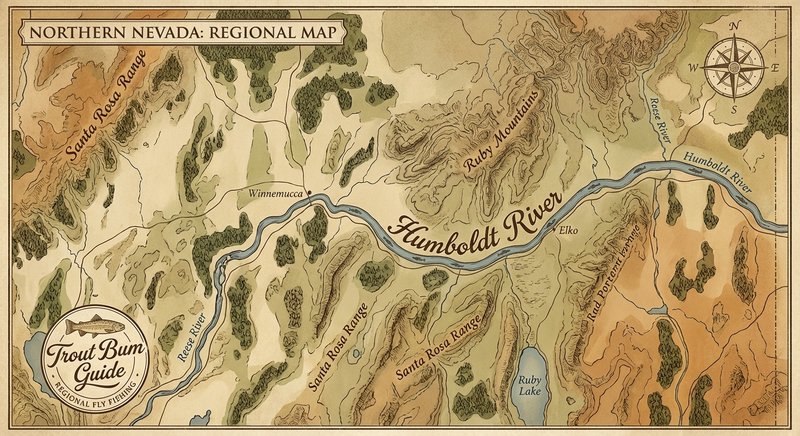
Humboldt River
Fly fishing in Nevada · intermediate · Best seasons: spring, fall
Target Species
Brown Trout, Rainbow Trout
About This Water
Historic emigrant trail river with brown trout. Nevada's longest river with varied fishing.
Fishing Recommendations
The Humboldt River is a unique gem in the high desert of Nevada. It is the longest river in the state and one of the most unusual in the world because it is an "endorheic" river—meaning it never reaches the ocean, eventually disappearing into the Humboldt Sink.
For the fly angler, the Humboldt is a study in contrasts. While the lower reaches are warm and silty, the Upper Humboldt and its tributaries (like the Marys River and the North and South Forks) offer some of the most underrated trout fishing in the Great Basin.
🎣 Location Overview
The Humboldt River meanders through a vast sagebrush landscape, characterized by cut banks, deep willow-lined pools, and a surprisingly rich aquatic ecosystem. Unlike the roaring freestone rivers of the Rockies, the Humboldt is often a slow-moving, technical meadow stream.
Anglers love the Humboldt for its solitude. It is rarely crowded, and the fish—particularly the wild Brown Trout—can grow to impressive sizes by feeding on the abundant forage found in its alkaline waters. It is a "hunter's" river, where you spend as much time stalking the banks as you do casting.
🐟 Target Species & Behavior
- Brown Trout: The "king" of the Humboldt. These fish are wary, aggressive, and highly territorial. They hold deep in undercut banks and beneath overhanging willows.
- Rainbow Trout: Found primarily in the swifter, oxygenated riffles of the upper forks and in sections supplemented by the Nevada Department of Wildlife (NDOW).
- Behavior: Due to the river's high alkalinity, there is a massive population of scuds and snails. Humboldt trout are often "bottom-feeders" until a major hatch occurs or until grasshoppers begin falling into the water in late summer.
📅 Best Times to Fish
Optimal Seasons
- Spring (Late April – June): This is the window between the winter freeze and the heat of summer. As the snow melts from the Ruby Mountains and the East Humboldt Range, the river rises. Fish the "shoulder" of the runoff when visibility returns to 18–24 inches.
- Fall (September – early November): The Prime Window. Water temperatures drop, the weeds begin to die back, and the Brown Trout become extremely aggressive as they prepare for the spawn.
Best Times of Day
- Dawn and Dusk: Essential for the larger Browns. These fish are light-sensitive and will move out of the deep undercuts into the shallows to hunt during low-light hours.
- Mid-day (Fall only): On cooler autumn days, the Blue Winged Olive (BWO) hatches can provide excellent dry fly action in the afternoon.
🪰 Recommended Flies & Techniques
Top Fly Patterns
- Nymphs:
- Ray Charles or Soft Hackle Scuds (Pink, Orange, or Olive) – Sizes 14-18.
- Bead-head Pheasant Tail – Sizes 14-16.
- Zebra Midges (Black/Silver) – Sizes 18-20.
- Dry Flies:
- Hopper Patterns (Morrish Hopper, Parachute Hopper) – Sizes 8-12.
- Blue Winged Olive (BWO) – Sizes 18-20.
- Elk Hair Caddis – Sizes 14-16.
- Streamers:
- Woolly Buggers (Olive or Black) – Sizes 6-10.
- Sculpzilla – To mimic the native sculpins.
Techniques & Presentation
- The "Bank Slap": During hopper season (late summer/fall), cast your fly tight to the grass line. A "plop" on the water often triggers a reactionary strike from a Brown Trout hiding under the bank.
- Deep Nymphing: Use a strike indicator and enough weight to get scuds down into the deep holes. The Humboldt has many deep "buckets" where fish congregate.
- Streamer Stripping: Cast downstream and across toward an undercut bank. Use a jerky, "injured baitfish" retrieve to draw big Browns out of cover.
💡 Pro Tips & Local Knowledge
- Focus on the Forks: The South Fork of the Humboldt (below the reservoir) and the East Fork (near Elko/Halleck) offer the most consistent trout habitat. The main stem near Elko can be productive but is more susceptible to temperature fluctuations.
- Stealth is Mandatory: The water can be clear and the banks are often high. If the fish see your silhouette against the desert sky, they will vanish. Crawl to the edge if you have to.
- Look for "Laminar" Flow: Because the river meanders so much, look for where the current pushes against a bank. That's where the deep water and the fish are.
- The "Humboldt Mud": The silt here is notorious. It is fine, alkaline, and can be very slippery. Wear wading boots with good traction, but be prepared for your gear to get dusty/muddy.
⚠️ Important Information
Access
- Much of the Humboldt runs through private ranch land. Use public access points near bridges and BLM (Bureau of Land Management) sections.
- The South Fork State Recreation Area provides excellent access and camping.
Regulations & Permits
- A valid Nevada Fishing License is required.
- Check the NDOW Fishing Guide for current bag limits. Many sections are "General Regulations," but some tributaries have specific lure/hook restrictions.
Special Considerations
- Rattlesnakes: The sagebrush banks are prime habitat for Great Basin Rattlesnakes. Watch your step, especially in the summer.
- Hydration: This is high-altitude desert. Bring twice as much water as you think you’ll need.
- Tread Lightly: The banks are prone to erosion. Use established paths to reach the water to preserve the riparian habitat.
Bug Hatches & Matching Flies
| Hatch | Type | Peak months | Time of day | Hook sizes | Matching flies |
|---|---|---|---|---|---|
| Blue-winged Olive Baetis spp. | mayfly | March, April, October, November | Late Morning/Afternoon | #16-22 | BWO Sparkle Dun #18-20, RS2 #18-22, Pheasant Tail #16-20 |
| Pale Morning Dun Ephemerella inermis | mayfly | June, July | Morning/Early Afternoon | #14-18 | PMD Parachute #16-18, Split Case PMD #16, Quigley Cripple #14-16 |
| Spotted Sedge Hydropsyche spp. | caddis | June, July, August | Evening | #14-18 | Elk Hair Caddis #14-16, LaFontaine Sparkle Pupa #16, Peacock Caddis #16-18 |
| Trico Tricorythodes spp. | mayfly | August, September | Early Morning | #20-24 | Trico Spinner #20-22, Trico Dun #22-24 |
| Grasshopper Melanoplus spp. | terrestrial | July, August, September | Late Morning/Afternoon | #8-12 | Dave's Hopper #10-12, Morrish Hopper #8-12, Parachute Hopper #12 |
| Little Brown Sedge Glossosoma spp. | caddis | May, June | Afternoon/Evening | #16-20 | Zebra Midge #18-20, CDC Caddis #18, Graphic Caddis #16-18 |
| Chironomids (Midges) Chironomidae | midge | February, March, December | All Day | #18-24 | Griffith's Gnat #18-22, Zebra Midge (Black/Silver) #20-22, Palomino Midge #20 |
| Blue Damselfly Enallagma spp. | other | July, August | Late Morning/Afternoon | #10-14 | Marabou Damsel Nymph #12-14, Adult Damsel #10-12 |