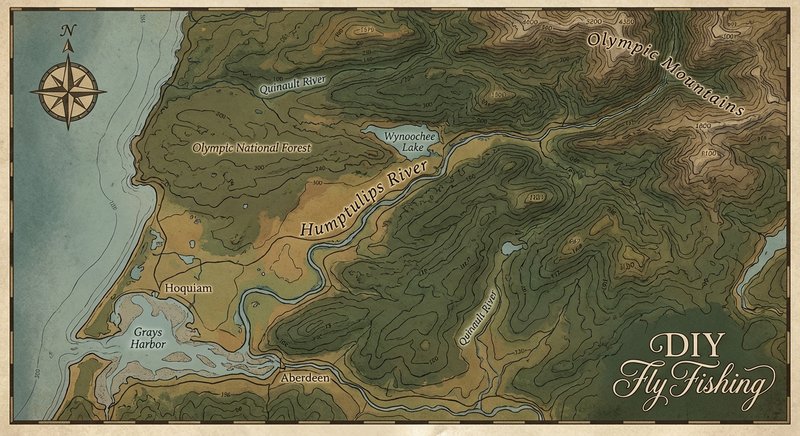
Humptulips River
Fly fishing in Washington · Intermediate · Best seasons: Winter, Spring
Target Species
Steelhead, Chinook Salmon
About This Water
Western Olympic Peninsula river with excellent steelhead runs. Less crowded than northern rivers.
Fishing Recommendations
The Humptulips River—locally known as "The Humpy"—is a legendary coastal drainage in Washington’s Olympic Peninsula region. While it doesn't get the same national "glamour" press as the Hoh or the Sol Duc, to local guides and serious chrome-chasers, it is one of the most productive and reliable systems in the Pacific Northwest.
Here is your guide to mastering the Humptulips.
🎣 Location Overview
Flowing through the lush temperate rainforest of Grays Harbor County, the Humptulips is a medium-sized coastal river characterized by its classic "pool-and-drop" structure. It is famous for its distinct water color; even when it’s "clear," the water often carries a milky, tea-colored tint due to tannins and silt, which provides fish with a sense of security even in lower flows.
The river is divided into the East and West Forks, which join to form the mainstem. The mainstem offers prime drift boat water, winding through cathedral-like forests of Sitka spruce and Douglas fir. Anglers love it because it often remains fishable when the northern Olympic Peninsula rivers (like the Bogachiel) are blown out, thanks to its slightly different drainage profile.
🐟 Target Species & Behavior
Chinook Salmon (King Salmon)
- Behavior: The Humpy is home to massive, "brute" Fall Chinook. These fish are aggressive when they first enter the system but become territorial as they hold in deep pools.
- Holding: Look for them in the "gut" of deep holes, near submerged timber, and at the heads of pools where oxygen levels are highest.
Winter & Spring Steelhead
- Behavior: The river hosts a strong run of hatchery "early" winter steelhead (returning Dec–Jan) and a prized run of large, wild "springer" steelhead (returning Feb–April).
- Holding: Steelhead here prefer "walking speed" water. Look for them in tailouts, the seams between fast and slow water, and behind the massive root balls and log jams that litter the river.
📅 Best Times to Fish
- Fall Chinook: September through November. October is the prime window for fresh, aggressive fish.
- Winter Steelhead (Hatchery): December and January. These fish are aggressive and often travel in pods.
- Spring Steelhead (Wild): February through mid-April. This is the trophy hunter’s window. March is arguably the best month for a chance at a 20-pound wild fish.
- The "Magic" Window: The best fishing occurs when the river is dropping and clearing after a rain event. Look for a flow between 1,500 and 2,500 cfs (at the Humptulips gauge) for ideal drift boat conditions.
🪰 Recommended Flies & Techniques
The Swing (Spey Casting)
The Humpy has fantastic swing water. Using a 7 or 8-weight Spey rod is the most "soulful" way to find fish.
- Flies:
- Steelhead: Intruders in pink/orange, blue/black, or "Nightshade" (purple/black).
- Chinook: Large Prom Dress patterns or Comets in chartreuse or hot pink.
- Tip: Use T-11 or T-14 sink tips. You need to get the fly down quickly in the Humptulips' deep slots.
Nymphing (Indicator Fishing)
This is often the most productive method, especially when fish are tucked into woody debris.
- Flies: 10mm or 12mm beads (mottled orange or "peach glow") are the gold standard for steelhead. Follow the bead with a Rubber-Legged Stonefly or a Nightmare Nymph.
- Technique: A dead drift is essential. If your indicator isn't twitching occasionally from hitting the bottom, you aren't deep enough.
Streamer Stripping
In the lower river (tidewater), stripping large, weighted streamers can trigger aggressive strikes from fresh-run Chinook.
💡 Pro Tips & Local Knowledge
- Fear the Wood, Fish the Wood: The Humptulips is notorious for "sweepers" (fallen trees). While dangerous for rowing, these log jams hold the biggest fish. Cast as close to the wood as you dare.
- The "Humpy Green": Don't stay home if the river looks "off-color." Because of the silt, the Humptulips can have 2 feet of visibility and still be "game on." If you can see your boots in knee-deep water, start fishing.
- The Hatchery Hole: The area around the Humptulips Salmon Hatchery (near Stevens Creek) is high-traffic but holds a high density of fish. If you want solitude, avoid this stretch. If you want a high probability of a hatchery "keeper," this is the spot.
- Short Leaders: When swinging in stained water, shorten your leader to 3–4 feet of 12lb or 15lb Maxima Ultragreen. This keeps your fly in the "zone" created by your sink tip.
⚠️ Important Information
- Access: Most of the river is best accessed by drift boat. Popular drifts include the "Hatchery to Highway 101" or "101 to Reyvans Landing." Bank access is limited primarily to the Hatchery area and a few bridge crossings.
- Regulations: Washington fishing regulations are complex and can change mid-season (Emergency Rules). Always check the WDFW website before heading out.
- Note: Wild Steelhead must be released and cannot be lifted out of the water for photos. Keep them wet!
- Permits: You need a Washington Freshwater Fishing License and a Catch Record Card (Steelhead/Salmon).
- Safety: The Humptulips changes every year with winter floods. New log jams appear overnight. If you are rowing, keep your eyes downstream and never "push" a blind corner without scouting if the flows are high.
Guide’s Final Word: The Humptulips is a "workhorse" river. It’s moody, woody, and often rainy, but when that chrome wild steelhead or 30-pound King hits your fly in the mist of a March morning, you’ll understand why we keep coming back.
Bug Hatches & Matching Flies
| Hatch | Type | Peak months | Time of day | Hook sizes | Matching flies |
|---|---|---|---|---|---|
| Blue-winged Olive Baetis tricaudatus | mayfly | March, April, September, October | Mid-day | #18-22 | Parachute Adams #18-20, RS2 #20, Pheasant Tail Nymph #18-22 |
| March Brown Rhithrogena morrisoni | mayfly | March, April, May | Afternoon | #12-14 | March Brown Western Red #12-14, Gold Ribbed Hare's Ear #12-14, March Brown Wet Fly #14 |
| Skwala Stonefly Skwala americana | stonefly | February, March, April | Mid-day | #8-12 | Skwala Stone #10-12, Pat's Rubber Leg (Olive) #8-12 |
| Golden Stonefly Hesperoperla pacifica | stonefly | June, July | All Day | #6-10 | Chubby Chernobyl #8-10, Kaufmann's Stone #6-10 |
| Little Black Stonefly Capniidae family | stonefly | January, February, March | Mid-day | #16-20 | Black Stone #18, Zebra Midge #18-20 |
| Spotted Sedge Hydropsyche | caddis | June, July, August, September | Evening | #14-16 | Elk Hair Caddis #14-16, Soft Hackle Peacock #14-16, Hydropsyche Larva #14-16 |
| October Caddis Dicosmoecus atripes | caddis | September, October | Afternoon/Evening | #8-12 | Orange Stimulator #8-10, October Caddis Pupa #10-12 |
| Pale Morning Dun Ephemerella excrucians | mayfly | June, July, August | Late Morning/Afternoon | #16-18 | PMD Sparkle Dun #16-18, Frenchie #16-18 |
| Midges Chironomidae | midge | January, February, March, December | All Day | #18-24 | Griffith's Gnat #20-22, Mercury Midge #20-24 |