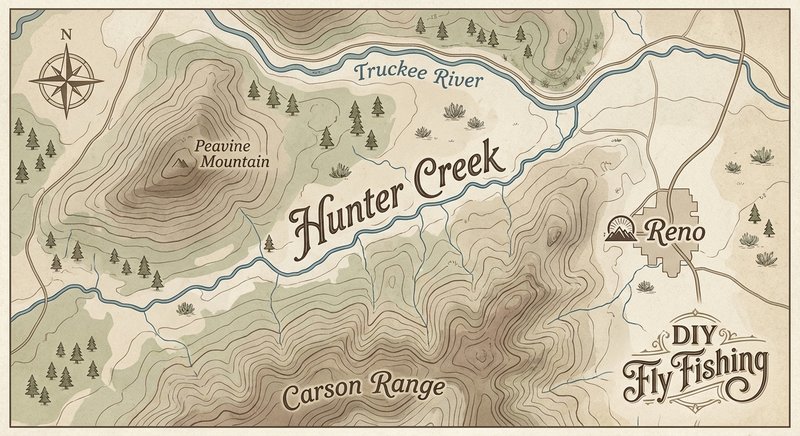
Hunter Creek
Fly fishing in Nevada · beginner · Best seasons: spring, summer
Target Species
Rainbow Trout, Brown Trout
About This Water
Reno area stream with wild trout. Urban fishing opportunity.
Fishing Recommendations
Hunter Creek is one of the Reno area’s best-kept secrets for small-stream enthusiasts. While most anglers flock to the brawny Truckee River, Hunter Creek offers a classic mountain stream experience—steep gradients, pocket water, and wild, eager trout—all within a short hike from the city limits.
🎣 Location Overview
Hunter Creek is a high-gradient tributary of the Truckee River that originates in the Mount Rose Wilderness. It carves a dramatic canyon through the high desert landscape before meeting the Truckee west of downtown Reno.
What makes it special is the transition of scenery; you start in sagebrush and bitterbrush and hike into a lush riparian corridor of aspens and pines. The water is crystal clear and cold, characterized by "pocket water"—small pools formed by boulders, plunge pools beneath mini-waterfalls, and tight runs. This is technical "tight-line" or "bushwhacking" fishing that rewards stealth and accurate casting rather than long-distance hucks.
🐟 Target Species & Behavior
The creek is home to wild Rainbow Trout and Brown Trout.
- Behavior: These are wild fish, not stockies. They are opportunistic feeders because the nutrient load in a high-gradient creek is lower than in the main stem of the river.
- Where they hold: Look for the "soft" water. In a fast-moving creek like this, fish won't waste energy in the main current. They sit in the eddies behind boulders, in the foam lines (the "bubble line is the food line"), and in the deep plunge pools at the base of small falls.
- Feeding: They are highly dependent on terrestrial insects (ants, beetles, grasshoppers) in the summer and aquatic nymphs (Caddis and small Mayflies) year-round.
📅 Best Times to Fish
Optimal Seasons
- Late Spring (May - June): This is highly dependent on snowpack. In high-water years, the creek can be a raging torrent and dangerous to fish. In normal years, the receding flows of late June provide excellent nymphing.
- Summer (July - September): This is the prime window. As the water clears and drops, the dry fly fishing becomes world-class for small-stream fans. The fish look up, and the canyon stays slightly cooler than the Reno valley floor.
Best Times of Day
- Morning: Best during the heat of mid-summer to catch the fish before the sun hits the water directly.
- Late Afternoon/Dusk: A heavy caddis flight often occurs in the canyon as the sun dips behind the Sierras, leading to frantic dry fly action.
🪰 Recommended Flies & Techniques
Top Fly Patterns
- Dry Flies:
- Elk Hair Caddis (Size 14-18) – The gold standard here.
- Parachute Adams (Size 16-20) – For slower pools.
- Royal Wulff or Humpy – High visibility attractors for broken water.
- Chernobyl Ant or Foam Beetles – Excellent in August.
- Nymphs:
- Bead-head Prince Nymph (Size 14-16) – Mimics the stoneflies found in the rocks.
- Pheasant Tail (Size 16-18) – A great generalist imitation.
- Perdigons – Weighted nymphs that sink fast in deep plunge pools.
Effective Techniques
- Dry-Dropper: This is the most effective way to fish Hunter Creek. Use a buoyant dry (like a Stimulator) and hang a small nymph 18–24 inches below it.
- High Sticking: Because the currents are complex, keep as much fly line off the water as possible to avoid drag.
- Bow-and-Arrow Cast: You will encounter overhanging willows. This cast is essential for getting your fly into tight spots without snagging the canopy.
💡 Pro Tips & Local Knowledge
- The "Hike-to-Fish" Ratio: The further you hike from the Michael D. Thompson Trailhead, the better the fishing gets. Most casual anglers fish the first half-mile. If you hike 2+ miles in toward the waterfall, you’ll find fish that see very few flies.
- Stealth is Key: Because the water is clear and the creek is small, the fish are spooky. Avoid wearing bright colors (stick to olives and tans) and try not to tower over the pools. Stay low and cast from downstream to upstream.
- Shadow Management: In the narrow canyon, your shadow can easily spook a pool. Pay attention to where the sun is and try to keep your shadow behind you.
- The "One-Cast" Rule: In small pools, your first cast is your best chance. If you slap the water or drag the fly, the fish will likely bolt for the undercut banks.
⚠️ Important Information
- Access: Access is via the Hunter Creek Trailhead at the end of Woodchuck Dr. in West Reno. There is a large parking lot, but it fills up early on weekends with hikers.
- Regulations: Nevada Department of Wildlife (NDOW) regulations apply. Ensure you have a valid Nevada fishing license. Always check current seasons and limits, though Catch and Release is strongly encouraged here to preserve the wild population.
- Safety: This is rattlesnake country. In the summer, they sun themselves on the rocks near the trail and the water. Wear sturdy boots and watch your step.
- Terrain: The banks are steep and can be slippery. Felt-soled wading boots or high-traction rubber soles with studs are recommended if you plan on wading.
Bug Hatches & Matching Flies
| Hatch | Type | Peak months | Time of day | Hook sizes | Matching flies |
|---|---|---|---|---|---|
| Blue-Winged Olive (BWO) Baetis | mayfly | March, April, October, November | Late Morning/Afternoon | #18-22 | Parachute Adams #18-22, RS2 #20-22, Pheasant Tail #18-20 |
| Golden Stonefly Hesperoperla pacifica | stonefly | June, July | Morning/Evening | #8-12 | Pats Rubber Legs #8-12, Chubby Chernobyl #10-12, Golden Rogue Stone #10-12 |
| Spotted Sedge Hydropsyche | caddis | June, July, August | Late Afternoon/Evening | #14-18 | Elk Hair Caddis #14-18, LaFontaine's Deep Sparkle Pupa #14-16, Holy Grail #16-18 |
| Pale Morning Dun (PMD) Ephemerella excrucians | mayfly | June, July | Late Morning/Early Afternoon | #16-18 | PMD Parachute #16-18, Split Case PMD #16-18, Trigger Finger PMD #16-18 |
| Yellow Sally Isoperla | stonefly | June, July | Afternoon/Evening | #14-16 | Yellow Sally Dry #14-16, Iron Lotus #16, Little Yellow Sloan #14-16 |
| Midges Chironomidae | midge | January, February, March, December | All Day | #18-24 | Zebra Midge #18-22, Griffith's Gnat #20-22, Top Secret Midge #20-24 |
| Hopper/Ant/Beetle Orthoptera/Formicidae | terrestrial | July, August, September | Midday/Afternoon | #10-16 | Parachute Ant #16-18, Dave's Hopper #10-14, Black Beetle #14-16 |
| Little Brown Stonefly Nemoura | stonefly | February, March, April | Midday | #14-18 | Copper John #14-18, Early Brown Stone Dry #16-18, Prince Nymph #14-16 |