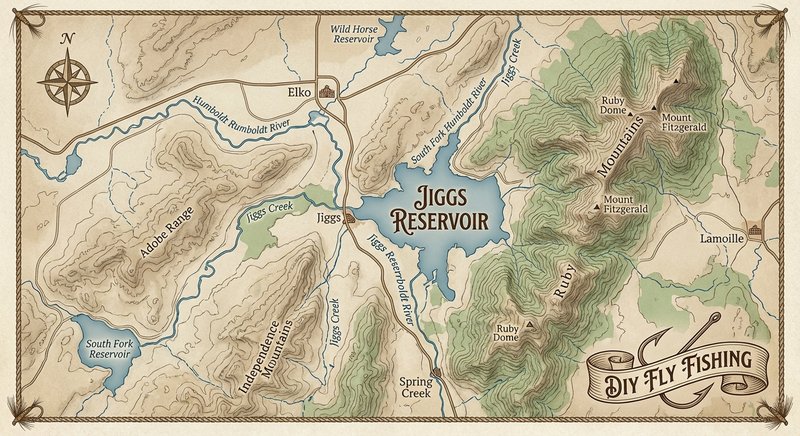
Jiggs Reservoir
Fly fishing in Nevada · beginner · Best seasons: spring, fall
Target Species
Rainbow Trout
About This Water
Small Elko County reservoir with trout stocking. Rural community water.
Fishing Recommendations
As an expert guide who has spent significant time navigating the high-desert fisheries of the Great Basin, I can tell you that Jiggs Reservoir is one of Nevada’s true "hidden gems"—though it is a fickle mistress. Located at the foot of the majestic Ruby Mountains south of Elko, this is a highly productive, nutrient-rich stillwater that can produce exceptionally fat, hard-fighting Rainbows when water levels are stable.
Here is the comprehensive guide to finding success at Jiggs Reservoir.
🎣 Location Overview
Jiggs Reservoir is a classic high-desert impoundment. Unlike the crystal-clear alpine lakes found higher up in the Rubies, Jiggs is a lowland reservoir characterized by its sagebrush surroundings and rich submerged vegetation.
What makes it special is its alkalinity and productivity. The water is teeming with scuds, snails, and damselfly nymphs. This "bug soup" allows stocked Rainbow Trout to grow at an accelerated rate, often putting on girth that makes them look more like footballs than fish. Anglers love it because it offers a "big fish" opportunity in a remote, serene setting with the stunning backdrop of the Ruby Mountains.
Water Characteristics:
- Clarity: Often stained or "milky" depending on wind and runoff.
- Depth: Relatively shallow; much of the productive water is under 15 feet.
- Structure: Primarily weed beds and submerged sagebrush.
🐟 Target Species & Behavior
Primary Species: Rainbow Trout.
Behavior: In Jiggs, Rainbows are nomadic cruisers. Because the reservoir is shallow and rich in food, the fish don't necessarily hold in one spot; they patrol the edges of weed lines and submerged channels looking for easy meals.
- Feeding: They are highly opportunistic. They focus heavily on the "benthic" (bottom) biomass—specifically Scuds (freshwater shrimp) and Chironomids.
- Fight: Because the water is oxygenated by wind and rich in nutrients, these fish are incredibly strong. Expect deep runs rather than acrobatic leaps.
📅 Best Times to Fish
Jiggs is a "shoulder season" fishery. In the heat of summer, water temperatures can rise too high for trout comfort, and in winter, it frequently freezes over.
- Spring (Late March – Early June): This is the prime window. As the ice recedes and the water warms into the 45–55°F range, the trout become extremely active. This is also when you will see the most significant Chironomid hatches.
- Fall (October – November): As the water cools, trout move back into the shallows to feed heavily before winter. This is the best time for stripping streamers.
- Best Time of Day: Early morning and the "golden hour" before sunset. Stillwater trout are light-sensitive; once the sun is high and bright, they tend to move to the center or deeper pockets.
- The Wind Factor: In Nevada, the wind is your friend and enemy. A light ripple ("the trout chop") hides your presence, but heavy winds make casting difficult.
🪰 Recommended Flies & Techniques
Top Fly Patterns
- Chironomids (Size 12–18): "Ice Cream Cones" in black/silver, red/silver, or olive.
- Scuds (Size 14–16): Olive or UV tan. Jiggs is loaded with freshwater shrimp.
- Damselfly Nymphs (Size 10–12): Marabou damsels in olive with gold beads.
- Streamers: Balanced Leeches (Black or Olive) and Woolly Buggers (Brown or Olive).
- Dries: While primarily a sub-surface fishery, a Parachute Adams or Griffiths Gnat can work during a calm evening midge hatch.
Effective Techniques
- The "Indicator Rig": This is the most effective way to fish Jiggs. Suspend a Chironomid or a Scud 12–18 inches off the bottom under a slip-indicator. The key is depth control. If you aren't within a foot of the mud, you aren't in the strike zone.
- The Slow Strip: Use an intermediate (slow-sink) line and pull a Damsel nymph or a small leech through the gaps in the weed beds. Use a "tweak-tweak-pause" retrieval.
- Balanced Leeches: Fishing a Balanced Leech under an indicator allows the fly to sit horizontally, perfectly mimicking a swimming leech or baitfish.
💡 Pro Tips & Local Knowledge
- The "Boom or Bust" Cycle: Before you make the drive, check local reports (NDOW or Elko fly shops). Jiggs is dependent on winter snowpack. In drought years, it can get very low, which stresses the fish. In wet years, it is world-class.
- Bring a Float Tube or Kayak: While shore fishing is possible near the dam, the best fish are reached by getting off the bank. A float tube allows you to stay stealthy and fish the outer edges of the weed mats that are unreachable by foot.
- Focus on the Inflow: The northern end, where water enters the reservoir, often has cooler, more oxygenated water and attracts fish, especially in late spring.
- The "Jiggs Wind": If the wind picks up (common in the afternoons), move to the windward shore. The wind pushes plankton and insects toward that bank, and the trout follow the food.
⚠️ Important Information
- Access: Located about 30 miles south of Elko via NV-228. The road is generally accessible for most vehicles, but can be muddy after a spring rain.
- Regulations: Jiggs is managed by the Nevada Department of Wildlife (NDOW). A valid Nevada fishing license is required. Check current seasons and bag limits, though many fly anglers practice 100% catch and release here to preserve the trophy quality.
- Supplies: There are zero services at the reservoir. Ensure you have plenty of water, gas, and sun protection before leaving Elko.
- Special Consideration: Respect the cattle. This is open-range country; you will likely encounter cows on the road or near the water's edge.
Guide’s Final Word: Jiggs Reservoir is for the angler who enjoys the solitude of the high desert and the challenge of stillwater technicality. If you time the Chironomid hatch right in May, you’ll have some of the best trout fishing in the Silver State.
Bug Hatches & Matching Flies
| Hatch | Type | Peak months | Time of day | Hook sizes | Matching flies |
|---|---|---|---|---|---|
| Chironomids (Midges) Chironomidae | midge | March, April, May, October | All Day | #12-22 | Ice Cream Cone #12-18, Zebra Midge #16-22, Griffith's Gnat #18-22 |
| Callibaetis (Speckled Duns) Callibaetis nigritus | mayfly | June, July, September | Morning/Early Afternoon | #12-16 | Hare's Ear Nymph #12-16, Callibaetis Spinner #14-16, Parachute Adams #14-18 |
| Damselflies Enallagma | terrestrial | June, July | Late Morning/Afternoon | #10-14 | Marabou Damsel Nymph #10-14, Adult Damsel #12-14 |
| Scuds (Freshwater Shrimp) Gammarus | mayfly | April, May, September, October | All Day | #12-16 | Ray Charles #14-16, Olive Scud #12-16 |
| Dragonflies Anisoptera | terrestrial | July, August | Afternoon | #4-10 | Dragonfly Nymph #6-10, Girdle Bug #8-10 |
| Water Boatmen & Backswimmers Corixidae / Notonectidae | terrestrial | September, October | Afternoon | #14-18 | Water Boatman #14-16, Prince Nymph #14-18 |
| Cinnamon Caddis Hydropsyche | caddis | July, August | Evening | #14-18 | Elk Hair Caddis #14-16, LaFontaine's Emerger #14-18 |
| Grasshoppers Acrididae | terrestrial | August, September | Afternoon | #8-12 | Hopper Juan #10-12, Dave's Hopper #8-12 |