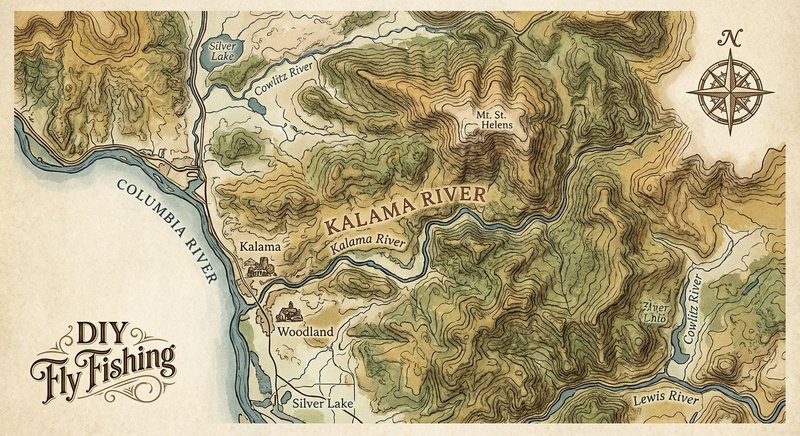
Kalama River
Fly fishing in Washington · Intermediate · Best seasons: Summer, Winter
Target Species
Steelhead
About This Water
Southwest Washington steelhead river with summer and winter runs. Excellent fly water throughout.
Fishing Recommendations
The Kalama River is a crown jewel of Southwest Washington fly fishing. Flowing from the western slopes of Mount St. Helens to the Columbia River, it offers some of the most classic "swing water" in the Pacific Northwest. It is a river of basalt ledges, deep emerald pools, and a storied history that has shaped modern steelhead fly fishing.
🎣 Location Overview
The Kalama is a quintessential freestone-style river characterized by its clarity and rugged beauty. Unlike its larger neighbor, the Cowlitz, the Kalama is smaller and more intimate, making it a favorite for fly anglers who prefer wading and Spey casting.
What makes it special is the gradient and structure. The river is littered with basalt shelves and "buckets" where steelhead love to rest. The water stays remarkably clear even when other rivers are blown out, thanks to its forested drainage and volcanic rock base. It feels like a "stepped" river, with distinct pools separated by beautiful riffles and runs.
🐟 Target Species & Behavior
The primary draw is the Steelhead, with two distinct runs:
- Summer Steelhead (Skamania Strain): These fish enter the river as early as April and peak in June and July. They are aggressive, acrobatic, and known for their willingness to rise to a surface or sub-surface fly. They hold in faster, highly oxygenated water—heads of pools and heavy riffles.
- Winter Steelhead: These are larger, more powerful fish arriving from December through March. They are less aggressive than summer runs due to colder water temperatures and tend to hold in the "walking speed" water of the tailouts or behind large boulders.
- Salmon: You will also encounter Chinook (Spring and Fall) and Coho, which can provide excellent sport, though steelhead remain the fly fisher's primary prize.
📅 Best Times to Fish
- Summer Run: June through August. The "Early Summer" window (June) is prime. Fish early in the morning or late in the evening to avoid the bright sun, as steelhead are light-sensitive.
- Winter Run: January through March. Look for "dropping and clearing" water conditions after a rain event. The "sweet spot" is when the river has a slight tea-colored tint but has 3–4 feet of visibility.
- Optimal Conditions: For the lower river, a flow between 500 and 1,200 CFS (Cubic Feet per Second) is generally considered ideal for wading and swinging.
🪰 Recommended Flies & Techniques
1. The Swing (Spey or Single-Hand)
This is the traditional method on the Kalama.
- Summer Patterns: The Kalama Special (essential), Green Butt Skunk, Blue Charm, and Purple Peril. In low light, try a Riffling Hitch or a Bomber on the surface for heart-stopping top-water takes.
- Winter Patterns: Large, weighted Intruders or Leeches in Pink/Orange, Black/Blue, or Chartreuse. You need to get these down to the fish’s level using sink tips (T-11 or T-14).
2. Nymphing / Indicator Fishing
Highly effective for winter fish or hatchery summer runs.
- Patterns: 10mm-12mm beads (peach or mottled orange), Prince Nymphs, and rubber-legged stones.
- Technique: Focus on the "seams" where fast water meets slow water.
3. Presentation Tips
- The "Dangle": On the Kalama, many fish strike at the very end of the swing when the fly is hanging straight downstream in the soft water near the bank. Don't strip in too early!
- Stealth: During summer low-water periods, long leaders and a stealthy approach are mandatory. These fish can see you on the high banks.
💡 Pro Tips & Local Knowledge
- The "Fly Fishing Only" Stretch: The upper Kalama (above Kalama Falls) has specific seasons where it is restricted to fly fishing only and is often catch-and-release. This area is breathtaking and offers a more secluded experience.
- Wading Safety: The Kalama is notorious for its slippery basalt ledges. The rock is like grease. Studded felt soles and a wading staff are not optional—they are requirements.
- The Kalama Special: This fly was originated here by local legend Bill Bakke. It features a yellow chenille body and a red tail. If you aren't swinging one, you're missing out on a piece of history that still catches fish today.
- Fish the "Buckets": Don't just look for long runs. Look for small depressions in the bedrock (buckets). A steelhead will often sit in a hole no bigger than a bathtub.
⚠️ Important Information
- Access: Key access points include Modrow Bridge (lower), Pritchard’s (middle), and the Beginner’s Hole. There are many pull-offs along Kalama River Road, but be mindful of private property signs.
- Regulations: Washington Department of Fish and Wildlife (WDFW) rules change frequently.
- Always check the "Emergency Rules" on the WDFW website before heading out.
- A Columbia River Salmon/Steelhead Endorsement is required in addition to your freshwater license.
- Wild Steelhead (with an intact adipose fin) must be released and cannot be removed from the water at any time.
- Gear:
- Summer: 6wt or 7wt Spey rod (12'–13') or an 8wt single-hand rod.
- Winter: 7wt or 8wt Spey rod with various T-series sink tips.
The Kalama is a "thinking man's" river. It rewards those who read the water carefully and wade with caution. Tight lines!
Bug Hatches & Matching Flies
| Hatch | Type | Peak months | Time of day | Hook sizes | Matching flies |
|---|---|---|---|---|---|
| Blue-Winged Olive (BWO) Baetis spp. | mayfly | March, April, October, November | Mid-day/Overcast afternoons | #18-22 | Parachute Adams #18-20, RS2 #20-22, Pheasant Tail #18-20 |
| March Brown Rhithrogena morrisoni | mayfly | March, April | Afternoon | #12-14 | March Brown Dry #12-14, Gold Ribbed Hare's Ear #12-14, March Brown Wet Fly #12-14 |
| Skwala Stonefly Skwala americana | stonefly | February, March | Late morning/Afternoon | #10-12 | Skwala Stone Dry #10-12, Pat's Rubber Leg #10-12, 20 Incher Stone #10-12 |
| Golden Stonefly Hesperoperla pacifica | stonefly | June, July | Morning/Evening | #6-10 | Chubby Chernobyl (Gold) #8-10, Kaufmann's Stone #6-8, Yazidi Stone #8-10 |
| Pale Morning Dun (PMD) Ephemerella spp. | mayfly | June, July, August | Mid-morning/Early afternoon | #16-18 | PMD Sparkle Dun #16-18, Split Case PMD #16-18, Quigley Cripple #16-18 |
| Spotted Sedge Hydropsyche spp. | caddis | July, August, September | Evening | #14-16 | Elk Hair Caddis #14-16, LaFontaine's Deep Sparkle Pupa #14-16, Holy Grail Caddis #14-16 |
| October Caddis Dicosmoecus atripes | caddis | September, October | Afternoon/Evening | #8-10 | Orange Stimulator #8-10, Morrish October Caddis Pupa #8-10, Peeking Caddis #8-10 |
| Yellow Sally Isoperla spp. | stonefly | June, July | Evening | #14-16 | Yellow Sally Dry #14-16, Iron Sally #14-16, Little Yellow Stone #14-16 |