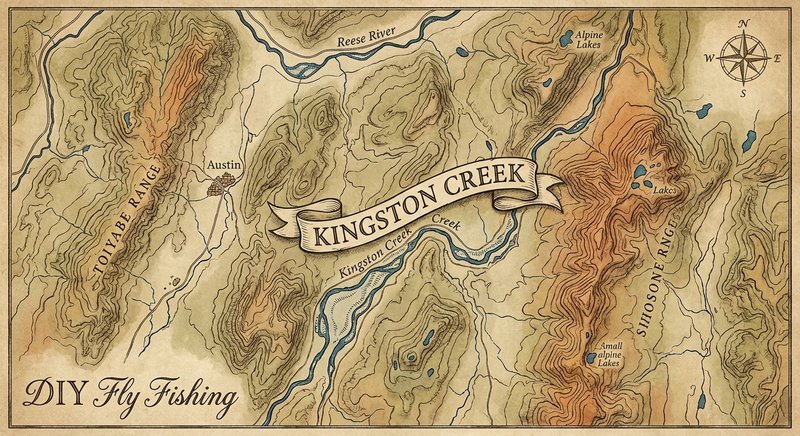
Kingston Creek
Fly fishing in Nevada · advanced · Best seasons: spring, summer, fall
Target Species
Lahontan Cutthroat Trout
About This Water
Toiyabe Range stream with Lahontan cutthroat. Remote central Nevada fishing.
Fishing Recommendations
Kingston Creek is a hidden gem tucked away in the rugged Toiyabe Range of Central Nevada. For the fly angler, it represents a classic "desert oasis" fishery, offering the rare opportunity to pursue the Lahontan Cutthroat Trout (LCT) in a small-stream environment rather than the massive alkaline lakes where they are more commonly found.
As your guide, here is the breakdown for tackling this unique Nevada water.
🎣 Location Overview
Kingston Creek is a high-gradient mountain stream that flows through a dramatic canyon near the town of Kingston, south of Austin, Nevada. What makes this area special is the stark contrast: you are in the middle of the Great Basin desert, yet you’re fishing a lush, willow-lined creek with cold, clear water.
The creek is small—averaging 5 to 15 feet wide—and is characterized by pocket water, small plunge pools, and several productive beaver pond complexes. It is an intimate fishery where stealth and accuracy are more important than long-distance casting. The scenery is spectacular, with towering canyon walls and high-altitude flora providing a stunning backdrop.
🐟 Target Species & Behavior
The primary draw here is the Lahontan Cutthroat Trout.
- Behavior: Unlike the giants of Pyramid Lake, the LCT in Kingston Creek are stream-dwellers. They are opportunistic feeders because the growing season at this elevation is short. However, they are wary; in the clear, shallow water, they will bolt for cover if they see a shadow or a clumsy approach.
- Where they hold: Look for them in the "textbook" spots: the head of pools just below small waterfalls, under overhanging willow banks, and in the deep, slow water of beaver ponds.
- Feeding: They primarily feed on aquatic insects (caddis and stoneflies) and are very reactive to terrestrial insects like grasshoppers and ants during the summer months.
📅 Best Times to Fish
Optimal Seasons
- Spring (Late May – June): This is the post-runoff sweet spot. As the snowpack in the Toiyabes begins to stabilize, the fish become very active.
- Summer (July – August): The most consistent fishing. While the valleys are scorching, the canyon stays relatively cool. This is prime "dry-dropper" season.
- Fall (September – October): My personal favorite. The cottonwoods turn gold, the water is low and crystal clear, and the fish are aggressively feeding before the winter freeze.
Best Times of Day
- Summer: Early morning and late evening are best to avoid the midday sun.
- Spring/Fall: Mid-morning to mid-afternoon when the water temperature rises enough to trigger insect activity.
🪰 Recommended Flies & Techniques
Top Fly Patterns
- Dry Flies: Stimulators (Orange or Yellow, #12-16), Elk Hair Caddis (#14-18), Parachute Adams (#14-20), and Royal Wulffs.
- Terrestrials: Foam Grasshoppers (#10-12), Black Ants (#16-18), and Beetles.
- Nymphs: Gold-ribbed Hare’s Ear (#14-18), Pheasant Tail (#16-20), and Copper Johns (#16-18).
- Streamers: Small Woolly Buggers (Black or Olive, #10-12) for the deeper beaver ponds.
Effective Techniques
- The Dry-Dropper: This is the bread and butter of Kingston Creek. Use a high-floating Stimulator or Hopper as your indicator and hang a small Pheasant Tail or Hare's Ear 18-24 inches below it.
- Stealth Approach: Because the water is small, stay low. Approach pools from downstream and cast upstream to avoid being seen.
- Bow-and-Arrow Cast: The willows are thick. You will often find yourself in spots where a traditional backcast is impossible. Master the bow-and-arrow cast to get your fly into tight pockets.
💡 Pro Tips & Local Knowledge
- Focus on the Beaver Ponds: There are several beaver pond complexes along the creek. These hold the largest fish in the system. Use a slow strip with a small bugger or a dead-drifted nymph under a dry fly.
- Groves Lake: At the top of the canyon sits Groves Lake (a small reservoir). If the creek is running too high or you want a change of pace, the lake holds LCT and Rainbows. It’s a great spot for a float tube or casting from the dam.
- The "Willow Whack": The brush is dense. Don't be afraid to lose a few flies to the trees—that's where the fish are. Use a shorter rod (7’6” to 8’6” 3-weight or 4-weight is perfect).
- Look for "The Blue": Lahontans often have a distinct purplish-blue hue on their gill plates. They are some of the most photogenic trout in the West, so have your camera ready.
⚠️ Important Information
- Access: Access is via Kingston Canyon Road. Much of the creek is on Forest Service land (Humboldt-Toiyabe National Forest), but there are patches of private property near the townsite. Always respect "No Trespassing" signs.
- Regulations: Nevada fishing regulations apply. Ensure you have a valid Nevada fishing license and a trout stamp. Check the current NDOW (Nevada Department of Wildlife) handbook for any seasonal closures or specific bag limits.
- Safety: This is remote country. Cell service is spotty at best. Watch for rattlesnakes in the lower rocky sections of the canyon during the summer. Always carry plenty of water and let someone know your itinerary.
- Conservation: Lahontan Cutthroats are a sensitive species. Practice Catch and Release, use barbless hooks, and keep the fish in the water as much as possible to ensure this unique population thrives.
Bug Hatches & Matching Flies
| Hatch | Type | Peak months | Time of day | Hook sizes | Matching flies |
|---|---|---|---|---|---|
| Blue-winged Olive Baetis spp. | mayfly | March, April, October, November | Mid-day | #18-22 | Parachute Adams #18-22, RS2 #20-22, Pheasant Tail #18-20 |
| Pale Morning Dun Ephemerella excrucians | mayfly | June, July | Late Morning/Afternoon | #14-18 | PMD Sparkle Dun #16-18, Split Case PMD #16, Hare's Ear Nymph #14-16 |
| Spotted Sedge Hydropsyche spp. | caddis | June, July, August | Evening | #14-16 | Elk Hair Caddis #14-16, LaFontaine's Deep Sparkle Pupa #14-16, Peacock Caddis #16 |
| Golden Stonefly Hesperoperla pacifica | stonefly | May, June | Morning/Afternoon | #8-12 | Rogue River Stone #8-10, Pat's Rubber Legs #8-12, Golden Twenty-Incher #10-12 |
| Little Yellow Sally Isoperla spp. | stonefly | June, July | Afternoon/Evening | #14-16 | Yellow Sally Dry #14-16, Iron Lotus #16 |
| Grasshopper Acrididae | terrestrial | July, August, September | All Day | #10-14 | Joe's Hopper #12, Parachute Hopper #10-14, Amy's Ant #12 |
| Midge Chironomidae | midge | January, February, March, December | Mid-day | #20-24 | Zebra Midge #20-22, Griffith's Gnat #20-24, Mercury Midge #20 |
| Black Carpenter Ant Camponotus spp. | terrestrial | June, July, August | Afternoon | #14-18 | Black Foam Ant #14-18, Cinnamon Ant #16 |