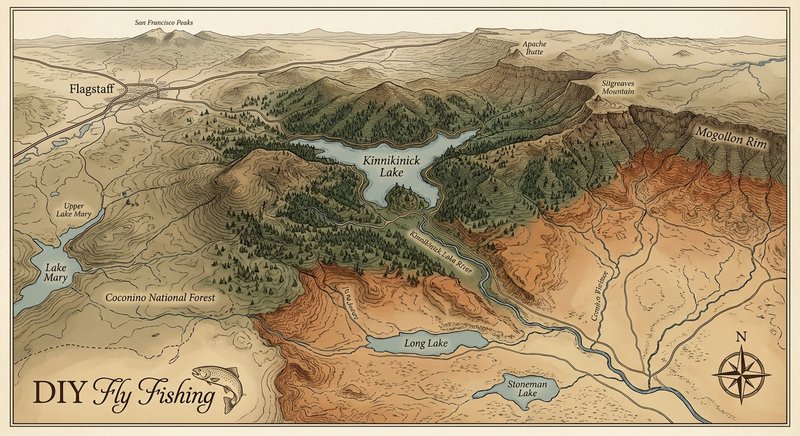
Kinnikinick Lake
Fly fishing in Arizona · intermediate · Best seasons: spring, fall
Target Species
Rainbow Trout, Brown Trout
About This Water
Large lake south of Flagstaff. Variable water levels but good trout when full.
Fishing Recommendations
Welcome to the high country of the Mogollon Rim. As your guide, I can tell you that Kinnikinick Lake is one of Arizona’s true gems for stillwater fly anglers. Located about 30 miles southeast of Flagstaff, it sits at 7,000 feet elevation on the Anderson Mesa.
Unlike many of the shallower "pothole" lakes in the area, Kinnikinick holds water better and produces significantly larger fish. It is a productive, nutrient-rich environment that allows trout to grow quickly and reach impressive sizes.
🎣 Location Overview
Kinnikinick Lake is a high-desert/alpine hybrid fishery. It is a relatively open, wind-swept lake surrounded by grasslands and scattered junipers and pines. What makes it special is its productivity. The lake is rich in aquatic vegetation and alkaline enough to support a massive population of scuds (freshwater shrimp) and leeches.
Anglers love it because it offers a "big fish" experience. While other nearby lakes might offer more frequent catches of 10-inch stockies, Kinnikinick is where you go to hunt for Rainbows and Browns that can push past the 20-inch mark. The water is often slightly stained or "off-color," which allows savvy anglers to get away with slightly heavier tippets than they would use in gin-clear water.
🐟 Target Species & Behavior
- Rainbow Trout: These are the primary residents. They are heavily stocked but hold over well. Because of the food source, they become "silver bullets"—thick-bodied and hard-fighting. They cruise the weed edges and the deeper channels during the heat of the day.
- Brown Trout: The "ghosts" of Kinnikinick. The Browns here are less frequent but can reach trophy proportions. They are highly piscivorous (fish-eating) once they reach a certain size and tend to hang out near the rocky dam structures or deep weed pockets.
- Behavior: These fish are focused on the bottom and the weeds. They aren't "surface-active" as often as some might like, but they are aggressive feeders. They key in on the massive scud and damselfly populations.
📅 Best Times to Fish
Optimal Seasons
- Spring (Late April – June): This is prime time. As the ice thaws and the water warms, the fish move into the shallows to feed aggressively after the winter. The damselfly migration in June can provide some of the best fishing of the year.
- Fall (September – November): As temperatures drop, the Brown trout become more aggressive in preparation for spawning, and the Rainbows move back into the shallows to gorge before winter.
Best Times of Day
- Morning/Evening: Low light is crucial here. The wind often dies down at dawn and dusk, making it easier to spot "midge" sips or cruising fish.
- Mid-Day: If there is a slight chop on the water, don't pack up. The wind oxygenates the water and breaks up the surface, making the fish feel secure enough to feed in the upper water column.
🪰 Recommended Flies & Techniques
Top Fly Patterns
- Scuds: This is the #1 food source. Pink, orange, or olive "Ray Charles" or UV Scuds (sizes 12–16).
- Damselflies: Olive Marabou Damsels with gold beads. Fish these with a jerky, rhythmic retrieve near weed beds.
- Simi Seal Leeches: A local Arizona favorite. Black/Red, Olive, or "Peacock" colors (sizes 10–12).
- Midges: Zebra Midges (black/silver or red/silver) in sizes 18–20 for fishing under an indicator.
- Streamers: For the big Browns, use Woolly Buggers or thin-mints to mimic small fathead minnows.
Effective Techniques
- The "Static" Indicator Rig: Suspend a midge or a scud 12–18 inches off the bottom. If the wind is blowing, the bobbing of the indicator gives the fly a natural "hop."
- Intermediate Sinking Lines: This is the "pro" way to fish Kinnikinick. Using a slow-sinking (Type I or II) line, cast over the weed beds and use a slow, "figure-eight" retrieve to keep your leech or damselfly nymph just above the vegetation.
💡 Pro Tips & Local Knowledge
- Focus on the "Blue Pockets": When the weeds get thick in the summer, look for the dark blue openings in the vegetation. These are "pockets" where trout sit to ambush prey. Drop a scud or leech vertically into these holes.
- The Wind is Your Friend: Anderson Mesa is notoriously windy. While it’s hard to cast, the wind pushes "zooplankton" and insects to the leeward shore. If you can handle the casting, fish the banks the wind is blowing toward.
- Vary Your Retrieve: If using streamers or leeches, these trout often follow for a long time. A sudden "pause" in your retrieve will often trigger a strike from a trailing fish.
- The "Dam" Area: The rocky area near the dam is a hotspot for Brown Trout. Fish deeper here with weighted streamers.
⚠️ Important Information
- Access: The road to Kinnikinick (FR 82) is unpaved. It is generally fine for passenger cars in dry weather, but monsoon rains or spring snowmelt can turn it into impassable "gumbo" mud. Check weather reports before heading out.
- Boating: High-sided boats can be difficult to manage in the wind. Float tubes and kayaks are popular, but stay close to the shore if the whitecaps start to form. There is a small boat ramp available.
- Regulations: Arizona fishing licenses are required. General statewide bag limits usually apply (typically 4 trout), but always check the current Arizona Game and Fish Department (AZGFD) regulations for any seasonal changes.
- Facilities: There are primitive campsites and vaulted toilets, but no running water or electricity. Pack in what you need and pack out your trash.
Guide’s Final Word: Bring a 5-weight or 6-weight rod to handle the wind and the potential for a 5-pound trout. Kinnikinick is a "patience" lake—it may take an hour to find them, but once you do, they are the highest quality trout in the Flagstaff area. Tight lines!
Bug Hatches & Matching Flies
| Hatch | Type | Peak months | Time of day | Hook sizes | Matching flies |
|---|---|---|---|---|---|
| Chironomids Chironomidae | midge | April, May, June, September | All Day | #12-22 | Zebra Midge #16-20, Chromie #14-18, Griffith's Gnat #18-22 |
| Speckled Dun Callibaetis | mayfly | June, July, August | Late Morning | #12-16 | Adams #14-16, Hare's Ear Nymph #12-16, Callibaetis Spinner #14-16 |
| Blue Damselfly Enallagma | terrestrial | June, July | Morning/Afternoon | #10-14 | Marabou Damsel Nymph #10-14, Adult Damsel #12-14 |
| Traveling Sedge Hesperophylax | caddis | August, September | Evening | #8-12 | Goddard Caddis #8-12, Elk Hair Caddis #10-14 |
| Water Boatmen Corixidae | terrestrial | September, October | Afternoon | #14-18 | Boatman Pattern #14-16, Prince Nymph #14-18 |
| Dragonflies Anisoptera | terrestrial | July, August | Afternoon | #4-10 | Dragonfly Nymph #6-10, Woolly Bugger (Olive) #4-10 |
| Carpenter Ants Camponotus | terrestrial | July, August | Afternoon | #12-16 | Black Foam Ant #12-16, Chernobyl Ant #10-14 |
| Scuds Gammarus | midge | May, June, September, October | All Day | #12-18 | Ray Charles #14-18, Scud (Olive/Pink) #12-16 |