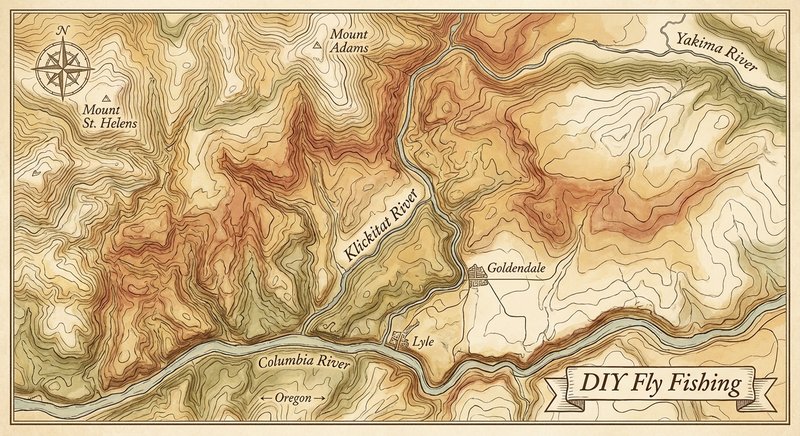
Klickitat River
Fly fishing in Washington · Intermediate · Best seasons: Summer, Fall
Target Species
Steelhead
About This Water
Columbia tributary famous for summer steelhead. Technical wading in scenic canyon water.
Fishing Recommendations
The Klickitat River—or "The Klick"—is a crown jewel of Washington fly fishing. Carving a dramatic, deep canyon through South Central Washington before meeting the Columbia River, it is a rugged, powerful, and moody river. It is widely considered one of the best rivers in the Pacific Northwest for targeting aggressive, wild summer-run Steelhead.
As your guide, here is everything you need to know to tackle this legendary water.
🎣 Location Overview
The Klickitat is a glacial-fed river, with its headwaters originating on the slopes of Mt. Adams. This glacial influence is the river's defining characteristic; it carries "glacial milk" (silt) that can turn the river from a beautiful emerald green to a chocolate milk consistency in a matter of hours during a heatwave.
What makes it special is its wild character. Unlike the manicured banks of some rivers, the Klickitat is raw. It’s a "big water" experience with massive basalt boulders, steep canyon walls, and powerful flows. Anglers love it because the fish are notoriously aggressive and "grabby," making it one of the premier destinations for those who love to swing flies with Spey rods.
🐟 Target Species & Behavior
Primary Target: Summer-run Steelhead.
- Behavior: These fish enter the system starting in June and stay through the winter. Unlike winter steelhead, summer-runs are metabolic and active. They are often willing to move a long distance to crush a fly.
- Holding Water: On the Klickitat, Steelhead love "walking pace" water—about the speed of a brisk walk. Look for the "seams" where fast water meets slow water, and don't overlook the "tailouts" (the flat water just above a riffle). Because the river is bouldery, fish often sit in the soft pockets directly behind or in front of large submerged rocks.
- Diet: While they aren't actively feeding like trout, they retain their predatory instincts. They react to movement, profile, and color.
📅 Best Times to Fish
The Klickitat is a late-summer and fall fishery.
- June – July: The "Opener." Water is often high and turbid from snowmelt. Fishing can be great if the visibility is at least 18 inches, but it’s a gamble.
- August: Great fishing, but watch the thermometer. High heat on Mt. Adams causes glacial melt, which can "blow out" the river by mid-afternoon.
- September – October (The Peak): This is the "Golden Window." The glacial melt slows down, the water clears to a perfect "Steelhead green," and the largest push of fish enters the river. The weather is crisp, and the canyon colors are spectacular.
- November: The "Big Fish" month. It gets cold, and the fish move into deeper, slower holding water. You'll need sink tips and larger flies.
Pro Tip: Always check the USGS Gauge at Pitt, WA. If the discharge is spiking, the river is likely muddy. If it’s dropping or stable, it’s game on.
🪰 Recommended Flies & Techniques
1. The Swing (Spey Casting)
This is the soul of the Klickitat. Using a 6-weight or 7-weight Spey rod allows you to cover the large expanses of water.
- Technique: Cast 45 degrees downstream, let the fly swing across the current until it is straight below you. Hang it for 5 seconds (the "hang down") before stripping back.
- Top Patterns:
- Intruders: Black/Blue, Purple/Pink, or Orange.
- Hoh Bo Spey: Great for lower water.
- Dirty Hoh: For when you need maximum vibration in murky water.
2. Nymphing (Indicator Fishing)
Extremely effective, especially in the deep, turbulent slots where a swung fly can't reach.
- Technique: Use a heavy fluorocarbon leader and a large indicator. You must get the fly to the bottom quickly.
- Top Patterns:
- Pat’s Rubber Legs: Sizes 4–8 in Olive or Orange/Black. This is the "bread and butter" nymph on the Klick.
- Glow Bugs / Beads: In various shades of orange and peach (mimicking Chinook salmon eggs in the fall).
- Prince Nymphs: Size 10-12.
💡 Pro Tips & Local Knowledge
- The "Two-Foot Visibility" Rule: You do not need crystal clear water. In fact, Steelhead are more confident in slightly "off" water. If you can see your boots in knee-deep water, the fish can see your fly.
- Shadow Management: Steelhead are incredibly light-sensitive. If the sun is hitting the water, they will tuck under ledges or move to the deep. The best fishing is often when the canyon walls provide shade over the run.
- Wading Safety: The Klickitat is a "bowling ball" river. The rocks are round, slick, and unstable. Always wear a wading belt and use a wading staff. If you fall in here, the current is unforgiving.
- Focus on the Lower River: Stretches near the town of Lyle and up to the "Icehouse" are famous for holding fresh, bright fish.
⚠️ Important Information
- Access: Much of the river is accessed via the Klickitat Trail (a converted rail-trail) or the Hwy 142 road turnouts. Be prepared to hike; the further you get from the easy pullouts, the better the fishing.
- Regulations: This is a Barbless Hook river. You must have a Washington freshwater fishing license and a Columbia River Salmon/Steelhead Endorsement.
- Wild Fish: All wild Steelhead (indicated by an intact adipose fin) must be released immediately without being removed from the water. Only hatchery fish (clipped fin) may be retained (check current WDFW limits).
- Tribal Lands: Respect the Yakama Nation lands. Some areas of the river are closed to non-tribal members or require specific permits. Always check the latest WDFW pamphlet for boundary lines.
Final Guide Advice: Bring a camera, a heavy jacket for the morning, and a healthy dose of patience. The Klickitat doesn't give up its secrets easily, but when a 12-pound wild Steelhead hammers your fly in that canyon, you'll be hooked for life.
Bug Hatches & Matching Flies
| Hatch | Type | Peak months | Time of day | Hook sizes | Matching flies |
|---|---|---|---|---|---|
| Salmonfly Pteronarcys californica | stonefly | May, June | All day | #4-8 | Chubby Chernobyl #6-10, Pats Rubber Legs #4-8 |
| Golden Stonefly Hesperoperla pacifica | stonefly | June, July | Afternoon/Evening | #8-12 | Golden Rogue Foam Stone #8-10, 20 Incher Stone #8-12 |
| October Caddis Dicosmoecus gilvipes | caddis | September, October | Late Afternoon/Evening | #8-12 | Stimulator (Orange) #8-10, Peeking Caddis #10-12 |
| Blue Winged Olive Baetis spp. | mayfly | March, April, October, November | Mid-day | #18-22 | Parachute Adams #18-20, RS2 #18-22 |
| Pale Morning Dun Ephemerella inermis/infrequens | mayfly | June, July | Morning/Afternoon | #14-18 | PMD Sparkle Dun #16-18, Pheasant Tail #14-18 |
| Mother's Day Caddis Brachycentrus occidentalis | caddis | April, May | Afternoon/Evening | #14-16 | Elk Hair Caddis (Olive) #14-16, Deep Sparkle Pupa #14-16 |
| March Brown Rhithrogena morrisoni | mayfly | March, April | Mid-day | #12-14 | March Brown Western Deceiver #12-14, Hare's Ear Nymph #12-14 |
| Grasshoppers Orthoptera | terrestrial | August, September | Afternoon | #8-12 | Morrish Hopper #8-12, Dave's Hopper #10-12 |