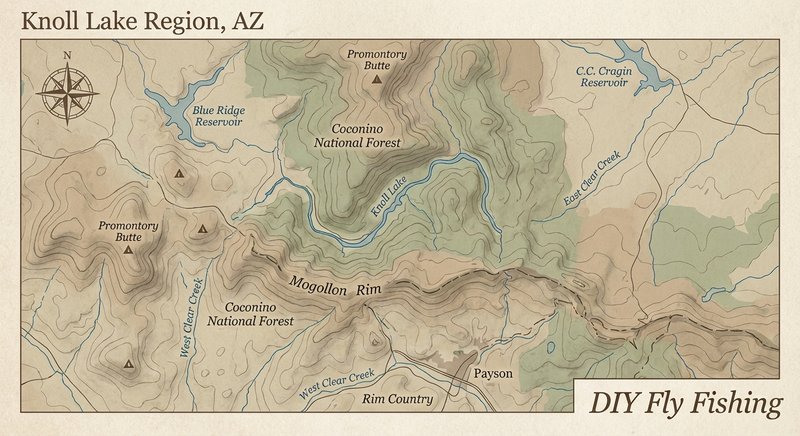
Knoll Lake
Fly fishing in Arizona · intermediate · Best seasons: spring, summer, fall
Target Species
Rainbow Trout, Brown Trout
About This Water
Remote Mogollon Rim lake with wild trout. Rough road access keeps pressure low.
Fishing Recommendations
Welcome to one of the crown jewels of the Mogollon Rim. As your guide, I can tell you that Knoll Lake is often overlooked by anglers rushing to the more popular Woods Canyon or Willow Springs lakes. That is a mistake you’ll be glad you didn’t make.
At an elevation of 7,340 feet, Knoll Lake is a 75-acre deep-water gem tucked away in the ponderosa pines and Douglas firs. It offers a more "backcountry" feel despite being accessible by vehicle.
🎣 Location Overview
Knoll Lake is defined by its stunning scenery and its dramatic underwater topography. Located on the edge of the Mogollon Rim, the lake is clear, cool, and surrounded by heavy timber.
What makes it special for fly anglers is the sunken timber. When the lake was created, many trees were left standing. This creates incredible "vertical structure" where trout can hide at various depths. It is a classic "bowl" lake with steep drop-offs and a few shallow flats near the inlets, offering diverse tactical challenges. Unlike many Arizona lakes that turn into "pea soup" in the summer, Knoll tends to stay relatively clear, making it a visual and technical delight.
🐟 Target Species & Behavior
- Rainbow Trout: These are the primary residents. The Arizona Game and Fish Department stocks them regularly. They tend to cruise the upper 5–10 feet of the water column looking for hatches but will dive deep near the dam when the sun is high.
- Brown Trout: This is the real prize of Knoll Lake. The Browns here are known to be "wilder" and more aggressive. They hold tight to the submerged logs and rock ledges. They are highly piscivorous (fish-eating) and become particularly active during low-light conditions or when the wind puts a "chop" on the water.
Primary Food Sources: Midges (year-round), Damselflies (huge in early summer), Callibaetis mayflies, Scuds, Crawdads, and terrestrial insects (ants/beetles) blown from the surrounding forest.
📅 Best Times to Fish
- Spring (Late April – June): This is prime time. As soon as the Forest Service roads open after the snow melts, the fish are hungry and patrolling the shallows. The Damselfly migration in June is legendary here.
- Summer (July – August): While the desert sizzles, Knoll stays cool. Focus on the "Magic Hour"—the 90 minutes before dark. During the day, fish deep near the dam or under the shade of the sunken trees.
- Fall (September – October): My personal favorite. The Brown trout begin to move into shallower water as they prepare for their spawn cycles. They become aggressive and will chase large streamers.
- Time of Day: Early morning (dawn to 10:00 AM) and late evening (4:00 PM to dark). Mid-day is tough unless there is significant cloud cover or wind.
🪰 Recommended Flies & Techniques
Dry Flies
- Patterns: Parachute Adams (#14-18), Elk Hair Caddis (#14-16), and Foam Ants or Beetles (#12-14) during summer afternoons.
- Technique: Look for rising fish in the shadows of the tall pines along the western shore. Use a long, 12-foot leader tapered to 5X or 6X to avoid spooking fish in the clear water.
Nymphing
- Patterns: Zebra Midges (Black/Silver or Red, #18-22), Gold Ribbed Hare’s Ear (#14-16), and Pheasant Tails (#16).
- Technique: Use a "midge tip" line or a long leader with a small indicator. Hang your fly 6–10 feet deep near the submerged timber. A slow, hand-twist retrieve is often better than a static dead-drift.
Streamers (The Brown Trout Special)
- Patterns: Woolly Buggers (Olive, Black, or Brown #8-12), Simi-Seal Leeches (Blood Leech or Canadian Olive), and Mickey Finns.
- Technique: Use a sinking tip line (Type 3 or 5). Cast toward the submerged logs, let it sink for 5-10 seconds, and strip it back with erratic movements.
💡 Pro Tips & Local Knowledge
- Bring a Float Tube: While you can fish from the bank, Knoll Lake is best fished from the water. A float tube or kayak allows you to reach the "Sunken Forest" on the opposite side of the boat ramp where the biggest Browns hide.
- The "Dam" Secret: The water near the dam is the deepest. In the heat of the summer, use a heavy sinking line to get a weighted leech pattern down 20+ feet.
- The Wind is Your Friend: If the wind picks up, don't head for the truck. The chop on the water masks your presence and pushes insects toward the windward banks. This is when the big fish come up to hunt.
- Watch the Logs: When navigating a boat or tube, be careful. Those submerged trees are closer to the surface than they look and can snag a fly or a boat motor easily.
⚠️ Important Information
- Access: Access is via Forest Road 300 (The Rim Road) to FR 290. These are dirt roads. While usually passable for passenger cars in dry weather, high-clearance vehicles are recommended, especially after rain.
- Regulations: Arizona fishing license required. Standard trout limits apply (typically 4 per day), but I highly recommend Catch and Release for the Brown trout to preserve the trophy quality of the lake.
- Supplies: There are NO services at the lake. The nearest gas and food are at Forest Lakes or Payson. Bring plenty of water and sun protection.
- Monsoons: In July and August, afternoon thunderstorms are frequent and violent on the Rim. If you hear thunder, get off the water immediately—you are the tallest thing on the lake in a float tube!
Tight lines, and enjoy the solitude of the Rim!
Bug Hatches & Matching Flies
| Hatch | Type | Peak months | Time of day | Hook sizes | Matching flies |
|---|---|---|---|---|---|
| Callibaetis (Speckled Duns) Callibaetis ferrugineus | mayfly | June, July, August | Late Morning/Early Afternoon | #12-16 | Adams Floating Nymph #14-16, Parachute Adams #12-16, Hare's Ear Nymph #14-16 |
| Chironomids (Midges) Chironomidae | midge | May, June, September | All Day | #16-22 | Zebra Midge #18-20, Ice Bud #16-18, Griffith's Gnat #18-22 |
| Traveling Sedge Hesperophylax | caddis | June, July | Evening/Dusk | #10-14 | Goddard Caddis #10-12, Elk Hair Caddis #12-14, Deep Sparkle Pupa #12-14 |
| Carpenter Ants Camponotus | terrestrial | July, August | Afternoon | #10-14 | Black Foam Ant #12-14, Chernobyl Ant #10-12 |
| Pale Morning Dun Ephemerella excrucians | mayfly | June, July | Morning | #16-18 | PMD Parachute #16-18, Pheasant Tail Nymph #16-18 |
| Speckled Spinner Callibaetis (Imago stage) | mayfly | July, August | Evening/Morning | #14-16 | Rusty Spinner #14-16, Poly Wing Spinner #14-16 |
| Green Grasshoppers Melanoplus | terrestrial | August, September | Late Morning/Afternoon | #8-12 | Joe's Hopper #10-12, Dave's Hopper #8-12 |
| Spotted Sedge Hydropsyche | caddis | May, June | Evening | #14-18 | LaFontaine's Emerger #16-18, Peacock Caddis #14-16 |