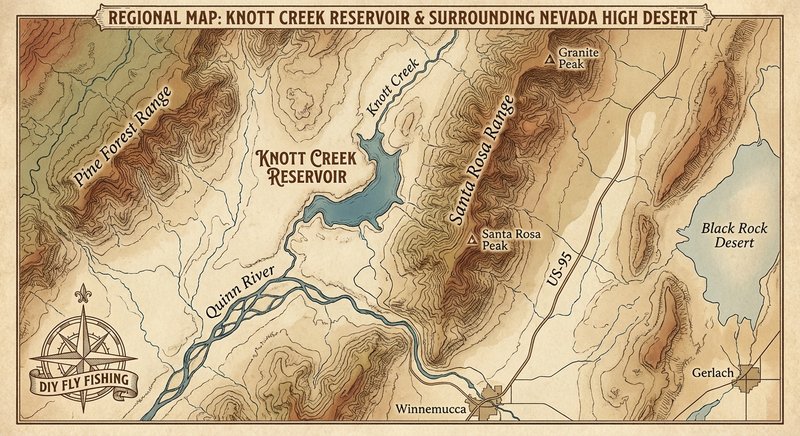
Knott Creek Reservoir
Fly fishing in Nevada · intermediate · Best seasons: spring, summer, fall
Target Species
Rainbow Trout
About This Water
Elko County reservoir with stocked rainbow trout. Remote fishing destination.
Fishing Recommendations
Knott Creek Reservoir is widely considered the "Crown Jewel" of Nevada stillwater fly fishing. Tucked away in the remote Pine Forest Range of Northwest Nevada, this high-desert oasis is a bucket-list destination for anglers seeking trophy-sized trout in a rugged, backcountry setting.
🎣 Location Overview
Knott Creek Reservoir is a high-altitude (approx. 6,000 ft), alkaline stillwater located about 100 miles northwest of Winnemucca. What makes this water special is its productivity. The alkaline chemistry of the water fosters a massive biomass of insects and crustaceans, allowing fish to grow at staggering rates.
The reservoir is characterized by extensive weed beds, crystal-clear water, and dramatic surrounding peaks. This is a "quality over quantity" fishery; while you might not hook 50 fish a day, the ones you do land are often in the 18-to-26-inch range, boasting incredible girth and power.
🐟 Target Species & Behavior
- Rainbow Trout: These are the primary residents. They are known for being exceptionally hard fighters that frequently "greyhound" across the surface when hooked.
- Tiger Trout: A sterile hybrid of Brown and Brook trout, these are the secondary stars of Knott Creek. They are highly aggressive, piscivorous (fish-eating), and often found patrolling the edges of steep drop-offs or lurking in weed pockets.
Behavior: Because the water is so clear, these fish are often "cruisers." They follow established beats along the weed lines and drop-offs. They are highly observant and can be easily spooked by poor casting or heavy boat movement.
📅 Best Times to Fish
- Spring (Late May – June): This is the prime window. As the ice recedes and the water warms, the trout move into the shallows to gorge after winter. This coincides with the legendary Chironomid and Damselfly hatches.
- Summer (July – August): Fishing remains good but requires a change in strategy. Fish move deeper to find cooler, oxygenated water. Early mornings and late evenings are mandatory; midday can be slow and stressful for the fish.
- Fall (September – October): As temperatures drop, the fish move back into the shallows. The Tiger Trout become particularly aggressive during this time, preparing for a "spawn" that won't happen, making them very susceptible to streamers.
Prime Window: The 90 minutes surrounding sunrise and sunset are often electric, especially for dry fly activity.
🪰 Recommended Flies & Techniques
Techniques
- Indicator Nymphing: The most effective way to fish Knott. Suspend chironomids or leeches 12–20 feet deep, just off the bottom or right above the weed tops.
- The "Slow Strip": Using an intermediate sinking line, retrieve damselfly nymphs or small leeches with a very slow, rhythmic "inchworm" retrieve.
- Dry Fly: When the wind dies down in the evening, look for rising fish. Delicate presentations with long leaders (12ft+) are required.
Top Fly Patterns
- Chironomids: Ice Bugs, Zebra Midges (Red/Silver or Black/Silver), and Tapered Glass Bead Midges (Sizes 12–16).
- Damselflies: Marabou Damsel Nymphs in olive or bright green. This is the "bread and butter" of Knott Creek.
- Leeches: Balanced Leeches (Bruised, Olive, or Wine) under an indicator; Mohair Leeches for stripping.
- Scuds: The reservoir is full of freshwater shrimp. Use olive or orange Scud patterns in size 14–16.
- Dries: Callibaetis patterns, Griffith’s Gnats, and Carpenter Ant terrestrials in late summer.
💡 Pro Tips & Local Knowledge
- Bring a Watercraft: You cannot effectively fish Knott Creek from the shore due to the thick belt of rushes and weeds. A float tube, pontoon, or small pram is essential.
- The "Gutter" Strategy: Look for "gutters" or lanes in the weed beds. Fish use these like highways. Position yourself to cast parallel to these lanes rather than across them.
- The Wind Factor: This is high-desert Nevada; it will be windy. A 6-weight rod is the standard here to punch through the afternoon gusts. If the wind dies, the fishing often gets harder because the fish can see you more easily—that’s when you switch to longer, thinner tippets (4X or 5X fluorocarbon).
- Tiger Tactics: If you want a trophy Tiger Trout, size up your streamers. A black or olive woolly bugger with a bit of flash, stripped aggressively near the dam or rocky outcrops, often triggers their predatory instinct.
⚠️ Important Information
- Access: The road to Knott Creek is notorious. It is a long, bumpy, dirt road that requires high-clearance vehicles. After a rain, the road can become impassable "gumbo" mud. Ensure you have a full tank of gas and a spare tire; there is zero cell service.
- Regulations: Knott Creek is managed as a trophy fishery. It is Catch and Release only, and you must use artificial lures/flies with barbless hooks. Always check the current Nevada Department of Wildlife (NDOW) regulations before heading out.
- Self-Reliance: Bring all the water, food, and first aid you need. The nearest services are in Denio or Winnemucca, both of which are a significant drive away.
- Sun/Elements: The sun is intense at 6,000 feet. Use high-SPF sunscreen and wear polarized sunglasses—not just to see the fish, but to protect your eyes from hooks in the wind.
Bug Hatches & Matching Flies
| Hatch | Type | Peak months | Time of day | Hook sizes | Matching flies |
|---|---|---|---|---|---|
| Chironomids Chironomidae | midge | April, May, June, September | All Day | #12-22 | Snowcone Midge #12-18, Zebra Midge #16-20, Chanter's Chironomid #12-16 |
| Callibaetis Callibaetis spp. | mayfly | June, July, August, September | Late Morning/Afternoon | #12-16 | Parachute Adams #14-16, Callibaetis Cripple #14-16, Hare's Ear Nymph #12-16 |
| Damselflies Enallagma spp. | terrestrial | June, July | Morning/Afternoon | #10-14 | Marabou Damsel #10-12, Adult Damsel #12-14, Braided Butt Damsel #12 |
| Scuds Hyalella azteca | terrestrial | April, May, October, November | All Day | #12-16 | Ray Charles #14-16, UV Scud #12-16, Flashback Scud #14 |
| Dragonflies Anisoptera | terrestrial | July, August | Afternoon | #4-10 | Gomphus Nymph #6-10, Olive Wooly Bugger #4-8, Dragon Slayer #6-10 |
| Traveling Sedge Hesperophylax spp. | caddis | July, August | Evening | #8-12 | Goddard Caddis #8-12, Mikulak Sedge #10, Caddis Pupa #10-12 |
| Water Boatmen Corixidae | terrestrial | September, October | Afternoon | #14-16 | Prince Nymph #14-16, Water Boatman #14-16, Backswimmer #12-14 |
| Grasshoppers Acrididae | terrestrial | August, September | Afternoon | #8-12 | Hopper Juan #10-12, Morrish Hopper #8-12, Dave's Hopper #10 |