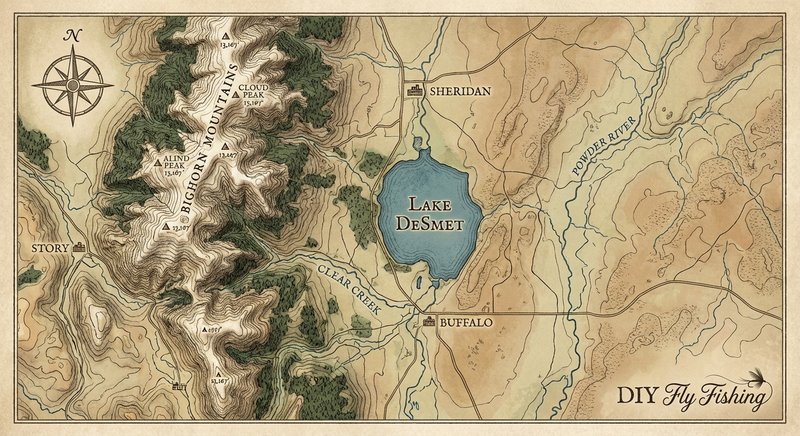
Lake DeSmet
Fly fishing in Wyoming · Beginner · Best seasons: Spring, Summer, Fall, Winter
Target Species
Rainbow Trout, Brown Trout, Tiger Trout
About This Water
Northeast Wyoming lake with trophy trout potential. Year-round fishery.
Fishing Recommendations
Welcome to the "Big Hole" of the high plains. As an expert guide, I can tell you that Lake DeSmet is one of Wyoming’s most underrated stillwater gems. Located between Buffalo and Sheridan, this is a large, deep, high-desert reservoir that offers a unique challenge compared to the nearby mountain streams.
Here is your comprehensive guide to fly fishing Lake DeSmet.
🎣 Location Overview
Lake DeSmet is a massive natural lake that was enlarged by a dam, sitting at approximately 4,600 feet of elevation. What makes it special is its incredible productivity; the water is rich in minerals and nutrients, leading to a massive biomass of scuds, midges, and baitfish.
Unlike the classic alpine lakes of the Bighorns, DeSmet is a "big water" experience. It is deep (over 100 feet in places) and can be intimidating. However, for the fly angler, the magic happens in the vast littoral zones (shallows) and along the rocky points where trophy trout cruise for a meal. It is famous for producing "football-shaped" trout with incredible girth and strength.
🐟 Target Species & Behavior
- Rainbow Trout: These are the most common and hardest fighting. They cruise the shoreline in pods. They are opportunistic but can become selective during midge or Callibaetis hatches.
- Brown Trout: The "kings" of the lake. DeSmet holds some absolute monsters. They are notoriously shy and piscivorous (fish-eating). They hug the rocky drop-offs and are most active in low light.
- Tiger Trout: A sterile hybrid of a Brook and Brown trout. They are aggressive, visual hunters. They love structure and will often follow a streamer right to your feet or the side of the boat.
- Forage Base: The "Big Three" for fly anglers here are Scuds (freshwater shrimp), Midges, and Crayfish. There is also a significant population of Yellow Perch and various minnows that the larger trout target.
📅 Best Times to Fish
Spring (April – June)
The Prime Window. As the ice recedes, trout move into the shallows to find warmer water and food. Rainbows will be looking for spawning gravel near the shorelines. This is the best time for shore-based fly anglers to intercept trophy fish.
Summer (July – August)
The fish move deep as the surface temperature rises. Fly fishing becomes difficult from the shore. Focus on the "Thermocline" (usually 15–25 feet down). Early morning (5:00 AM – 8:00 AM) is the only time you’ll find fish consistently in the shallows.
Fall (September – November)
The Trophy Window. As water temperatures drop, the Brown trout move shallow to prepare for the spawn. They become aggressive and territorial. This is the best time to throw large streamers for the fish of a lifetime.
Winter (December – March)
DeSmet is a premier ice-fishing destination. Fly fishing is generally not viable unless there is a rare patch of open water near an inlet or a very late freeze.
🪰 Recommended Flies & Techniques
1. Indicator Nymphing (The Go-To)
This is the most effective way to fish DeSmet. Suspend your flies 4 to 10 feet under a slip-indicator.
- Flies: Zebra Midges (size 16-20) in red, black, or olive; Ray Charles or Pale Olive Scuds (size 14-16); Balanced Leeches in black or wine.
- Technique: Fish the windward shores. The wind pushes food into the banks. Let the chop move your indicator; the "bobble" gives life to the flies below.
2. Stripping Streamers
Best for Tiger Trout and big Browns.
- Flies: Pine Squirrel Leeches, Gold Ribbed Hare’s Ear streamers, and Sparkle Minnows. For Tigers, use high-contrast colors like orange/black or bright olive.
- Technique: Use an intermediate sinking line. Vary your retrieve—sometimes a slow, "inch-worm" crawl is better than fast strips.
3. Dry Fly Action
- Flies: Callibaetis Spinners (size 14-16) or Griffith’s Gnats.
- Technique: On calm summer evenings, look for "the gulp." Rainbows will cruise the surface. You must lead the fish by several feet; don't land the fly right on their head.
💡 Pro Tips & Local Knowledge
- The "DeSmet Wind": The wind here can be dangerous. If you are in a float tube or a small boat and you see whitecaps forming, get off the water immediately. However, a light "walleye chop" is your friend; it hides your leader and makes the fish less spooky.
- Barkey Draw: The north end of the lake (Barkey Draw) has extensive shallows and weed beds. This is the "nursery" of the lake and is fantastic for sight-fishing on sunny, calm spring days.
- The "Hang": When stripping flies from a boat or shore, always pause for 5 seconds when your fly is 10 feet away. Stillwater trout often follow a fly for a long distance and will strike the moment it stops or starts to "rise" toward the surface.
- Color Palette: In the clear water of DeSmet, UV materials make a huge difference. Use flies with a hint of UV purple or UV pearl.
⚠️ Important Information
- Access: There are several well-maintained public access points. Mrak Beach (west side) and Barkey Draw (north end) are the most popular for fly anglers.
- Regulations: You must have a valid Wyoming Fishing License and a Conservation Stamp. Lake DeSmet has specific limit regulations (typically 6 trout, only one can exceed 20 inches), but most fly anglers practice 100% Catch and Release to preserve the trophy quality.
- Boats: While shore fishing is possible, a float tube, pontoon, or motorized boat significantly increases your success rate by allowing you to reach the drop-offs.
- Invasive Species: Wyoming is strict about AIS (Aquatic Invasive Species). If you bring a boat from out of state, it must be inspected before launching.
Guide’s Final Word: Bring a 6-weight rod to handle the wind and the size of these fish. Be patient, watch the water for cruisers, and don't be afraid to fish "smaller" flies than you think you need. Tight lines!
Bug Hatches & Matching Flies
| Hatch | Type | Peak months | Time of day | Hook sizes | Matching flies |
|---|---|---|---|---|---|
| Chironomids Chironomidae | midge | April, May, June | All Day | #12-18 | Ice Cream Cone #12-16, Chromie #14-18, Griffith's Gnat #16-20 |
| Callibaetis Callibaetis ferrugineus | mayfly | June, July, August | Late Morning/Early Afternoon | #12-16 | Callibaetis Spinner #14-16, Hare's Ear Nymph #14-16, Parachute Adams #14-16 |
| Damselflies Enallagma | terrestrial | June, July | Morning/Afternoon | #10-14 | Marabou Damsel Nymph #10-14, Adult Braided Damsel #12-14 |
| Water Boatmen Corixidae | terrestrial | September, October | Afternoon | #14-16 | Boatman Soft Hackle #14-16, Prince Nymph #14-16 |
| Traveling Sedge Hesperophylax | caddis | July, August | Evening | #8-12 | Mikulak Sedge #8-10, Elk Hair Caddis #10-12 |
| Grasshoppers Melanoplus | terrestrial | August, September | Afternoon | #8-12 | Hopper Juan #10-12, Morrish Hopper #8-12 |
| Tricos Tricorythodes | mayfly | August, September | Early Morning | #20-24 | Trico Spinner #20-24, RS2 #20-22 |
| Backswimmers Notonectidae | terrestrial | September, October | Afternoon | #10-14 | Water Backswimmer #12-14, Floating Backswimmer #12-14 |