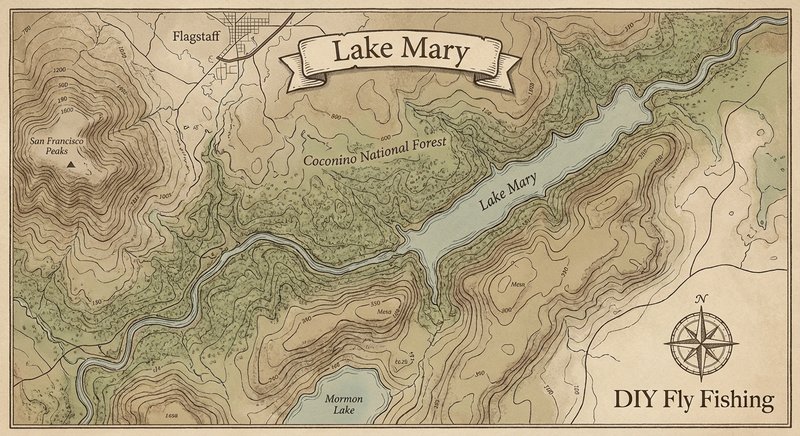
Lake Mary
Fly fishing in Arizona · beginner · Best seasons: spring, fall
Target Species
Rainbow Trout, Brown Trout
About This Water
Flagstaff area lake with stocked trout. Easy access near town with good spring fishing.
Fishing Recommendations
As an expert guide who has spent considerable time navigating the high-desert plateaus of Northern Arizona, I can tell you that Lake Mary—specifically Upper Lake Mary—is a unique gem. Located just southeast of Flagstaff at an elevation of about 7,000 feet, it offers a distinct contrast to the small creek fishing found in the nearby Oak Creek Canyon.
Here is your comprehensive guide to fly fishing Lake Mary.
🎣 Location Overview
Lake Mary is divided into two distinct bodies of water: Upper Lake Mary and Lower Lake Mary.
- Upper Lake Mary is a long, narrow "ribbon" lake. It is the deeper of the two and holds water year-round, making it the primary destination for trout anglers. It is unique because it allows powerboats (no speed limit), but its size and numerous coves make it very accessible for float tubers and kayak anglers.
- Lower Lake Mary is ephemeral; it often dries up during drought years. However, when it is full after a wet winter, the Arizona Game and Fish Department stocks it heavily with Rainbows, and the fishing can be lights-out.
The water is often "chalky" or slightly turbid due to the clay soil, which means visibility isn't always crystal clear. This affects fly choice and presentation, favoring silhouettes and vibrations over hyper-realism.
🐟 Target Species & Behavior
While Lake Mary is famous for Northern Pike and Walleye, it is a highly productive trout fishery.
- Rainbow Trout: These are the most common targets. They are stocked regularly and can grow quickly in the nutrient-rich water. They tend to cruise the shorelines and weed edges in the spring and fall.
- Brown Trout: The "ghosts" of Lake Mary. These are less common than Rainbows but grow to impressive sizes by feeding on fathead minnows and smaller trout. They are structure-oriented and often hold near rocky drop-offs or submerged timber.
- Behavior: Because the lake is relatively shallow and windswept, trout here are "cruisers." They cover a lot of ground looking for midges, damselflies, and crayfish.
📅 Best Times to Fish
Optimal Seasons
- Spring (April – June): This is the prime window. As the ice thaws and the water warms, trout become extremely active in the shallows. The "ice-off" period can produce some of the largest fish of the year.
- Fall (Late September – November): As water temperatures drop, trout move back into the shallows to bulk up for winter. The Brown Trout become more aggressive during the fall as they prepare for their spawning cycle.
Best Times of Day
- Early Morning/Dusk: The "Golden Hours" are essential here. The wind is usually calmest, and trout move closest to the bank.
- Overcast Days: Because the lake is high-altitude, the sun is intense. On cloudy days, fish feel more secure and will feed in shallower water all day long.
🪰 Recommended Flies & Techniques
Top Fly Patterns
- Streamers:
- Simi Seal Leech (Black/Red or Olive): The absolute "must-have" for Arizona lakes.
- Woolly Bugger (Size 8-12, Black or Thin Mint): Effective for both Rainbows and Browns.
- Clouser Minnow: If you are targeting big Browns, use patterns that mimic small perch or fathead minnows.
- Nymphs:
- Chironomids (Size 12-16, Red or Black/Silver): Crucial for "indicator" fishing.
- Prince Nymphs & Hare’s Ears: Standard prospecting flies.
- Damselfly Nymphs: Vital in late spring.
- Dry Flies:
- Parachute Adams: Good for evening midge hatches.
- Ant/Beetle patterns: Excellent in late summer/early fall when terrestrials get blown onto the water.
Effective Techniques
- The "Slow Strip": Using an intermediate sinking line, cast a Simi Seal Leech toward the shore or weed line and retrieve with very slow, 2-inch tugs.
- Static Indicator Rig: Suspend a midge or small nymph 4–8 feet below a slip indicator. This is deadly when the wind creates a light "chop" on the water, giving the flies a natural motion.
- Float Tubing: This is the most effective way to fish Lake Mary. It allows you to stay outside the weed line and cast back toward the shore, reaching fish that bank anglers cannot.
💡 Pro Tips & Local Knowledge
- Watch the Wind: Flagstaff is notoriously windy. If the wind is howling from the Southwest (as it often does), focus on the windward shore. The wind pushes insects and baitfish toward those banks, and the "mud line" created by the waves provides cover for feeding trout.
- Focus on "The Narrows": The middle section of Upper Lake Mary, where the lake constricts, often has slightly more current and concentrated fish movement.
- The Pike Factor: Be aware that Lake Mary has a large population of Northern Pike. If you feel a massive hit and get "bitten off" instantly, it was likely a Pike. Many trout anglers carry a few steel leaders just in case they want to switch targets.
- Color Selection: Due to the turbid water, darker colors (black, purple, dark olive) often perform better than light colors because they create a stronger silhouette against the murky background.
⚠️ Important Information
- Access: Access is excellent. There are several paved boat ramps and numerous pull-offs along Lake Mary Road. The "Lakeview" and "Narrows" areas are the most popular.
- Regulations:
- A valid Arizona Fishing License is required for anyone 10 years or older.
- There are no special gear restrictions (bait is allowed), so be prepared to share the water with gear anglers.
- Check current Arizona Game and Fish Department regulations for bag limits, as they can change seasonally.
- Weather Safety: Storms move in fast over the San Francisco Peaks. If you see lightning or dark clouds building, get off the water immediately—graphite fly rods are lightning magnets.
- Tonto Pass: Note that some parking areas around the lake may require a Coconino National Forest day-use pass (Red Rock Pass or America the Beautiful Pass usually suffice).
Tight lines, and enjoy the cool mountain air of Northern Arizona!
Bug Hatches & Matching Flies
| Hatch | Type | Peak months | Time of day | Hook sizes | Matching flies |
|---|---|---|---|---|---|
| Chironomids Chironomidae | midge | April, May, June, October | All Day | #12-22 | Zebra Midge #16-20, Chironobunyan #14-18, Ice Budgie #12-16 |
| Callibaetis Callibaetis nigritus | mayfly | June, July, August, September | Late Morning/Afternoon | #12-16 | Parachute Adams #14-16, Callibaetis Nymph #14-16, Quigley Cripple #14-16 |
| Damselfly Enallagma | terrestrial | June, July | Mid-day | #10-14 | Marabou Damsel #10-12, Adult Damsel #12-14, Braided Butt Damsel #12 |
| Scud Gammarus | midge | April, May, September, October | All Day | #12-16 | Ray Charles #14-16, Flashback Scud #12-14, Olive Scud #14-16 |
| Water Boatman Corixidae | terrestrial | September, October | Afternoon | #14-18 | Water Boatman #14-16, Prince Nymph #14-18 |
| Dragonfly Nymph Anisoptera | terrestrial | May, June, July | All Day | #4-10 | Dragon Nymph #6-10, Woolly Bugger (Olive/Brown) #4-8 |
| Grasshoppers Melanoplus | terrestrial | August, September | Afternoon | #6-12 | Dave's Hopper #8-12, Parachute Hopper #10-12, Morrish Hopper #6-10 |
| Cinnamon Caddis Leptoceridae | caddis | July, August | Evening | #14-18 | Elk Hair Caddis #14-16, LaFontaine's Deep Sparkle Pupa #16 |