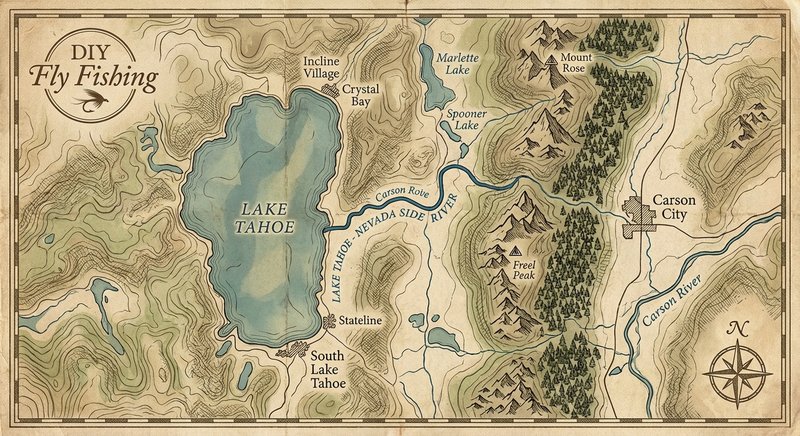
Lake Tahoe - Nevada Side
Fly fishing in Nevada · intermediate · Best seasons: spring, summer, fall
Target Species
Lake Trout, Rainbow Trout, Brown Trout
About This Water
Crystal clear alpine lake with trophy lake trout. World-renowned scenery with excellent fishing.
Fishing Recommendations
Welcome to the "Big Blue." As an expert guide, I can tell you that fly fishing Lake Tahoe—specifically the Nevada side—is one of the most challenging yet rewarding experiences in the Sierras. Unlike the shallow, weedy lakes of the high desert, Tahoe is an ultra-oligotrophic (ultra-clear) alpine lake with depths reaching 1,645 feet.
On the Nevada side, the shelf drops off much more aggressively than the California side, meaning "big water" tactics are the name of the game.
🎣 Location Overview
Lake Tahoe is a massive, high-altitude inland sea. The Nevada side (East Shore) is characterized by its iconic massive granite boulders, steep underwater drop-offs, and crystal-clear turquoise water.
What makes this area special for fly anglers is the "Ledge." Because the bottom drops from 10 feet to 100 feet very quickly near the shore, predatory trout can move from the depths into the shallows to hunt and then retreat into the abyss in seconds. It is a visual fishery; in the right light, you can see a 10-pound Mackinaw cruising 30 feet below you.
🐟 Target Species & Behavior
Lake Trout (Mackinaw)
These are the apex predators of the lake. While gear fishermen troll for them at 100+ feet, fly anglers can target them in the Spring and late Fall when they move into the "shallows" (20–40 feet) to follow cooler water and spawning Kokanee or Crawfish. They are aggressive but light-sensitive.
Rainbow Trout
Mostly found cruising the rocky shorelines. They are opportunistic feeders, looking for terrestrial insects, midges, and small minnows (Lahontan Redside Shiners). They tend to stay in the top 20 feet of the water column.
Brown Trout
The "ghosts" of the Nevada shore. Browns here grow large by feeding on crawfish and smaller trout. They are notoriously wary and are best targeted during low-light conditions (pre-dawn or dusk) around rocky structures like those near Cave Rock.
📅 Best Times to Fish
- Spring (April – June): This is the prime window for fly anglers. As the surface water is still cold, the Mackinaw and large Rainbows move within casting distance of the shore.
- Summer (July – September): Difficult for fly fishing. Fish move deep to find the thermocline. You must fish the "Grey Ghost" hours—30 minutes before sunrise until the sun hits the water.
- Fall (October – November): Another excellent window. Brown trout become more aggressive as they prepare for spawning, and Lake Trout move toward the shallows as surface temperatures drop.
Optimal Window: 4:30 AM to 9:00 AM. Once the "Washoe Zephyr" (afternoon wind) kicks up, fly casting becomes dangerous and the fish move deep.
🪰 Recommended Flies & Techniques
The Gear
You cannot fish Tahoe effectively with a floating line. You need a 7 to 9-weight rod with a Fast Sinking Line (Type 5 or 7) or a heavy integrated sink-tip (300-400 grains).
Top Fly Patterns
- Streamers:
- Micky Finn or Sculpin Patterns: (Size 2-6) in white/olive to mimic minnows.
- Game Changers: Large (4-6 inch) articulated streamers in white or silver.
- Bunny Leeches: In "Dark Crawdad" or black/purple for low light.
- Nymphs/Terrestrials:
- Carpenter Ants: (Summer) Large black foam ants can trigger massive Rainbows near the boulders.
- Chironomids: (Size 14-18) in zebra or red, fished deep under a long leader if the water is glass-calm.
Techniques
- The "Count Down": Cast as far as possible over a ledge. Count to 30 or 45 seconds to let your line sink deep. Use a "strip-strip-pause" retrieve. Most hits occur the moment the fly starts to lift off the bottom.
- Float Tube Stripping: Launching a float tube from Sand Harbor allows you to stay 50 feet off the rocks and cast back toward the shore, stripping your fly down the underwater granite faces.
💡 Pro Tips & Local Knowledge
- The Cave Rock Shelf: Just north and south of the Cave Rock boat launch, there are massive underwater boulders. This is a magnet for big Browns. Use a "vertical strip" technique here.
- Watch the Weather: If the water is "glassy," the fish can see your leader from a mile away. You actually want a slight "Tahoe Chop" (small ripples) to break up the surface tension and hide your presence.
- Stealth is Key: Because the water is so clear, wear neutral colors (grey/blue). Avoid standing on top of high boulders where you'll be silhouetted against the sky.
- The Crawdad Secret: Tahoe is crawling with signal crayfish. If you aren't catching fish on minnow patterns, switch to a heavy, weighted crawdad pattern and "hop" it along the sandy pockets between boulders.
⚠️ Important Information
- Access:
- Sand Harbor: Great access but gets very crowded with tourists. Go at sunrise.
- Logan Shoals: Provides some of the best cliff-access for deep-water casting.
- Hidden Beach: A hike-in spot that offers more privacy and excellent rocky points.
- Regulations:
- A valid Nevada OR California fishing license is legal for fishing Lake Tahoe from a boat. However, if you are fishing from the Nevada shore, a Nevada Fishing License is required.
- The limit is generally 5 trout, but only 2 can be Lake Trout. (Check current NDOW regulations as they can change).
- Invasive Species: If using a float tube or kayak, you must ensure it is clean, drain, and dry. Tahoe has strict aquatic invasive species (AIS) protocols.
- Safety: The water is cold enough to cause hypothermic shock in minutes, even in July. If fishing from a float tube, always wear a PFD and never fish alone.
Bug Hatches & Matching Flies
| Hatch | Type | Peak months | Time of day | Hook sizes | Matching flies |
|---|---|---|---|---|---|
| Chironomids Chironomidae | midge | April, May, June | All Day | #12-22 | Zebra Midge #16-20, Ice Cream Cone #12-16, Griffith's Gnat #18-22 |
| Callibaetis Callibaetis | mayfly | June, July, August | Morning/Early Afternoon | #12-16 | Callibaetis Spinner #14-16, Hare's Ear Nymph #12-16, Quigley Hackle Stacker #14-16 |
| Carpenter Ants Camponotus | terrestrial | June, July | Afternoon | #10-14 | Carpenter Ant #10-12, Chernobyl Ant #12-14 |
| Damselflies Enallagma | terrestrial | July, August | Late Morning/Afternoon | #10-12 | Marabou Damsel Nymph #10-12, Adult Damsel #10-12 |
| Traveling Sedge Hesperophylax | caddis | July, August | Evening | #8-12 | Godzilla Caddis #8-10, Elk Hair Caddis #10-14 |
| Grasshoppers Acrididae | terrestrial | August, September | Afternoon | #8-12 | Hopper Juan #10-12, Morrish Hopper #8-12 |
| Trico Tricorythodes | mayfly | August, September, October | Early Morning | #20-24 | Trico Spinner #20-24, RS2 #20-22 |
| Water Boatmen Corixidae | terrestrial | September, October | All Day | #14-16 | Water Boatman #14-16, Prince Nymph #14-18 |