Lamar River
Fly fishing in Wyoming · Intermediate · Best seasons: Summer, Fall
Target Species
Cutthroat Trout
About This Water
Remote fishing in Yellowstone's Lamar Valley. Native cutthroat trout in pristine wilderness.
Fishing Recommendations
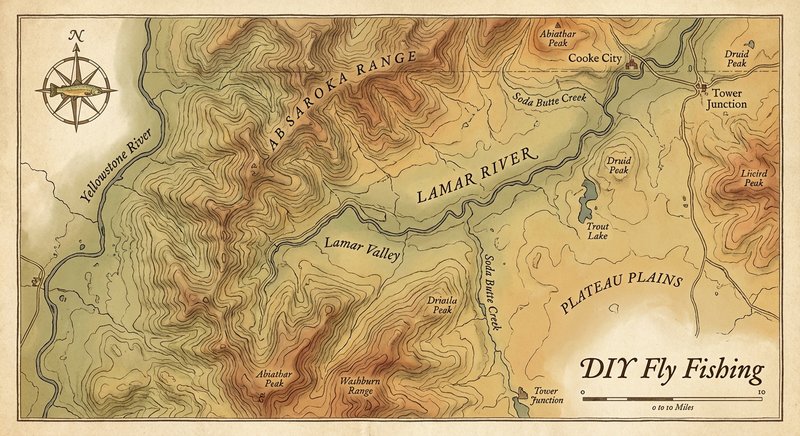
The Lamar River, located in the northeastern corner of Yellowstone National Park, is often referred to as the "Serengeti of North America." Fishing here is a bucket-list experience not just for the trout, but for the raw, prehistoric landscape shared with grizzly bears, wolves, and massive herds of bison.
As your guide, here is the comprehensive breakdown for tackling one of the finest dry-fly fisheries in the world.
🎣 Location Overview
The Lamar River flows through a wide, glacial valley characterized by sweeping meadows and steep, rugged canyons. It is the primary artery of the Lamar Valley ecosystem.
What makes it special: The Lamar is world-renowned for its native Yellowstone Cutthroat Trout. Unlike many technical rivers, the Lamar is a "classic" Western freestone. It features broad riffles, deep undercut banks, and long, glassy slicks. It is a high-elevation meadow stream that provides some of the best terrestrial (land-based insect) fishing on the planet.
Water Characteristics: The river is highly susceptible to "blowing out." Because it is fed by the Lamar Canyon and Soda Butte Creek, a heavy rainstorm miles away can turn the river into chocolate milk quickly due to the highly erosive volcanic soils of the Absaroka Mountains.
🐟 Target Species & Behavior
The star of the show is the Yellowstone Cutthroat Trout. You may also encounter Rainbow trout and "Cutbow" hybrids in the lower reaches, though the Park Service encourages the harvest of these to protect the native Cutthroat genetics.
- Behavior: Yellowstone Cutthroats are famously "lookers." They are bold and will often rise to a large dry fly even in fast water. However, in the slow meadow stretches, they can become remarkably selective during a hatch.
- Where they hold: Look for them in the "seams" (where fast water meets slow water), right against the grassy undercut banks, and in the tail-outs of deep pools during the evening.
- Feeding: They are opportunistic. Because the growing season is short, they feed aggressively on stoneflies, mayflies, and—most importantly—terrestrials.
📅 Best Times to Fish
The Lamar has a relatively short fishing window due to snowmelt and altitude.
- The Season: Usually begins in mid-July (after spring runoff subsides) and runs through September.
- Optimal Months:
- August: The prime month for terrestrial fishing (hoppers/ants).
- September: Cooler water temps and the Drake/Hecuba hatches make for legendary fishing.
- Time of Day: In the heat of summer, 10:00 AM to 4:00 PM is prime for terrestrial action. During late summer/fall, the evening "spinner fall" can be electric.
- The "Mud" Factor: Always check the weather. If it rained the night before, the Lamar might be unfishable, but its tributaries (Soda Butte or Slough Creek) might stay clear.
🪰 Recommended Flies & Techniques
The Lamar is a dry-fly angler's paradise. While nymphing works, most come here to see the take.
Top Fly Patterns
- Terrestrials:
- Morrish Hopper (Size 8-12, Pink or Tan)
- Amy’s Ant (Size 10-14, Cinnamon)
- Chernobyl Ant (the "Standard" for the Lamar)
- Mayflies:
- Parachute Adams (Size 12-18)
- Flavs/Green Drakes (Size 12-14) in late August.
- Attractors:
- Royal Wulff or Royal Stimulator (Size 12-16). Cutthroats love purple—try a Purple Haze.
Effective Techniques
- Hopper-Dropper: This is the bread and butter. Use a large, buoyant foam hopper as your "bobber" and hang a Pheasant Tail or Prince Nymph (Size 14-16) about 2-3 feet below it.
- The "Twitch": When fishing hoppers near the bank, give the fly a tiny strip or twitch. It mimics a grasshopper struggling and often triggers a violent strike.
- Dead Drift: In the flat water, your drift must be drag-free. Use a long leader (9ft to 12ft) tapered to 4X or 5X.
💡 Pro Tips & Local Knowledge
- The Bison Rule: Bison are everywhere in the Lamar Valley. They have the right of way. If a herd is blocking the path to the river, wait or move. Never approach them; they are faster and more dangerous than they look.
- Walk the Banks: Don't just fish the pull-outs. The further you walk from the road, the less pressured the fish are. Even a 20-minute hike can lead you to fish that haven't seen a fly all day.
- Check the Confluence: The area where Soda Butte Creek meets the Lamar is a major holding area for larger fish, but it gets crowded.
- The "Lamar Lull": If the sun is high and the fishing slow, switch to a very small black ant pattern (#18-20). Often, the fish are keyed into tiny terrestrials you can barely see.
⚠️ Important Information
Access
- Access is easy via the Northeast Entrance Road. There are numerous pull-outs between the Lamar Canyon and the Pebble Creek campground.
- The Canyon: For the adventurous, the Lamar Canyon (downstream) offers rugged hiking and hard-fighting fish in pocket water.
Regulations & Permits
- Park Permit: You need a specific Yellowstone National Park Fishing Permit. A state license (WY/MT) is not valid inside the park.
- Hooks: Only barbless hooks are allowed. Pinch your barbs before you head out.
- Lead-Free: Yellowstone is a lead-free zone. Ensure your split shot and weighted flies are non-lead.
- Mandatory Kill: Any Rainbow trout or Cutbows caught in the Lamar drainage must be killed (to protect the Cutthroat population).
Safety: The "Grizzly" Reality
- You are in the heart of Grizzly country. Carry bear spray on your person (not in your pack) and know how to use it.
- Avoid fishing alone if possible, and make noise when walking through tall willows or brush near the river banks.
Guide's Final Word: The Lamar is a river of moods. One hour it's a calm meadow, the next it's a thunderstorm-lashed wilderness. Respect the fish, keep them in the water while unhooking, and take a moment to look up from your fly—the scenery is as world-class as the fishing.
Bug Hatches & Matching Flies
| Hatch | Type | Peak months | Time of day | Hook sizes | Matching flies |
|---|---|---|---|---|---|
| Pale Morning Dun Ephemerella excrucians | mayfly | July, August | Late Morning/Afternoon | #14-18 | Sparkle Dun #16-18, Pheasant Tail #14-18, RS2 #16-18 |
| Green Drake Drunella doddsii | mayfly | July, August | Afternoon | #10-12 | Hackle Stacker Green Drake #10-12, Quigley Cripple #10-12, Hare's Ear #10-12 |
| Grasshopper Acrididae | terrestrial | August, September | Late Morning/Afternoon | #8-12 | Parachute Hopper #10-12, Morrish Hopper #8-12, Pink Pookie #10-12 |
| Blue Winged Olive Baetis tricaudatus | mayfly | June, September, October | Late Morning/Afternoon | #18-22 | Parachute Adams #18-22, BWO CDC Emerger #20-22, JujuBaetis #18-20 |
| Spotted Sedge Hydropsyche | caddis | July, August, September | Evening | #14-16 | Elk Hair Caddis #14-16, LaFontaine's Deep Sparkle Pupa #14-16, Iris Caddis #14-16 |
| Salmonfly Pteronarcys californica | stonefly | June, July | All Day | #4-8 | Rogue River Stone #4-8, Pat's Rubber Legs #4-8, Cat Puke #6-8 |
| Western Black Ant Formicidae | terrestrial | July, August | Afternoon | #16-20 | Cinnamon Ant #16-18, Black Foam Ant #16-20 |
| Flav Drunella coloradensis | mayfly | August | Afternoon | #12-14 | Drunella Emerger #14, Guide's Choice Hare's Ear #12-14 |
| Mormon Cricket Anabrus simplex | terrestrial | July, August | All Day | #6-10 | Mormon Cricket Foam #8, Black Fat Boy #8-10 |