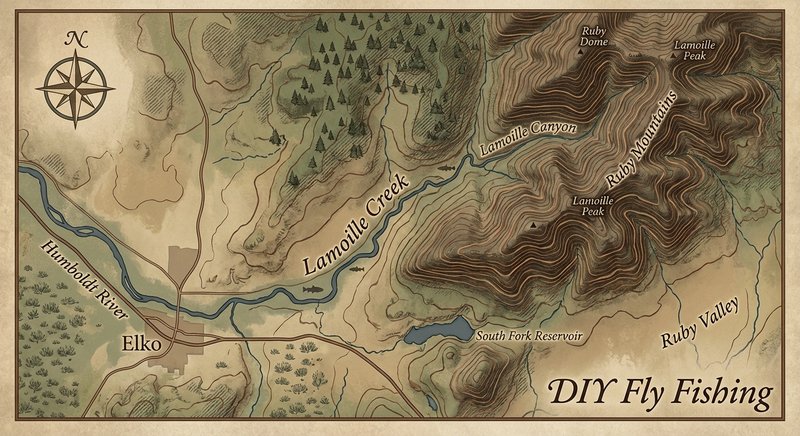
Lamoille Creek
Fly fishing in Nevada · intermediate · Best seasons: summer, fall
Target Species
Brook Trout, Rainbow Trout
About This Water
Ruby Mountains stream with wild trout. Scenic canyon below glacial cirque.
Fishing Recommendations
Welcome to the "Alps of Nevada." As an expert guide, I can tell you that Lamoille Creek, tucked away in the Ruby Mountains just south of Elko, is one of the state’s best-kept secrets. This is high-elevation, small-water fly fishing at its finest, offering a rugged alternative to the crowded rivers of the Rockies.
Here is your comprehensive guide to fishing Lamoille Creek.
🎣 Location Overview
Lamoille Creek flows through the stunning Lamoille Canyon, a glacially carved masterpiece within the Humboldt-Toiyabe National Forest. The water is a classic high-desert freestone stream—crystal clear, cold, and oxygen-rich.
What makes this area special is the sheer verticality of the canyon. You are fishing at elevations between 6,000 and 9,000 feet, surrounded by 11,000-foot peaks. The creek transitions from a tumbling, high-gradient stream with pocket water in the upper canyon to more meandering meadow stretches and beaver ponds as it moves lower. Anglers love it for its wild scenery, lack of crowds, and the "eager" nature of its resident trout.
🐟 Target Species & Behavior
The creek is primarily a Brook Trout and Rainbow Trout fishery, though you may occasionally find a wild Brown Trout in the lower reaches.
- Brook Trout: These dominate the upper reaches and the beaver ponds. They are stunningly colored, especially in the fall. They are opportunistic but cautious; they hold in the deep, slow-moving pockets and under the undercut banks of beaver ponds.
- Rainbow Trout: Found throughout the middle and lower stretches. They prefer the swifter water, holding in the "seams" between fast and slow water and at the heads of pools.
- Behavior: Due to the short growing season at high altitudes, these fish are not "picky" eaters, but they are extremely "spooky." The water is so clear that if you can see them, they have likely already seen you.
📅 Best Times to Fish
Optimal Seasons
- Summer (July – August): This is the prime window. Because of the high elevation, snowmelt often keeps the creek high and turbid through June. By July, the water clears, and the dry fly action becomes world-class.
- Fall (September – October): My personal favorite time. The Brook Trout are in their vibrant spawning colors and become very aggressive. The cottonwoods and aspens turn gold, and the crowds (which are already small) disappear entirely.
Best Times of Day
- Mid-Morning to Late Afternoon: Unlike lower-elevation rivers that get too hot in the afternoon, Lamoille stays cool. The best insect activity usually happens between 10:00 AM and 4:00 PM.
🪰 Recommended Flies & Techniques
Top Fly Patterns
Because these fish see relatively little pressure, Attractor Patterns are often more effective than exact imitations.
- Dry Flies:
- Royal Wulff or Royal Coachman (Size 14-18): The white wings make them easy to track in bubbly pocket water.
- Elk Hair Caddis (Size 14-16): A staple for the summer evenings.
- Stimulators (Size 12-16): Orange or Yellow; great for imitating the large stoneflies or grasshoppers found in the meadows.
- Parachute Adams: The ultimate "all-purpose" dry fly for these waters.
- Nymphs:
- Bead-head Pheasant Tail (Size 16-20): Works year-round.
- Prince Nymph (Size 14-18): Great for the swifter runs.
- Zebra Midge (Size 18-22): Essential if the fish are being finicky in the slower pools.
Effective Techniques
- Dry-Dropper Rig: This is the most effective way to fish Lamoille. Use a buoyant dry fly (like a Stimulator) and hang a small Pheasant Tail nymph 18–24 inches below it.
- Stealth Approach: Use a 3-weight or 4-weight rod. Keep a low profile. Crawl to the edge of the beaver ponds if you have to. If you cast your shadow over a pool, the fishing is over for at least 20 minutes.
- Short Casts: You rarely need to cast more than 20 feet. Accuracy and a delicate presentation are far more important than distance.
💡 Pro Tips & Local Knowledge
- Focus on the Beaver Ponds: If you want the larger Brookies, hike to the beaver pond complexes. Look for the "inlet" where the creek enters the pond; the fish stack up there waiting for food to be delivered by the current.
- The "Powerhouse" Stretch: The area near the old powerhouse (lower canyon) has some of the best pocket water for Rainbows.
- High-Sticking: In the steep, rocky sections, don't even worry about a traditional cast. Just "dap" or "high-stick" your fly into the small pockets behind boulders.
- Check the Wind: The canyon can act as a wind tunnel in the afternoon. If it gets breezy, switch to a heavier terrestrial pattern like a Foam Beetle or Hopper to cut through the wind.
⚠️ Important Information
- Access: Access is excellent via the Lamoille Canyon Scenic Byway. There are numerous pull-outs and trailheads (like the Thomas Canyon Campground or the Road's End trailhead).
- Regulations: A valid Nevada fishing license is required. Always check current Nevada Department of Wildlife (NDOW) regulations for seasonal closures or bag limits.
- Wading: Wading is generally easy as the creek is small, but the rocks are incredibly slippery. Felt soles or studs are recommended.
- Safety: This is bear and mountain lion country. While encounters are rare, carry bear spray if you are hiking deep into the upper canyon. Also, be prepared for sudden thunderstorms that can roll over the peaks in the afternoon.
Guide’s Final Word: Lamoille Creek isn't about catching 20-inch trophies; it's about catching wild, gem-like trout in one of the most beautiful settings in the Great Basin. Pack a light rod, bring plenty of water, and take time to look up from the stream once in a while. Tight lines!
Bug Hatches & Matching Flies
| Hatch | Type | Peak months | Time of day | Hook sizes | Matching flies |
|---|---|---|---|---|---|
| Blue-Winged Olive Baetis | mayfly | April, May, September, October | Late Morning/Afternoon | #18-22 | Parachute Adams #18-22, RS2 #20-22, Pheasant Tail #18-20 |
| Pale Morning Olive Ephemerella | mayfly | June, July | Morning/Mid-day | #14-18 | PMO Sparkle Dun #16-18, Military May #16-18, Quill Gordon #14-16 |
| Golden Stonefly Hesperoperla pacifica | stonefly | June, July | All Day | #8-12 | Chubby Chernobyl #8-12, Pat's Rubber Leg #8-12, Golden Rogue Stone #10-12 |
| Spotted Sedge Hydropsyche | caddis | July, August, September | Evening | #14-16 | Elk Hair Caddis #14-16, LaFontaine's Deep Sparkle Pupa #14-16, Caddis God #14-16 |
| Yellow Sally Isoperla | stonefly | June, July, August | Afternoon/Evening | #14-16 | Yellow Sally #14-16, Little Yellow Stone Nymph #14-16 |
| Green Drake Drunella doddsii | mayfly | July | Mid-day/Afternoon | #10-12 | Hairwing Green Drake #10-12, Green Drake Cripple #10-12 |
| Grasshoppers Melanoplus | terrestrial | August, September | Late Morning/Afternoon | #8-12 | Dave's Hopper #10-12, Morrish Hopper #8-12 |
| Midges Chironomidae | midge | March, April, October, November | Morning | #20-24 | Zebra Midge #20-22, Griffith's Gnat #20-22, Mercury Midge #20-24 |