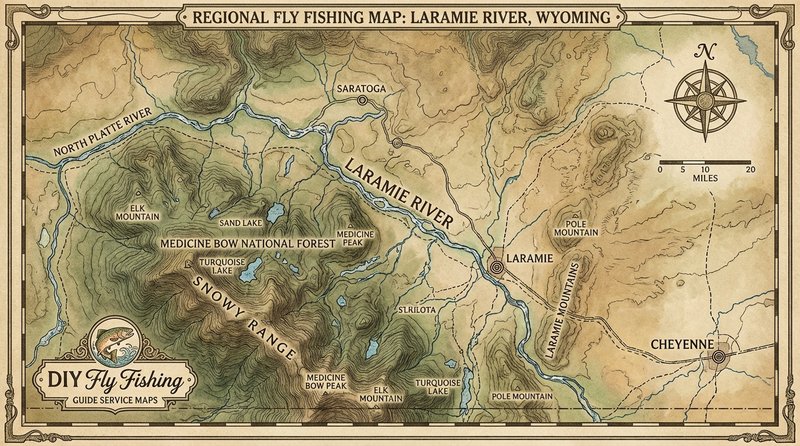
Laramie River
Fly fishing in Wyoming · Beginner · Best seasons: Summer, Fall
Target Species
Brown Trout, Rainbow Trout, Brook Trout
About This Water
Southeast Wyoming stream with diverse trout species. Good public access available.
Fishing Recommendations
The Laramie River in Wyoming is one of the West’s most underrated "sleeper" fisheries. Flowing from the high mountains of Colorado into the plains of the Laramie Valley, this river transforms from a tumbling mountain stream into a classic, meandering meadow river. It is a technical, rewarding, and often challenging fishery that favors the observant angler.
🎣 Location Overview
The Laramie River is a tale of two waters. The upper reaches (near the Colorado/Wyoming border) offer high-gradient pocket water, while the lower sections through the Laramie Valley are characterized by tight oxbows, deep undercut banks, and slow-moving glides.
What makes it special is the solitude and the caliber of the Brown Trout. Unlike the high-traffic rivers near Jackson or Casper, you can often have miles of the Laramie to yourself. It is a "classic" meadow stream where stealth is more important than a long cast. The water is often tea-colored (tannic), hiding large, predatory Browns that lie in wait beneath the overhanging willow banks.
🐟 Target Species & Behavior
- Brown Trout: The undisputed kings of the Laramie. They are wary, territorial, and love structure. They hold tight to the undercut banks and under submerged root balls. In the fall, they become highly aggressive.
- Rainbow Trout: Found more frequently in the faster riffles and oxygenated runs, especially in the upper public sections (Jelm area). They are less structure-dependent than the Browns.
- Brook Trout: Primarily found in the upper reaches and tributaries. They are opportunistic feeders but remain small, providing a fun diversion in the high-country meadow sections.
Behavior: These fish are easily spooked. Because the river is often narrow, heavy wading will shut down a hole instantly. The "Laramie Lean"—crouching low to avoid being silhouetted against the wide-open Wyoming sky—is a mandatory skill here.
📅 Best Times to Fish
Summer (Late June – August)
This is the prime window for dry fly action. Once the spring runoff subsides (usually late June), the insect life explodes.
- Prime Window: July for the Golden Stonefly hatch and the start of the Trico madness.
- Time of Day: Early morning (6 AM – 10 AM) for Tricos; midday for terrestrials.
Fall (September – October)
Many guides consider this the best time for trophy hunters.
- Prime Window: Late September through October.
- Conditions: The Brown Trout move into their pre-spawn aggression phase. Overcast days are gold—the fish lose their inhibitions and move away from the banks to chase streamers.
🪰 Recommended Flies & Techniques
Dry Flies
- Terrestrials (The Summer Staple): Amy’s Ant (Size 10-14), Morrish Hopper (Tan/Pink, Size 10-12), and Dave’s Hopper.
- Technical Dries: Trico Spinner (Size 20-24) for morning rises; Parachute Adams (Size 16-20) for general hatches.
- Stoneflies: Golden Stonefly patterns (Size 8-12) in the faster water sections in July.
Nymphing
- The "Laramie Special": A Beadhead Prince Nymph or a Copper John (Red) works wonders in the tea-colored water.
- Droppers: Hang a Pheasant Tail (Size 16-18) or a Flashback Hare’s Ear 18 inches behind a large hopper.
Streamers (The "Big Fish" Strategy)
- Patterns: Gold Sparkle Minnow, Black or Olive Woolly Bugger, and the Sex Dungeon (Natural or White).
- Technique: "Pounding the banks." Cast as close to the grass as possible and strip immediately.
💡 Pro Tips & Local Knowledge
- The "Stealth Approach": On the meadow sections, stay 10 feet back from the bank when you first arrive. Some of the biggest Browns sit in just 6 inches of water right against the grass. If you walk to the edge to look, they are gone.
- Wind Strategy: This is Wyoming; it will be windy. Instead of fighting it, use it. Wind blows grasshoppers into the water. If the wind is howling, tie on the biggest, foamist hopper you have and "splat" it near the leeward bank.
- The Jelm Access: Focus on the Monolith or Jelm public access areas for the best mix of Rainbows and Browns. These areas have more "pocket water" which is easier to read for beginners.
- Dark Water, Bright Fly: Because the water can be tannic, flies with a bit of flash or internal weight (bead heads) help fish track the fly in lower visibility.
⚠️ Important Information
Access
- Public vs. Private: Wyoming has strict trespass laws. You cannot walk on the riverbed if it flows through private land without permission. Stick to established Wyoming Game & Fish Public Access Areas (PAAs).
- Key Access Points: Jelm PAA, Monolith PAA, and the Laramie River Access near the town of Laramie.
Regulations
- A valid Wyoming Fishing License and Conservation Stamp are required.
- Check the current Wyoming Fishing Regulations booklet, as some stretches have specific creel limits or "artificial flies and lures only" designations.
Special Considerations
- Moose & Cattle: You are likely to encounter both. Give moose a very wide berth; they are more dangerous than bears in this region.
- Sun Protection: At 7,000+ feet of elevation, the sun is intense. Wear polarized sunglasses—not just to see the fish, but to protect your eyes from the high UV and the occasional wind-blown hook.
Bug Hatches & Matching Flies
| Hatch | Type | Peak months | Time of day | Hook sizes | Matching flies |
|---|---|---|---|---|---|
| Blue-Winged Olive (BWO) Baetis spp. | mayfly | April, May, September, October | Late Morning/Afternoon | #18-22 | Parachute Adams #18-22, RS2 #20-22, Pheasant Tail #18-20 |
| Pale Morning Dun (PMD) Ephemerella excrucians | mayfly | July, August | Morning/Early Afternoon | #16-18 | PMD Sparkle Dun #16-18, Barr's PMD Emerger #16-18, Split Case PMD #16 |
| Trico Tricorythodes | mayfly | August, September | Early Morning | #20-24 | Trico Spinner #20-24, Drowned Trico Spinner #22, Trico Dun #20-22 |
| Caddis Hydropsyche / Brachycentrus | caddis | June, July | Evening | #14-18 | Elk Hair Caddis #14-18, LaFontaine's Deep Sparkle Pupa #14-16, Soft Hackle Peacock #16 |
| Grasshoppers Acrididae | terrestrial | August, September | Late Morning/Afternoon | #8-12 | Morrish Hopper #10-12, Dave's Hopper #8-12, Amy's Ant #10 |
| Yellow Sally Isoperla spp. | stonefly | July | Afternoon/Evening | #14-16 | Yellow Sally Dry #14-16, Iron Lotus #16, Yellow Stimulator #14-16 |
| Midges Chironomidae | midge | March, April, October, November | All Day | #18-24 | Zebra Midge #18-22, Griffith's Gnat #20-22, Morgan's Midge #20-24 |
| Ants and Beetles Formicidae / Coleoptera | terrestrial | July, August, September | Afternoon | #12-18 | Chernobyl Ant #12-14, Cinnamon Ant #16-18, Fat Albert #12-14 |