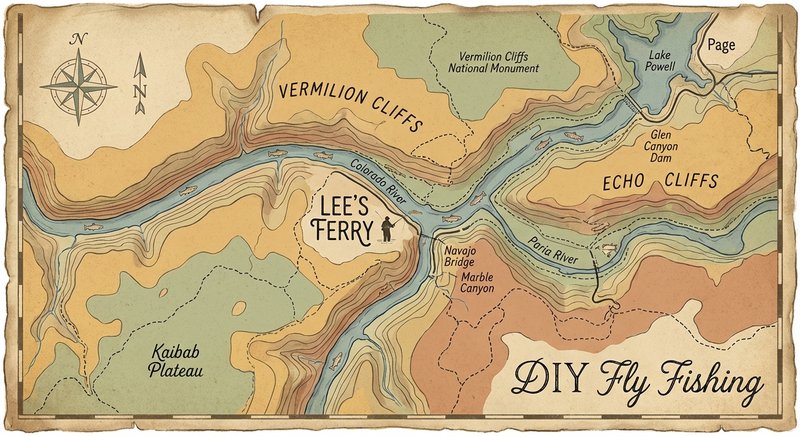
Lee's Ferry
Fly fishing in Arizona · intermediate · Best seasons: spring, fall, winter
Target Species
Rainbow Trout
About This Water
World-class tailwater below Glen Canyon Dam. Trophy rainbow trout in stunning desert canyon setting with year-round fishing.
Fishing Recommendations
Welcome to the "Colorado River’s Grand Canyon Tailwater." As your guide, I’m excited to walk you through one of the most visually stunning and productive trout fisheries in the American West. Lee’s Ferry is a bucket-list destination that feels more like a cathedral of red rock than a typical river.
🎣 Location Overview
Lee’s Ferry is a 15-mile stretch of the Colorado River located just below Glen Canyon Dam and upstream from the Grand Canyon. What makes this water special is its tailwater stability. The water released from Lake Powell stays a consistent 45–55°F year-round, creating a "biological factory" for midges and scuds.
The river is massive, characterized by crystal-clear turquoise water set against 1,000-foot sheer vermillion cliffs. Anglers love it because it offers a "big water" experience that is surprisingly accessible. Whether you are wading the "Walk-In" area or taking a jet boat up-river to the sandbar riffles, the sheer scale of the landscape is humbling.
🐟 Target Species & Behavior
Species: Wild Rainbow Trout (with occasional brown trout). Behavior: These are hard-fighting, wild fish. Unlike hatchery trout, Lee's Ferry rainbows are sleek, colorful, and incredibly strong due to the high oxygen levels and constant current.
- Where they hold: They favor the "seams" where fast water meets slow water and the shallow riffles over gravel bars (especially during spawning).
- Feeding: They are opportunistic but focused. Because the biomass is dominated by a few specific sources, they can be incredibly selective about size and depth. They primarily feed on midges, scuds, and aquatic worms.
📅 Best Times to Fish
While you can fish here year-round, the windows you requested are the prime times:
- Spring (March – May): This is the peak. As days lengthen, midge activity intensifies. This is also the tail end of the spawn, where fish are aggressive and active in the riffles.
- Fall (September – November): The "Second Season." Water temperatures are perfect, and the crowds thin out. The terrestrial fishing (beetles/ants) can be surprisingly good against the canyon walls.
- Winter (December – February): The "Local's Secret." This is the primary spawning season. While you should avoid stepping on "redds" (spawning beds), the fish are concentrated in the shallows and are very hungry.
- Best Time of Day: High sun can actually be beneficial here to see into the water, but the "Golden Hour" (when the sun dips behind the high canyon walls) often triggers a massive midge hatch.
🪰 Recommended Flies & Techniques
Top Fly Patterns
- Scuds: This is the "steak and potatoes" of Lee’s Ferry.
- Patterns: Ray Charles (Grey/Tan), Woven Scuds, or Flashback Scuds in sizes 16–20.
- Midges: Essential year-round.
- Patterns: Zebra Midges (Black/Silver, Red/Silver), Zebra Midges with glass beads, and Griffith’s Gnat for surface action. Sizes 18–22.
- Annelids (Worms): Especially effective after a bump in water flow.
- Patterns: San Juan Worm (Bright Red or Fluorescent Orange).
- Glo-Bugs/Eggs: Vital during the winter and spring spawning cycles.
Effective Techniques
- Nymphing (The Go-To): 90% of fish are caught on a 2-fly nymph rig under an indicator. Use a long leader (9–12ft) as the water is exceptionally clear.
- The "Leisenring Lift": When fishing scuds in the current, let them swing at the end of the drift. Often, the trout will strike as the fly begins to rise toward the surface.
- Dry Fly: Look for rising fish in the back eddies or along the "Wall of Bronze." A double-midge dry rig is deadly.
💡 Pro Tips & Local Knowledge
- The "Walk-In" vs. Upriver: If you don't have a boat, the Walk-In area (near the boat ramp) offers over a mile of great water. However, to see the best of the Ferry, hire a "back-haul" service—a jet boat that drops you and your gear at an upstream sandbar and picks you up at the end of the day.
- Watch the Water Levels: This is a hydro-electric dam. Water levels can rise or fall several feet in a matter of hours. Never leave your gear sitting right on the water's edge, and be mindful of your wading position.
- Sight Fishing: Because the water is so clear, use high-quality polarized glasses (amber or copper lenses). You aren't just fishing the water; you are hunting individual fish.
- Cicada Magic: If you find yourself there in early summer, ask about the Cicada hatch. Seeing a 20-inch rainbow crush a giant dry fly against a red rock wall is an experience you'll never forget.
⚠️ Important Information
- Access: Located at Marble Canyon, AZ. About 4.5 hours north of Phoenix and 2.5 hours from Flagstaff.
- Regulations:
- Artificial Lure and Fly ONLY.
- Barbless hooks are required (pinch your barbs!).
- Check current AZGFD regulations for creel limits, though Catch & Release is highly encouraged to maintain the wild population.
- Permits: You need a valid Arizona Fishing License. You can buy these online via the AZGFD website.
- Safety: The water is cold (roughly 47°F). Hypothermia is a real risk even in the summer if you are waded deep for too long. Wear insulated waders and carry plenty of drinking water—the desert sun is brutal even if the river is cold.
Guide’s Final Word: Bring a camera. Even if the fishing is tough, the scenery at Lee's Ferry is worth the price of admission alone. Tight lines!
Bug Hatches & Matching Flies
| Hatch | Type | Peak months | Time of day | Hook sizes | Matching flies |
|---|---|---|---|---|---|
| Midges Chironomidae | midge | February, March, April, September, October, November | All day | #18-24 | Zebra Midge #18-22, Griffith's Gnat #20-24, Morgan's Midge #20-22 |
| Blue Winged Olive Baetis | mayfly | March, April, October, November | Afternoon | #18-22 | RS2 #18-22, Parachute Adams #18-22, Pheasant Tail Nymph #18-20 |
| Cicada Magicicada / Diceroprocta | terrestrial | May, June, July | Late Morning/Afternoon | #6-10 | Mormon Girl #8-10, Chernobyl Ant #6-10, Black Foam Cicada #8-10 |
| Black Flies Simuliidae | midge | June, July, August | All day | #18-22 | Bead Head Midge #18-20, Buffalo Gnat #18-22 |
| Spotted Sedge Hydropsyche | caddis | July, August, September | Evening | #14-18 | Elk Hair Caddis #14-16, LaFontaine Sparkle Pupa #16-18 |
| Grasshoppers Acrididae | terrestrial | August, September | Afternoon | #8-12 | Chubby Chernobyl #10-12, Dave's Hopper #8-12 |
| Ants and Beetles Formicidae / Coleoptera | terrestrial | June, July, August | Afternoon | #12-18 | Cinnamon Ant #14-18, Black Foam Beetle #12-16 |
| Aquatic Worms Tubifex tubifex | midge | March, April, May | All day | #10-14 | San Juan Worm #10-14, Micro Worm #14-16 |