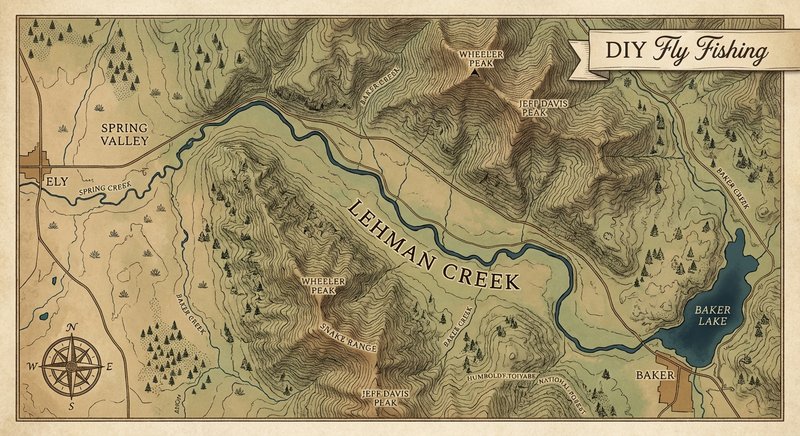
Lehman Creek
Fly fishing in Nevada · intermediate · Best seasons: summer, fall
Target Species
Rainbow Trout, Brook Trout
About This Water
Great Basin National Park stream with wild trout. Scenic Wheeler Peak area.
Fishing Recommendations
Welcome to the high-desert oasis of the Silver State. As your guide, I’m excited to introduce you to Lehman Creek, the crown jewel of Great Basin National Park. This isn't your typical wide-open western river; this is technical, intimate, small-stream fly fishing at its finest.
🎣 Location Overview
Lehman Creek is a high-gradient mountain stream that tumbles from the slopes of Wheeler Peak (13,063 ft) down into the Snake Valley. What makes it special is the dramatic "ecology on display." In just a few miles, the water travels from alpine tundra through ancient Bristlecone pine forests and down into lush riparian corridors.
The water is crystal clear, cold, and fast. It is characterized by tight "pocket water," small plunge pools, and undercut banks shaded by mountain mahogany and aspen. Anglers love it because it offers a true wilderness experience—you’ll rarely see another fly fisher, and the fish are wild, colorful, and incredibly eager to rise to a dry fly.
🐟 Target Species & Behavior
- Brook Trout: These are the gems of the upper reaches. They are vibrantly colored and congregate in the colder, higher-elevation sections. They are opportunistic feeders but can be spooky in the glassy pools.
- Rainbow Trout: Found throughout the creek but more dominant in the middle and lower stretches. They are hardy, wild fish that fight significantly harder than their size (usually 6–10 inches) would suggest.
- Behavior: Because the growing season is short and the water is nutrient-poor, these fish are not "selective" in the way a Spring Creek trout might be. They are "fast-water feeders"—they have a split second to decide to eat before the current sweeps the bug away.
📅 Best Times to Fish
- Optimal Seasons:
- Summer (Late June – August): This is the prime window. Once the spring runoff subsides (usually by late June), the water clears and the dry fly action is non-stop.
- Fall (September – October): My personal favorite. The Brookies are in their spectacular spawning colors, the aspens are turning gold, and the fish are aggressively feeding to bulk up for winter.
- Best Times of Day:
- 10:00 AM – 4:00 PM: Unlike lower-elevation rivers, you don't need to be there at dawn. In this high-alpine environment, the insect activity picks up as the sun warms the water.
- Prime Conditions: Look for clear days following a stable weather pattern. If a late summer monsoon hits, the water can turbid quickly, but it usually clears within 24 hours.
🪰 Recommended Flies & Techniques
Top Fly Patterns
- Dry Flies:
- Royal Wulff (#14-16): High visibility is key in the bubbly pocket water.
- Elk Hair Caddis (#14-18): In tan or peacock; mimics the abundant local caddis.
- Parachute Adams (#16-20): The ultimate generalist for flatter water.
- Amy’s Ant or Foam Beetles (#12-14): Great for "splatting" against the banks in late summer.
- Nymphs:
- Bead-head Pheasant Tail (#16-18): Works everywhere, all the time.
- Prince Nymph (#14-16): The flash helps in the faster riffles.
Effective Techniques
- The "Dap & Drop": The brush is thick here. Often, you won't be making a 30-foot cast. You’ll be "dapping"—poking your rod tip through the willows and dropping the fly into a pocket.
- Dry-Dropper: A buoyant dry fly (like a Stimulator) with a small nymph tied 12-18 inches below it is the most effective way to cover all water columns in the deeper plunge pools.
- Short Line Nymphing: In the steepest sections, keep as much fly line off the water as possible to avoid "drag" caused by the complex currents.
💡 Pro Tips & Local Knowledge
- Think Like a Ninja: The water is small and clear. If you can see the fish, they’ve probably already seen you. Wear earthy colors (no bright white hats) and stay low to the ground.
- Focus on the Campgrounds: The stretches near Upper Lehman Creek Campground and Lower Lehman Creek Campground are surprisingly productive. Most people don't fish more than 50 yards from their campsite; if you hike half a mile upstream from Upper Lehman, you’ll have pristine water all to yourself.
- The "One-Cast" Rule: In these small pockets, your first cast is your best chance. If you botch the drift, the fish will likely hunker down for 20 minutes. Make your first presentation count.
- Gear Recommendation: Leave the 5-weight at home. A 2-weight or 3-weight rod (7.5 to 8 feet) is perfect. It makes a 7-inch Brookie feel like a monster and allows for better casting under the low-hanging branches.
⚠️ Important Information
- Access: Access is excellent via the Wheeler Peak Scenic Drive. The Lehman Creek Trail parallels the water for several miles, providing a perfect corridor to hop in and out of the stream.
- Regulations:
- A valid Nevada Fishing License is required (available online from NDOW).
- Great Basin National Park allows fishing, but always check current park-specific regulations at the Lehman Caves Visitor Center regarding bag limits (though catch-and-release is highly encouraged to protect this fragile ecosystem).
- Special Considerations:
- Elevation: You are fishing between 7,000 and 10,000 feet. Stay hydrated and be aware of altitude sickness.
- Wildlife: This is Mountain Lion and Black Bear country. While sightings are rare, it’s wise to make noise when moving through thick brush.
- LNT: Practice Leave No Trace. This is a fragile desert-alpine environment.
Lehman Creek is a place to slow down, appreciate the small things, and enjoy the pure joy of a wild trout rising to a dry fly. Tight lines!
Bug Hatches & Matching Flies
| Hatch | Type | Peak months | Time of day | Hook sizes | Matching flies |
|---|---|---|---|---|---|
| Blue Winged Olive Baetis spp. | mayfly | April, May, September, October | Midday | #16-22 | Parachute Adams #18-20, RS2 #18-22, Pheasant Tail #16-20 |
| Golden Stonefly Hesperoperla pacifica | stonefly | June, July | Morning/Evening | #8-12 | Stimulator #8-12, Pat's Rubber Leg #8-12, Golden Rogue Stone #10 |
| Yellow Sallies Isoperla spp. | stonefly | June, July, August | Afternoon/Evening | #14-16 | Yellow Stimulator #14-16, Little Yellow Sloan #16, Iron Lotus #14-16 |
| Spotted Sedge Hydropsyche spp. | caddis | July, August, September | Evening | #14-18 | Elk Hair Caddis #14-16, LaFontaine's Deep Sparkle Pupa #14-18, X-Caddis #14-16 |
| Pale Morning Dun Ephemerella excrucians | mayfly | July, August | Late Morning/Afternoon | #14-18 | PMD Sparkle Dun #16-18, Pale Morning Dun Parachute #14-16, Military May #16 |
| Terrestrials (Ants and Beetles) Formicidae / Coleoptera | terrestrial | July, August, September | All Day | #12-18 | Black Foam Ant #14-18, Chernobyl Ant #10-14, Cinnamon Ant #16-18 |
| Midges Chironomidae | midge | March, April, October, November | Morning | #18-24 | Zebra Midge #18-22, Griffith's Gnat #20-22, Top Secret Midge #20-24 |
| Western March Brown Rhithrogena morrisoni | mayfly | April, May | Midday | #12-14 | March Brown Western #12-14, Hare's Ear #12-14, Soft Hackle March Brown #14 |