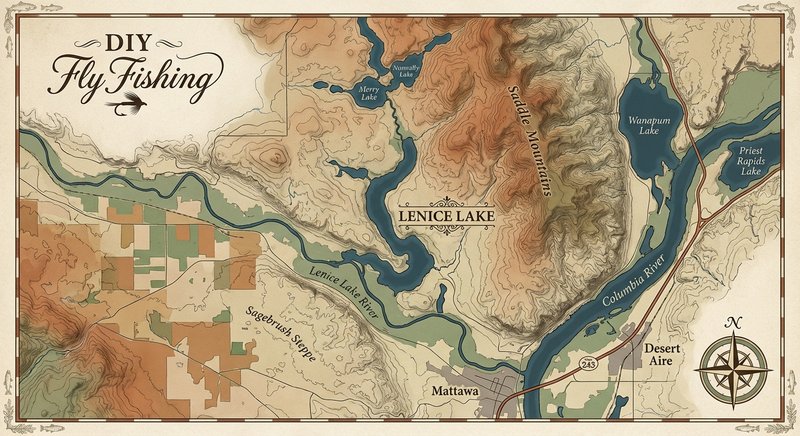
Lenice Lake
Fly fishing in Washington · Intermediate · Best seasons: Spring, Fall
Target Species
Rainbow Trout
About This Water
Eastern Washington seep lake with quality rainbow trout. Selective gear rules and excellent chironomid fishing.
Fishing Recommendations
Welcome to one of the crown jewels of Washington’s "Desert Lakes." As a guide who has spent many cold March mornings and crisp October evenings on these waters, I can tell you that Lenice Lake is a premier destination for fly anglers seeking "quality" over "quantity"—though on a good day, you can certainly have both.
Here is the professional breakdown for finding success at Lenice.
🎣 Location Overview
Located in the Seep Lakes area of Grant County, near the town of Beverly, Lenice Lake is a classic desert coulee fishery. Carved by Ice Age floods and surrounded by basalt cliffs and sagebrush, it is part of a three-lake chain (Lenice, Merry, and Nunnally).
What makes Lenice special is its alkalinity and productivity. Like a giant nutrient-rich petri dish, the lake produces staggering amounts of biomass. This results in trout that grow at an incredible rate—often gaining an inch a month during the growing season. The water is relatively shallow, filled with extensive weed beds, and is a strictly "Selective Gear" water, meaning you won't find bait casters or gas motors here. It is a quiet, soulful place built for float tubes and pontoons.
🐟 Target Species & Behavior
The primary target here is Rainbow Trout. These are often triploid fish, meaning they put all their energy into growth rather than reproduction.
- Size: Expect fish in the 16–22 inch range, with "pigs" pushing 5–7 pounds.
- Feeding Habits: Because the lake is shallow and weed-heavy, these fish are "cruisers." They follow the edges of weed lines and submerged channels.
- The Diet: Lenice is an insect factory. The fish focus heavily on Chironomids (midges), Scuds (freshwater shrimp), Damselflies, and Leeches. Because of the high fishing pressure, these trout can be surprisingly selective; they will often inspect a fly closely before committing.
📅 Best Times to Fish
Seasons
- Spring (March – Early June): This is the prime window. The lake usually opens March 1st. Early spring is all about Chironomids. As May approaches, the Damselfly migrations begin, providing some of the most exciting fishing of the year.
- Fall (September – November): As water temperatures drop, the trout move out of the deep "sump" areas and back into the shallows. They become aggressive, feeding heavily on leeches and scuds to bulk up for winter.
Time of Day
- Spring: Mid-morning to late afternoon is best. You need the sun to warm the water slightly to kick off the insect hatches.
- Fall: Early morning and the "Golden Hour" before sunset are most productive.
🪰 Recommended Flies & Techniques
1. The Indicator Rig (The "Bread and Butter")
The most effective way to fish Lenice is hanging flies under a slip-indicator.
- Flies: Chironomids (sizes 12–18). Top colors: "Chromie" (silver/red wrap), "Ice Man" (clear/white), and "Bloodworms" (deep red).
- Technique: Set your flies 6 inches to 1 foot off the bottom. Use a long leader (12–18 feet). The key is patience. The indicator should remain motionless until a fish pulls it under.
2. The Balanced Leech
- Flies: Balanced Leeches in Black, Olive, or "Bruised" (purple/black).
- Technique: These are also fished under an indicator. The "balanced" nature allows the fly to sit perfectly horizontal, mimicking a swimming leech. Give it occasional tiny twitches.
3. Stripping Streamers/Nymphs
- Flies: Olive Marabou Damselfly nymphs (spring) or Seal Buggers (fall).
- Technique: Use an intermediate (slow-sink) line. Cast toward the weed edges and use a "twist-retrieve" or short, erratic strips.
💡 Pro Tips & Local Knowledge
- The "Walk of Fame": There is a hike (about 0.5 to 0.75 miles) from the parking lot to the water. Do not try to carry your float tube inflated by hand; bring a collapsible cart or a sturdy backpack system. Your back will thank you.
- Wind Management: The Columbia Basin is notoriously windy. An anchor is not optional at Lenice; it is a requirement. Use a pyramid anchor (8–10 lbs) to keep your float tube from spinning while you fish the midges.
- The "Saddle" and the West End: The western end of the lake near the outlet and the "saddle" area between the two main basins are consistent holding spots for big fish.
- Leader Stealth: Because the water is often clear, use fluorocarbon tippet. 4X or 5X is standard. If you use 3X, you might see fish turn away at the last second.
⚠️ Important Information
- Regulations: Lenice is a Selective Gear Rules lake. This means:
- Unscented artificial flies or lures only.
- One single-point barbless hook per fly.
- No bait of any kind.
- Internal combustion motors are prohibited (electric motors are okay).
- Permits: A valid Washington State Freshwater Fishing License is required. No special vehicle permit is needed for the main lot, but a Discover Pass is generally required for WDFW lands.
- Safety: This is rattlesnake country. Be extremely careful when walking the trail, especially in the tall grass or near rock piles, during the warmer months.
- Catch & Release: While there is a harvest limit (usually 1 fish over a certain size—check current WDFW pams), the "local law" among fly anglers here is 100% Catch and Release to maintain the trophy quality of the lake.
Guide’s Final Word: Lenice is a "thinking man's" lake. If you aren't getting bites, change your depth by 6 inches before you change your fly. Precision is what separates the masters from the amateurs on this water. Tight lines!
Bug Hatches & Matching Flies
| Hatch | Type | Peak months | Time of day | Hook sizes | Matching flies |
|---|---|---|---|---|---|
| Chironomid (Midges) Chironomidae | midge | April, May, September | All Day | #12-18 | Chromie #14-16, Ice Man #12-14, Bloodworm #14-18 |
| Chironomid 'Bombers' Chironomus tentans | midge | May, June | Morning/Afternoon | #8-12 | Zebra Midge #10-12, Chan's Bomber #8-10 |
| Callibaetis (Speckled Duns) Callibaetis | mayfly | May, June, September | Mid-day | #12-16 | Hare's Ear Nymph #14-16, Parachute Adams #14-16, Callibaetis Cripple #14-16 |
| Damselfly Enallagma/Ischnura | other | June, July | Late Morning/Afternoon | #10-14 | Marabou Damsel #10-12, Adult Damsel #12-14 |
| Scud (Freshwater Shrimp) Gammarus | other | March, April, October | All Day | #12-16 | Olive Scud #12-16, Ray Charles #14-16 |
| Water Boatman / Backswimmers Corixidae / Notonectidae | other | September, October | Afternoon | #12-16 | Water Boatman #14-16, Prince Nymph #14-16 |
| Dragonfly Nymph Anisoptera | other | June, July, August | All Day | #4-10 | Gomphus #6-10, Carey Special #6-10 |
| Traveler Sedge (Great Blue Winged Sedge) Banksiola crotchi | caddis | August, September | Evening | #8-12 | Mikulak Sedge #8-10, Goddard Caddis #10-12 |
| Terrestrials (Ants/Beetles) Formicidae / Coleoptera | terrestrial | July, August, September | Afternoon | #12-16 | Black Foam Ant #14-16, Cinnamon Ant #14-16 |