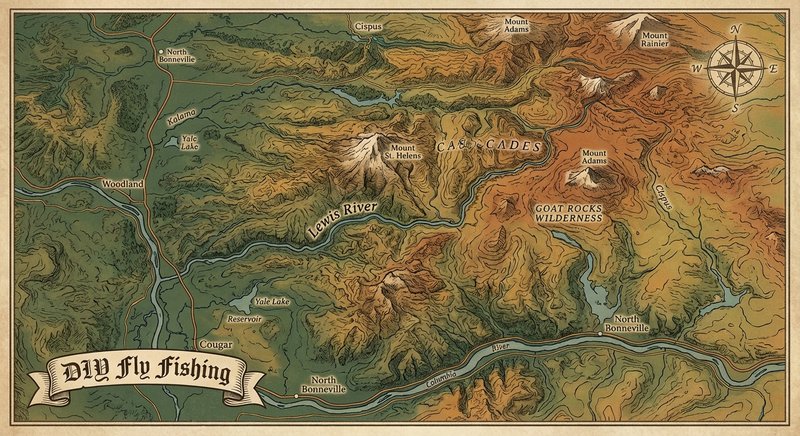
Lewis River
Fly fishing in Washington · Intermediate · Best seasons: Winter, Spring
Target Species
Steelhead, Chinook Salmon
About This Water
Southwest Washington river with excellent steelhead. Both North and East forks offer quality water.
Fishing Recommendations
As a guide who has spent years navigating the emerald waters of the Pacific Northwest, I can tell you that the Lewis River—specifically the North Fork Lewis—is one of the crown jewels of Southwest Washington. It is a powerhouse of a river, fueled by glacial melt and regulated by a series of dams, creating a consistent environment for some of the hardest-fighting salmonids in the region.
Here is your comprehensive guide to fly fishing the Lewis River for Winter Steelhead and Spring Chinook.
🎣 Location Overview
The Lewis River is a major tributary of the Columbia River. For the fly angler, the action primarily centers on the North Fork, specifically the stretch from the Merwin Dam down to the mouth.
What makes the Lewis special is its clarity and consistency. Unlike many "rain-fed" coastal rivers that blow out for weeks, the dams (Merwin, Yale, and Swift) help regulate flow and sediment. Even after a heavy storm, the Lewis is often the first river to "green up" and become fishable. The river is characterized by long, deep tailouts, walking-speed glides, and heavy "buckets" that are tailor-made for swung flies and deep nymphing.
🐟 Target Species & Behavior
Winter Steelhead
- Behavior: These are "chromers"—fresh, aggressive, and incredibly powerful. Unlike summer runs that might hold in faster ripples, winter fish tend to hug the bottom in slower, deeper "travelling lanes."
- Holding Water: Look for "walking pace" water (about 3–4 mph) that is 4 to 8 feet deep. They love the inside seams of gravel bars and the soft water just in front of or behind large boulders.
Spring Chinook (Springers)
- Behavior: Widely considered the "prize" of the PNW for their oil content and fighting ability. They enter the river in the spring but are notoriously moody. They don't "feed" in freshwater, but they strike out of aggression or territorial instinct.
- Holding Water: Springers are "depth dwellers." They hold in deep holes (10–15 feet) and move through the river in pods. They prefer the deepest slots and the "crook" of a bend where the current slows down.
📅 Best Times to Fish
Winter Steelhead
- Prime Months: Late December through March.
- Peak: February is often the "sweet spot" when the largest numbers of hatchery and wild fish overlap.
- Conditions: Look for a "dropping and clearing" trend on the hydrograph. Water temps between 42°F and 48°F are ideal.
Spring Chinook
- Prime Months: April through June.
- Peak: Mid-May is generally the height of the run.
- Conditions: Early morning is paramount. Once the sun hits the water, these fish often go deep and dormant. Overcast days are your best friend.
🪰 Recommended Flies & Techniques
For Steelhead (The Swing)
The Lewis is a premier Spey casting river.
- Technique: Use a 7 or 8-weight Spey rod with a Skagit head and T-11 or T-14 sink tips to get the fly down to the fish's eye level.
- Flies:
- Intruders: Pink/White, Blue/Black, or Chartreuse (especially in murky water).
- Prom Dress: A classic PNW flashy fly.
- Hobo Spey: In purple or black for lower, clearer water.
For Chinook (The Dredge)
Springers are difficult on a fly, but highly rewarding.
- Technique: You must get deep. Use heavy sink tips (T-17 or T-20) or "high-stick" nymphing with heavy weight.
- Flies:
- Comets: Orange or Pink with plenty of flash.
- Bunny Leeches: Large, weighted patterns in Chartreuse or Cerise.
- Flash Flies: Anything with a lot of Krystal Flash to trigger an aggression strike.
💡 Pro Tips & Local Knowledge
- The "Hatchery Hole" Mentality: The area near the Lewis River Salmon Hatchery (near Woodland) is the most productive but also the most crowded. If you are fly fishing, head slightly downstream to the long runs where you have space to swing a line without tangling with gear anglers.
- The "Inside Out" Rule: Many anglers cast as far as they can. On the Lewis, Steelhead often travel surprisingly close to the bank to avoid the heavy mid-river current. Always fish your swing all the way to the "hang down" (straight downstream) before stripping back.
- Boat vs. Wade: While there is decent wading access at Eagle Island and near the hatchery, the Lewis is best fished from a drift boat or a jet boat. This allows you to reach the "soft" side of the river that bank anglers can't get to.
- The East Fork: If you prefer a smaller, more intimate "wild" experience, check out the East Fork Lewis. It is restricted to selective gear (no bait) and is catch-and-release only for wild fish. It's a classic wading stream.
⚠️ Important Information
- Regulations: Washington Department of Fish and Wildlife (WDFW) rules are subject to emergency changes based on fish counts. Always check the WDFW "Emergency Rules" page before heading out.
- Permits: You will need a Washington Freshwater Fishing License and a "Columbia River Salmon and Steelhead Endorsement."
- Release Requirements: Wild Steelhead (intact adipose fin) must be released and cannot be removed from the water at any time.
- Access Points:
- Merwin Boat Launch: High up, near the dam.
- Lewis River Hatchery: Main access for bank and boat.
- Haapa Boat Launch: Lower river, good for Spring Chinook.
- Eagle Island State Park: Excellent for wading and side-channel exploration.
Guide’s Final Word: The Lewis is a "big shoulder" river. Come prepared with heavy tips, sharp hooks, and a lot of patience. When a Lewis River Springer or Steelhead hits your fly, it’s not a nibble—it’s an explosion. Tight lines!
Bug Hatches & Matching Flies
| Hatch | Type | Peak months | Time of day | Hook sizes | Matching flies |
|---|---|---|---|---|---|
| Blue Winged Olive Baetis spp. | mayfly | March, April, September, October | Late Morning/Afternoon | #16-22 | RS2 #18-20, Parachute Adams #16-20, Pheasant Tail #16-20 |
| March Brown Rhithrogena morrisoni | mayfly | March, April | Midday | #12-14 | March Brown Western Red #12-14, Gold Ribbed Hare's Ear #12-14, March Brown Wet Fly #14 |
| Golden Stonefly Calineuria californica | stonefly | June, July | All Day | #6-10 | Kaufmann's Stone #6-10, Chubby Chernobyl (Gold/Tan) #8-12, Pat's Rubber Legs #8-12 |
| Pale Morning Dun Ephemerella spp. | mayfly | June, July, August | Late Morning | #14-18 | Sparkle Dun #16-18, Split Case PMD #16-18, PMD Cripple #16 |
| Spotted Sedge Hydropsyche spp. | caddis | June, July, August, September | Evening | #14-18 | Elk Hair Caddis (Tan) #14-18, Pupa-tator #14-16, LaFontaine's Deep Sparkle Pupa #14-16 |
| Yellow Sally Isoperla spp. | stonefly | June, July, August | Afternoon/Evening | #14-16 | Yellow Sally Stimulator #14-16, Iron Lotus (Yellow) #16, Little Yellow Stone Nymph #14-16 |
| October Caddis Dicosmoecus gilvipes | caddis | September, October | All Day | #8-12 | Orange Stimulator #8-10, Morrish October Caddis Pupa #10-12, Peeping Caddis #10-12 |
| Little Black Stonefly Capniidae/Leuctridae | stonefly | February, March | Midday | #16-20 | Black Stimulator #18-20, Zebra Midge (Black) #18-20, Micro Stone Nymph #18 |
| Midges Chironomidae | midge | January, February, March, December | Anytime | #18-24 | Griffith's Gnat #18-22, Top Secret Midge #20-22, Black Beauty #20-24 |