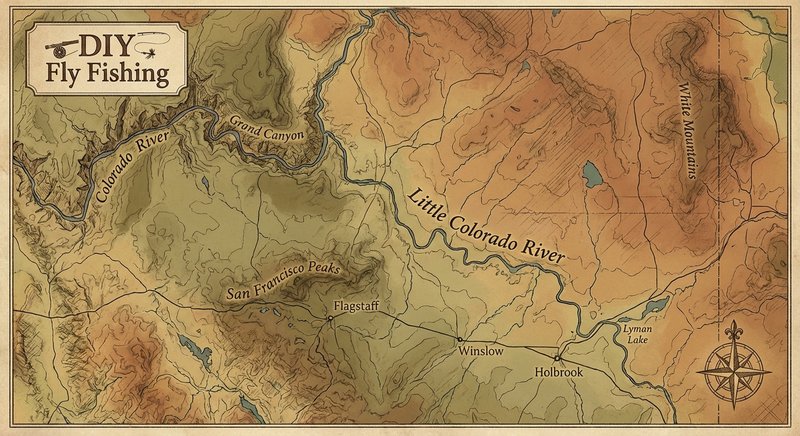
Little Colorado River
Fly fishing in Arizona · intermediate · Best seasons: summer, fall
Target Species
Apache Trout, Brown Trout
About This Water
High country stream with native Apache trout. Remote fishing in the White Mountains wilderness.
Fishing Recommendations
The Little Colorado River (LCR) in Arizona’s White Mountains is a hidden gem of the Southwest. Unlike the silt-laden lower reaches that join the Colorado River in the Grand Canyon, the headwaters near Greer, Arizona, offer high-altitude, cold-water trout fishing in a stunning alpine setting.
As your guide, here is the comprehensive breakdown for fishing the LCR.
🎣 Location Overview
The Little Colorado River headwaters flow through the high meadows and timbered canyons of the White Mountains at elevations between 8,000 and 9,500 feet. The river is divided into several forks, primarily the West Fork and the South Fork, and flows through the town of Greer.
What makes this water special is the East Fork and West Fork’s transition from meandering meadow streams to pocket water in steeper canyons. The water is generally small, crystal clear, and cold. Anglers love it because it offers a rare opportunity to catch the Apache Trout, Arizona’s state fish, in its native drainage. It is "intimate" fly fishing—short casts, stealthy approaches, and beautiful scenery.
🐟 Target Species & Behavior
- Apache Trout: This is the crown jewel. Native only to the White Mountains, they are beautiful golden fish with black spots and characteristic "masks" over their eyes. They are opportunistic feeders but can be spooky in the thin, clear meadow water.
- Brown Trout: Found primarily in the lower reaches near Greer and in the deeper pools of the canyons. These fish are more aggressive and predatory.
- Behavior: In the meadows (like Sheep’s Crossing), fish hold in the undercut banks and deep bends. In the steeper canyon sections, they hold in the "cushion" in front of boulders or in the plunge pools. Because the growing season is short, these fish are generally eager to rise to a well-presented dry fly.
📅 Best Times to Fish
Optimal Seasons
- Summer (June – August): This is prime time. While the rest of Arizona swelters, the LCR remains cool. The "Monsoon" season (July/August) brings afternoon rain, which can cloud the water slightly but often triggers massive feeding frenzies.
- Fall (September – October): My personal favorite. The aspens turn gold, the crowds disappear, and the Brown Trout become aggressive as they prepare to spawn. The Apache trout are also very active, bulking up for winter.
Best Times of Day
- Mid-Morning to Late Afternoon: At 9,000 feet, mornings are frosty. Wait for the sun to hit the water and wake up the bugs. 10:00 AM to 4:00 PM is the "Golden Window."
🪰 Recommended Flies & Techniques
Top Fly Patterns
- Dry Flies:
- Humpy (Yellow or Royal): High buoyancy for choppy water.
- Parachute Adams (Size 14-18): The gold standard for meadow sections.
- Ants and Beetles: Critical in late summer. A #16 Cinnamon Ant is deadly.
- Hoopers: Size 10-12 Dave’s Hopper or Joe’s Hopper for "Hopper-Copper-Dropper" rigs in August.
- Nymphs:
- Gold-Ribbed Hare’s Ear (#14-16): Mimics a wide variety of local nymphs.
- Pheasant Tail (#16-18): Perfect for the skinnier water.
- Prince Nymph: Provides great visibility in pocket water.
- Streamers:
- Woolly Bugger (Black or Olive, Size 10-12): Best for the deeper pools in the canyons to entice larger Browns.
Effective Techniques
- Dry-Dropper: This is the most effective way to fish the LCR. Use a buoyant dry fly as your indicator and hang a small nymph 18-24 inches below it.
- Dapping/Short Line: In the heavy brush areas, you won't be casting. You'll be "poking" your rod through the willows and dropping the fly directly onto the surface.
- Stealth: The water is clear. Wear earthy tones, stay low, and avoid casting your shadow over the pools.
💡 Pro Tips & Local Knowledge
- The "Greer Meadows" vs. The Canyons: If you want easy walking and technical dry fly fishing, fish the meadows near the Sheep’s Crossing area. If you want larger fish and solitude, hike into the West Fork canyon stretches above the meadows.
- The Monsoon Strategy: If a summer thunderstorm rolls through, wait 30 minutes for the runoff to subside slightly. Fish a large terrestrial or a flashy nymph; the fish expect worms and bugs to be washed into the stream.
- Light Tackle: Leave your 5-weight at home. This is 2-weight or 3-weight territory. A 7.5-foot rod is ideal for navigating the thick willows.
⚠️ Important Information
Access
- Sheep’s Crossing: Easy access off Forest Service Road 113. Great for beginners.
- Mount Baldy Wilderness: Requires hiking. The West Fork trail offers miles of pristine water but requires a physical commitment.
Regulations & Permits
- License: An Arizona Fishing License is required for all anglers 10 and older.
- Special Rules: Portions of the LCR and its tributaries are Catch and Release Only or have specific lure restrictions (Artificial Lure and Fly Only). Always check the current Arizona Game and Fish Department (AZGFD) regulations, as some areas are closed to protect pure-strain Apache Trout recovery.
- Tribal Lands: Note that the river flows near the White Mountain Apache Tribe boundary. Fishing on tribal land requires a separate tribal permit. Make sure you know exactly where you are on the map.
Safety
- Monsoons: Lightning is a serious threat on the high plateaus. If you hear thunder, get off the water and away from tall trees.
- Wildlife: This is bear and elk country. Keep a clean camp and give the elk plenty of space, especially during the fall rut.
Bug Hatches & Matching Flies
| Hatch | Type | Peak months | Time of day | Hook sizes | Matching flies |
|---|---|---|---|---|---|
| Blue Winged Olive Baetis spp. | mayfly | March, April, September, October | Late Morning/Afternoon | #18-22 | Parachute Adams #18-22, RS2 #20-22, Pheasant Tail #18-20 |
| Pale Morning Dun Ephemerella dorothea infrequens | mayfly | June, July | Late Morning | #14-18 | PMD Sparkle Dun #16-18, Trigger Finger PMD #14-16, Military Mayfly #16-18 |
| Spotted Sedge Hydropsyche spp. | caddis | June, July, August | Evening | #14-16 | Elk Hair Caddis #14-16, LaFontaine's Deep Sparkle Pupa #14-16, Goddard Caddis #14-16 |
| Yellow Sally Isoperla spp. | stonefly | June, July | Afternoon/Evening | #14-16 | Yellow Sally Foam Dry #14-16, Iron Lotus #14-16 |
| Midges Chironomidae | midge | January, February, March, December | All Day | #20-26 | Zebra Midge #20-24, Griffith's Gnat #20-22, Mercury Midge #20-22 |
| Grasshoppers Melanoplus spp. | terrestrial | August, September | Late Morning/Afternoon | #8-12 | Morrish Hopper #10-12, Dave's Hopper #8-12, Amy's Ant #10-12 |
| Trico Tricorythodes spp. | mayfly | August, September | Early Morning | #20-24 | Trico Spinner #22-24, Sunken Trico Spinner #22-24 |
| Golden Stonefly Hesperoperla pacifica | stonefly | May, June | Morning/Evening | #8-12 | Pats Rubber Legs #8-12, Golden Rogue Stone #8-10 |