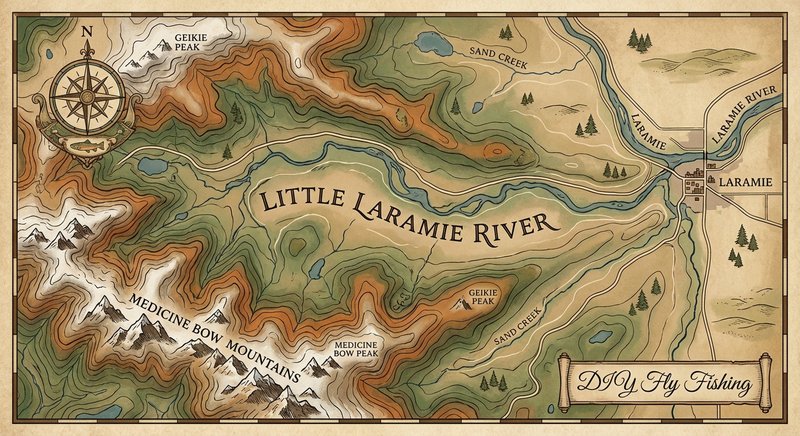
Little Laramie River
Fly fishing in Wyoming · Beginner · Best seasons: Summer, Fall
Target Species
Brown Trout, Rainbow Trout
About This Water
Southeast Wyoming stream with brown and rainbow trout. Accessible fishing near Laramie.
Fishing Recommendations
The Little Laramie River is one of Wyoming’s best-kept secrets, often overshadowed by its larger sibling, the Big Laramie, and the nearby North Platte. Flowing out of the Snowy Range and meandering through the high-altitude hay meadows of the Laramie Valley, this is a quintessential "meadow creek" experience. It offers technical, rewarding fishing for wild, buttery Brown Trout and hard-fighting Rainbows.
🎣 Location Overview
The Little Laramie is a classic serpentine river characterized by tight oxbow bends, deep undercut banks, and gravel riffles. What makes it special is its intimate nature—this is not a river you float; it’s a river you stalk.
The water is generally tea-colored due to the surrounding ranch land and peat-heavy soils. Because it flows through private ranch land for much of its length, the public access points feel exclusive and see significantly less pressure than other Western rivers. Anglers love it for the "big fish in small water" potential; it is not uncommon to pull a 20-inch Brown out of a hole no wider than a dinner table.
🐟 Target Species & Behavior
- Brown Trout: The dominant species. They are predatory and highly territorial. They live for the undercut banks. On the Little Laramie, Browns behave like ghosts—they stay tucked under the grass banks during bright sun and move into the shallows to feed during low light or overcast conditions.
- Rainbow Trout: Found more frequently in the faster riffles and the heads of pools. They tend to be more opportunistic feeders than the Browns and will often look up for dries even when there isn't a massive hatch.
Feeding Behavior: These fish are highly keyed into Terrestrials (grasshoppers, beetles, ants) in the summer and Small Nymphs (baetis and midges) year-round. Because the river is relatively shallow, fish are very spooky; a heavy footstep on the bank can send a shockwave through the water that shuts down a hole for an hour.
📅 Best Times to Fish
- Summer (July – August): This is the "Hopper-Copper-Dropper" window. Once the hay is tall in the surrounding meadows, the terrestrial fishing is world-class.
- Fall (September – October): My personal favorite. The Brown Trout become aggressive as they prepare for the spawn. The crowds (which are already small) disappear, and the cottonwoods turn gold.
- Best Time of Day:
- Summer: Early morning for tricos/nymphing, or late evening for the caddis flight.
- Fall: Mid-day (11:00 AM – 3:00 PM) when the water warms up just enough to activate the bugs.
- Prime Conditions: Overcast days are "magic" on the Little Laramie. The lack of shadows gives the fish confidence to leave the undercut banks and hunt in open water.
🪰 Recommended Flies & Techniques
Top Fly Patterns
- Dry Flies: Fat Albert (Tan/Pink #10-14), Amy’s Ant (#12), Parachute Adams (#16-20), Elk Hair Caddis (#14-18), and Trico Spinners (#20-22) for summer mornings.
- Nymphs: Copper John (#16-18), Prince Nymph (#14-16), Juju Baetis (#18-22), and San Juan Worms (especially after a rain).
- Streamers: Gold or Olive Slumpbusters (#8), Woolly Buggers (Black/Thin Mint), and small articulated patterns like the Mini Sex Dungeon (Natural/Olive).
Effective Techniques
- The "Tight-Line" Bank Drop: When fishing hoppers, you want your fly to land with a "splat" within 2 inches of the grassy bank. Often, the strike occurs the micro-second the fly hits the water.
- Duo-Rig (Hopper-Dropper): Use a buoyant foam hopper as your indicator and hang a bead-head nymph 18-24 inches below it. This covers two zones in the shallow water.
- Streamer Stripping: Cast downstream and across, swinging the streamer right into the "dark water" under the overhanging grass.
💡 Pro Tips & Local Knowledge
- Stay Off the Skyline: The banks are flat. If you stand tall on the edge of the bank, the fish will see your silhouette against the sky from 30 feet away. Kneel or stay back 5 feet from the water's edge.
- Focus on the Bends: Every sharp turn in the river creates a deep pool on the outside and a shallow point bar on the inside. The "bucket" at the tail-out of these bends is where the largest Browns often sit.
- The "Hopper Twitch": Don't just let your grasshopper pattern drift dead. Give it a tiny, rhythmic twitch to mimic a drowning insect. It often triggers a violent reaction.
- Wading: The bottom can be "mucky" in spots. Stick to the gravel bars when possible to avoid clouding up the water for yourself downstream.
⚠️ Important Information
- Access: Much of the Little Laramie is private. However, there are excellent Wyoming Game & Fish Public Access Areas (look for the "Yellow Signs"). The Monolith Access and the Wild Horse Access are two of the most popular. Always respect private property boundaries; Wyoming trespass laws are strict.
- Regulations: Check the current Wyoming Game & Fish Department (WGFD) regulations. Generally, it is a 6-fish limit, but most serious anglers practice 100% Catch and Release here to preserve the wild trout population.
- Wind: This is Wyoming. The wind will blow. Bring a 5-weight or 6-weight rod with a fast action to punch through the gusts.
- Permits: You need a valid Wyoming Fishing License and a Conservation Stamp. These can be purchased online or at any fly shop in Laramie.
Expert Advice: If you are in the area, stop by the local fly shops in Laramie. They are the best source for "up to the minute" hatch info and water flow updates. Bring plenty of water and sunblock—the high altitude (7,000ft+) will burn you and dehydrate you faster than you realize.
Bug Hatches & Matching Flies
| Hatch | Type | Peak months | Time of day | Hook sizes | Matching flies |
|---|---|---|---|---|---|
| Blue Winged Olive Baetis spp. | mayfly | April, May, September, October | Midday | #18-22 | RS2 #18-22, Parachute Adams #18-22, Pheasant Tail #18-20 |
| Pale Morning Dun Ephemerella excrucians | mayfly | June, July | Late Morning/Early Afternoon | #14-18 | PMD Sparkle Dun #16-18, Split Case PMD #16-18, Quigley Cripple #14-16 |
| Trico Tricorythodes | mayfly | July, August, September | Early Morning | #20-24 | Trico Spinner #20-24, Sunken Trico #20-22 |
| Mother's Day Caddis Brachycentrus occidentalis | caddis | May | Afternoon | #14-16 | Peacock Caddis #14-16, Guide's Choice Hare's Ear #14-16 |
| Yellow Sally Isoperla spp. | stonefly | June, July | Late Afternoon/Evening | #14-16 | Little Yellow Sloan #14-16, Iron Lotus #16 |
| Grasshoppers Orthoptera | terrestrial | August, September | Late Morning through Evening | #8-12 | Amy's Ant #10-12, Fat Albert #8-12, Morrish Hopper #10-12 |
| Spotted Sedge Hydropsyche spp. | caddis | July, August, September | Evening | #14-18 | Elk Hair Caddis #14-18, LaFontaine's Deep Sparkle Pupa #14-16 |
| Midges Chironomidae | midge | March, April, October, November | Anytime | #18-24 | Zebra Midge #18-22, Griffith's Gnat #20-22, Top Secret Midge #20-24 |