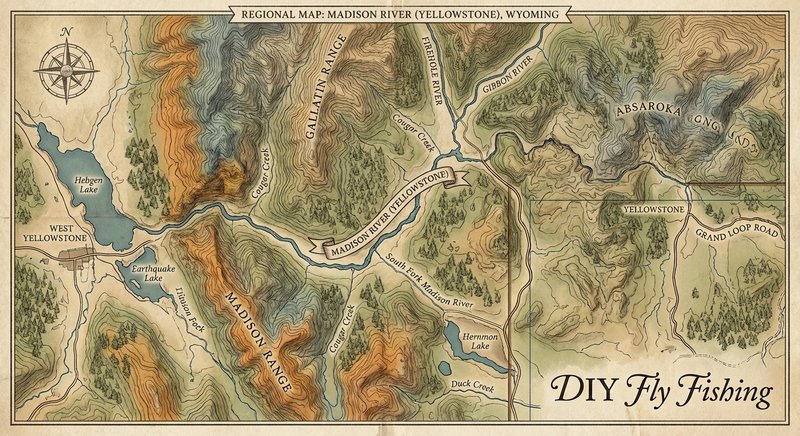
Madison River (Yellowstone)
Fly fishing in Wyoming · Intermediate · Best seasons: Summer, Fall
Target Species
Rainbow Trout, Brown Trout
About This Water
The section within Yellowstone National Park offers excellent fishing in pristine wilderness.
Fishing Recommendations
The Madison River within Yellowstone National Park is hallowed ground for fly fishers. Unlike the "Fifty Mile Riffle" section downstream in Montana, the Park section of the Madison is a classic meadow river—winding, subtle, and profoundly influenced by the geothermal activity of the Geyser Basins.
Here is your guide to fishing the Madison River from Madison Junction to the Wyoming/Montana state line.
🎣 Location Overview
The Madison River begins at the confluence of the Firehole and Gibbon Rivers at Madison Junction. From there, it flows west through a picturesque valley characterized by sweeping meadows, timbered hillsides, and the constant presence of bison and elk.
What makes this water special is its thermal influence. Because the Firehole River is fed by geysers, the Madison stays warmer than most mountain rivers. This leads to incredible insect biomass but also means the river can become too warm for trout in the peak of mid-summer (July). Anglers love it for its "big water" feel in a meadow setting, offering world-class dry fly opportunities and the legendary fall run of migratory lake trout.
🐟 Target Species & Behavior
- Rainbow Trout: Known for their aerial acrobatics, these fish are found in the swifter riffles and at the heads of pools. During the summer, they key in on heavy hatch cycles.
- Brown Trout: The "residents" hide under undercut banks and near submerged woody debris. However, the Madison is most famous for its migratory Brown Trout. In the fall, massive browns move up from Hebgen Lake into the Park to spawn, providing a chance at a trophy fish of a lifetime.
- Behavior: These fish are "PhD trout." They see a lot of flies. They hold in the "seams" between the fast current and the slow meadow water. During hatches, they move into surprisingly shallow water (sometimes only 6 inches deep) to sip duns.
📅 Best Times to Fish
Optimal Seasons
- Early Summer (June): Once the park opens (usually late May), the Madison can be great before the thermal heat kicks in. Look for the Salmonfly hatch in late June.
- Fall (September - October): This is the Prime Window. As water temperatures drop, the fish become active again, and the Hebgen Lake run begins.
Best Times of Day
- Summer: Early morning (6:00 AM – 10:00 AM) and late evening. Avoid the "mid-day doldrums" when water temps peak.
- Fall: The opposite—bank on the "heat" of the day (10:00 AM – 4:00 PM) for the best insect activity and aggressive strikes.
Prime Fishing Windows
The "Golden Fortnight" (last two weeks of September and first week of October) is arguably the best time to be on the Madison for the combination of fall colors, bugling elk, and big migratory trout.
🪰 Recommended Flies & Techniques
Top Fly Patterns
- Dries: Sparkle Dun (PMD or BWO), Parachute Adams (#16-20), Chubby Chernobyl (Gold/Orange #8-12) for the Salmonfly or hopper season.
- Nymphs: Pat’s Rubber Legs (Brown/Black), Pheasant Tail (#16-18), Zebra Midge (Red/Black #18-22).
- Streamers (The Fall Staple): Woolly Buggers (Olive/Black), Peanut Envy, and the Barron’s Soft Hackle or Partridge & Orange (swinging soft hackles is a local tradition here).
Effective Techniques
- The "Swing": Especially in the fall, swinging soft hackles or small streamers on a down-and-across presentation is deadly. It mimics emerging insects or small baitfish.
- Technical Nymphing: Use a long leader (9-12ft) with a small, subtle strike indicator. The water is clear, and the fish are spooky.
- Dry-Dropper: During the summer, a hopper with a small dropper nymph is the most efficient way to cover the meadow bends.
Presentation Tips
Reach Casts are mandatory. The Madison has complex micro-currents. If your fly drags for even a millisecond, the fish will refuse it. Always mend upstream immediately upon the fly hitting the water.
💡 Pro Tips & Local Knowledge
- The "Thermal Trap": In July and August, the water can hit 70°F. If the water feels warm to the touch, stop fishing. It’s lethal for the trout. Move to the higher-altitude Gallatin or the Gardner rivers instead.
- Focus on the "Bucks": In the fall, look for the darker water in the bends. The big lake-run browns aren't usually in the shallow riffles; they are resting in the deep holes before moving up to the Firehole or Gibbon.
- Soft Hackle Secret: If the fish are rising but won't take your dry fly, they are likely taking "emergers" just under the surface. Swing a size #16 Partridge and Orange just a few inches under the film.
⚠️ Important Information
- Permits: You need a Yellowstone National Park Fishing Permit. A state license (Wyoming or Montana) is not valid inside the park boundaries. You can buy these online or at ranger stations.
- Regulations: The Madison in the Park is Catch and Release only. Use barbless hooks only (pinch your barbs). Lead weights/split shot are prohibited.
- Wading Safety: The Madison has a slick, "cobblestone" bottom. Felt soles or studs are highly recommended. Be mindful of the "quicksand" silt in certain meadow stretches.
- Wildlife: This is prime Grizzly and Bison habitat. Always carry bear spray, stay at least 100 yards from bears/wolves and 25 yards from bison. If a bison enters the river where you are fishing, give them the right of way!
Bug Hatches & Matching Flies
| Hatch | Type | Peak months | Time of day | Hook sizes | Matching flies |
|---|---|---|---|---|---|
| Blue Winged Olive Baetis | mayfly | April, May, September, October | Late Morning/Afternoon | #18-22 | Parachute Adams #18-22, BWO Sparkle Dun #18-20, Pheasant Tail Nymph #18-22 |
| Salmonfly Pteronarcys californica | stonefly | June, July | All Day | #2-6 | Rogue Stone #4-6, Sofa Pillow #6-8, Pat's Rubber Legs #4-8 |
| Pale Morning Dun Ephemerella excrucians | mayfly | June, July, August | Morning/Early Afternoon | #14-18 | PMD Sparkle Dun #16-18, RS2 #16-18, Military Mayfly #16-18 |
| Golden Stonefly Hesperoperla pacifica | stonefly | June, July | Afternoon/Evening | #8-12 | Kaufmann's Stimulator #8-12, Golden Chubby Chernobyl #10-12, 20 Incher #8-12 |
| Spotted Sedge Hydropsyche | caddis | July, August, September | Evening | #14-18 | Elk Hair Caddis #14-16, LaFontaine's Sparkle Pupa #14-18, Iris Caddis #16-18 |
| White Miller Caddis Nectopsyche | caddis | August | Late Afternoon/Evening | #14-16 | White Elk Hair Caddis #14-16, White God-Light Caddis #14-16 |
| Grasshoppers Acrididae | terrestrial | August, September | Late Morning/Afternoon | #8-14 | Morrish Hopper #10-12, Dave's Hopper #8-12, Parachute Hopper #12-14 |
| Midges Chironomidae | midge | March, April, October, November | Late Morning/Afternoon | #18-24 | Zebra Midge #18-22, Griffith's Gnat #18-22, Mother's Day Midge #20-24 |