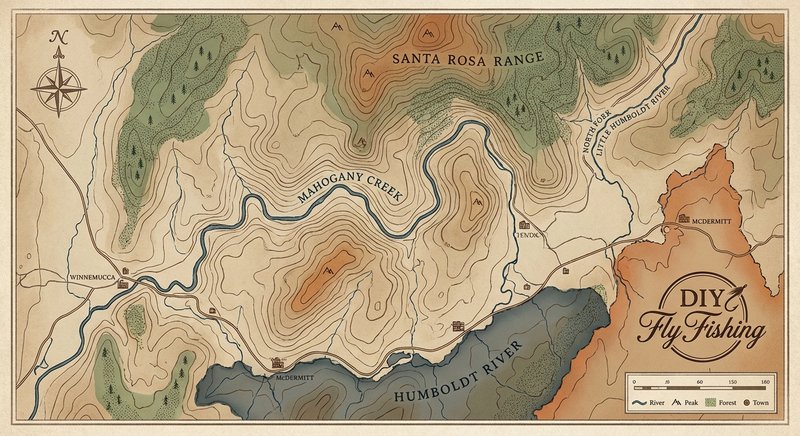
Mahogany Creek
Fly fishing in Nevada · advanced · Best seasons: summer, fall
Target Species
Lahontan Cutthroat Trout
About This Water
Santa Rosa Range stream with Lahontan cutthroat. Remote northwestern Nevada.
Fishing Recommendations
Mahogany Creek is a hidden gem tucked away in the high desert of the Summit Lake Indian Reservation and the Black Rock Desert-High Rock Canyon Emigrant Trails National Conservation Area in northwestern Nevada. This is one of the most critical recovery streams for the rare, native Lahontan Cutthroat Trout (LCT).
As your guide, I’m taking you to a place that feels like a time capsule. This is small-stream desert fly fishing at its most raw and rewarding.
🎣 Location Overview
Mahogany Creek is a high-elevation desert stream flowing through a rugged canyon landscape. What makes it special is its pedigree: it is one of the few places where you can find genetically pure, self-sustaining populations of Lahontan Cutthroat Trout.
The water is characterized by its small size—often only 5 to 12 feet wide—with a high gradient in sections and classic pool-riffle-run sequences in others. It is heavily lined with willow, wild rose, and mountain mahogany (hence the name), making casting a tactical challenge. Anglers love it because it offers a "blue-line" adventure in a state better known for neon lights and arid playas. It is the definition of "skinny water" fishing.
🐟 Target Species & Behavior
The primary (and only) target here is the Lahontan Cutthroat Trout (LCT).
- Behavior: These fish are opportunistic but wary. Because this is a high-desert environment with limited food resources, they are generally eager to rise to a well-presented fly. However, in the crystal-clear, shallow water, they are incredibly "spooky." If they see your shadow or feel the vibration of a heavy footstep, the pool is finished.
- Where they hold: Look for them in the "head of the pool" where oxygen is highest, or tucked deep under the undercut banks and overhanging willow branches. In the fall, they will drop into the deeper, slower pools to conserve energy.
- Feeding: Their diet consists mainly of caddis, small mayflies, and a significant amount of terrestrials (ants, beetles, crickets) that fall from the dense riparian vegetation.
📅 Best Times to Fish
While you can technically fish here whenever the roads are passable, the window is narrow.
- Summer (July - August): This is the prime window for dry fly action. The water levels stabilize after the spring runoff. Note: It can get very hot; fish early in the morning and late in the evening. Monitor water temperatures—if the water hits 68°F, give the fish a break.
- Fall (September - October): My personal favorite. The air cools down, the willows turn gold, and the trout begin feeding aggressively to bulk up for winter. The LCT often show more vivid colors during this time.
- Time of Day: In the summer, the "Golden Hour" (first and last light) is king. In the fall, mid-day fishing is excellent as the sun warms the water and activates insect life.
🪰 Recommended Flies & Techniques
Top Fly Patterns
- Dry Flies:
- Royal Wulff or Humpy (#14-16): High visibility and buoyant—perfect for choppy pocket water.
- Elk Hair Caddis (#14-18): A staple for Nevada desert streams.
- Parachute Adams (#16-20): For when the fish are being picky during a BWO hatch.
- Terrestrials:
- Black Ants (#16-18): Essential. Mahogany Creek fish love ants.
- Dave’s Hopper or Foam Beetles (#12-14): Great for "splatting" against the banks.
- Nymphs:
- Pheasant Tail (#16-18): Works year-round.
- Gold-Ribbed Hare’s Ear (#16): Great for imitating various larvae.
Techniques & Presentation
- The "Bow and Arrow" Cast: Because of the dense brush, you will rarely make a traditional overhead cast. Master the bow-and-arrow cast to flick your fly into tight pockets under willows.
- Small Stream Stealth: Stay low. Kneel on the bank. Cast from well behind the pool. Wear earth-toned clothing (greens and browns) to blend into the sagebrush and mahogany.
- Dry-Dropper: Use a buoyant dry fly (like a Stimulator) with a small, unweighted nymph 12–18 inches below it. This covers both bases without snagging the shallow bottom too often.
💡 Pro Tips & Local Knowledge
- Focus on the Under-Cuts: The largest fish in Mahogany Creek are almost always under the banks. If your fly isn't within two inches of the bank, you’re missing the "honey hole."
- The "Dapping" Method: Sometimes the brush is so thick you can’t cast at all. Simply poke your rod tip through the leaves and drop the fly onto the surface, dancing it like a trapped insect.
- Be Bear Aware: While rare, black bears do inhabit these canyons. More commonly, keep an eye out for rattlesnakes in the tall grass near the water.
- Travel Prepared: This is a very remote area. Bring a full-sized spare tire, extra gas, and plenty of water. There is zero cell service.
⚠️ Important Information
Access
Mahogany Creek is located in the Summit Lake Basin. Much of the creek is within the Summit Lake Indian Reservation.
- Crucial Note: You must respect tribal boundaries. Fishing is generally restricted to the sections of the creek located on BLM land outside the reservation. Always check a high-quality map (like OnX or Gaia GPS) to ensure you are on public land.
Regulations & Permits
- Nevada Fishing License: Required for all anglers.
- Barbless Hooks Only: These fish are fragile and part of a sensitive recovery effort. Use barbless hooks and handle fish with wet hands, keeping them in the water as much as possible.
- Catch and Release: While regulations may vary by year, it is strongly encouraged (and often mandated) to practice 100% catch and release for Lahontan Cutthroats in this drainage to protect the population.
Special Considerations
The road to Mahogany Creek (usually via Leonard Creek Road) is rugged. A high-clearance 4WD vehicle is non-negotiable. If it rains, these roads turn into "greasewood gumbo"—slick mud that can trap even the best rigs. Always check the weather forecast before heading into the canyon.
Bug Hatches & Matching Flies
| Hatch | Type | Peak months | Time of day | Hook sizes | Matching flies |
|---|---|---|---|---|---|
| Blue-Winged Olive (BWO) Baetis tricaudatus | mayfly | April, May, September, October | Mid-day | #18-22 | RS2 #18-22, Parachute Adams #18-22, Pheasant Tail Nymph #18-20 |
| Pale Morning Dun (PMD) Ephemerella excrucians | mayfly | June, July | Late Morning to Afternoon | #14-18 | PMD Sparkle Dun #16-18, Mercer's Poxy Back PMD #16-18, Quigley Cripple #16 |
| Golden Stonefly Hesperoperla pacifica | stonefly | June, July | Morning/Evening | #8-12 | Rogue River Stone #8-10, Pat's Rubber Leg #8-12, Golden Stimulator #10-12 |
| Little Brown Sedge Lepidostoma | caddis | July, August, September | Evening | #14-18 | Elk Hair Caddis #14-16, LaFontaine's Deep Sparkle Pupa #14-18, Goddard Caddis #14-16 |
| Mahogany Dun Paraleptophlebia | mayfly | September, October | Afternoon | #16-18 | Mahogany Dun Sparkle Dun #16-18, Pheasant Tail #16-18 |
| Grasshoppers Melanoplus | terrestrial | August, September | All Day | #8-12 | Morrish Hopper #8-12, Parachute Hopper #10-12, Amy's Ant #10-12 |
| Black Carpenter Ant Camponotus | terrestrial | June, July, August | Afternoon | #12-16 | Chernobyl Ant #12-14, Black Foam Ant #14-16 |
| Midges Chironomidae | midge | March, April, November | Morning/Afternoon | #20-24 | Zebra Midge #20-22, Griffith's Gnat #20-24, Top Secret Midge #20-22 |