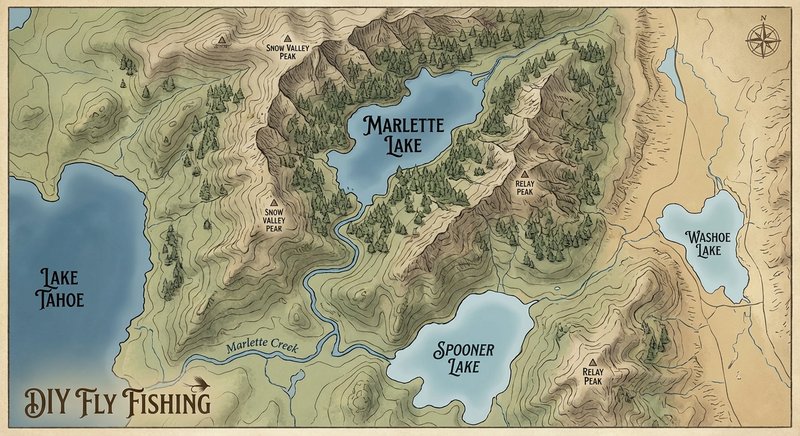
Marlette Lake
Fly fishing in Nevada · advanced · Best seasons: summer, fall
Target Species
Lahontan Cutthroat Trout, Rainbow Trout
About This Water
Backcountry lake requiring hike. Remote fishing in Tahoe basin.
Fishing Recommendations
Welcome to one of the crown jewels of the Sierra Nevada. As your guide, I can tell you that Marlette Lake is not just a fishing destination; it is a high-altitude sanctuary. Perched at 7,841 feet above Lake Tahoe, this is a "hike-in" fishery that rewards effort with some of the most beautiful Lahontan Cutthroat Trout in the world.
Here is your comprehensive guide to fly fishing Marlette Lake.
🎣 Location Overview
Marlette Lake is a man-made reservoir with a backcountry feel, located within the Lake Tahoe Basin Management Unit and Spooner Backcountry (Lake Tahoe Nevada State Park). What makes it special is its role as a broodstock lake. The Nevada Department of Wildlife (NDOW) uses this lake to collect eggs from Lahontan Cutthroat Trout (LCT) to stock other waters across the state.
The water is crystal clear, cold, and surrounded by granite boulders and stands of lodgepole pine and aspen. Because it requires a significant hike or bike ride to reach, the fishing pressure is relatively low compared to the easily accessible Tahoe shores. It is a stillwater angler's dream, offering a classic alpine experience with trophy potential.
🐟 Target Species & Behavior
- Lahontan Cutthroat Trout (LCT): The stars of the show. These are native to the Great Basin. They are opportunistic feeders but can be notoriously moody. They often cruise the drop-offs and "flats" near the dam or the western shore.
- Rainbow Trout: While the LCT are the primary focus, the lake holds healthy, hard-fighting Rainbows. They tend to be slightly more aggressive than the Cutthroats and often hold near submerged timber or rocky ledges.
Behavior: During the summer, fish retreat to the deeper, cooler channels during the midday sun. In the fall, they move back into the shallows to cruise the edges, looking to bulk up for winter.
📅 Best Times to Fish
- Optimal Seasons:
- Summer (July – August): Great for consistent dry fly action in the mornings and evenings.
- Fall (September – October): This is the prime window. As the water cools, the large Lahontans move into the shallows. The aspen trees turning gold provide a spectacular backdrop.
- Best Times of Day:
- Early Morning: First light until about 10:00 AM offers the calmest water for sight-casting.
- Late Evening: The "magic hour" before sunset often triggers a significant midge or caddis hatch.
- Prime Conditions: A "Tahoe Chop" (light wind rippling the surface) is actually your friend here. It breaks up the surface tension and makes the fish less spooky in the gin-clear water.
🪰 Recommended Flies & Techniques
Top Fly Patterns
- Midges: Zebra Midges (size 18-22) in black/silver or red.
- Terrestrials: Ants and Beetles (size 14-16). In late summer, a foam Carpenter Ant is deadly.
- Streamers: Woolly Buggers (size 8-12) in olive, black, or "Peacock." Also, the Balance Leech under a indicator.
- Dries: Parachute Adams (16-20), Elk Hair Caddis (14-16), and Griffith’s Gnat.
- Nymphs: Pheasant Tail (16-18) and Hare’s Ear.
Effective Techniques
- The "Indicator Rig": Suspend a Balance Leech or a Zebra Midge 4 to 8 feet below an indicator. Let the wave action provide the movement. This is the most consistent producer for LCT.
- Sight Casting: On calm days, walk the banks slowly. Look for the "cruisers." Cast your fly (usually a dry or a lightly weighted nymph) 5 feet in front of their path.
- Stripping Streamers: Use a slow-sinking line or a long leader on a floating line. Use erratic, short strips to mimic the small baitfish or leeches in the lake.
💡 Pro Tips & Local Knowledge
- The "Dam" Area: The area near the dam is a popular starting point, but the western shore has more complex underwater structures (boulders and logs) where the larger fish like to ambush prey.
- The Hike Factor: It is roughly a 5-mile hike (one way) with 1,200 feet of elevation gain from Spooner Lake. Mountain biking is the pro move—it allows you to reach the lake faster and save your legs for wading.
- Stealth is Key: Because the water is so clear, these fish can see you from a long way off. Avoid wearing bright colors, stay low on the banks, and try to avoid "lining" the fish (casting your fly line directly over their heads).
- Float Tubes: If you are feeling ambitious, packing in a lightweight float tube (like a belly boat) is a game changer. It allows you to reach the drop-offs that are just out of casting range from the shore.
⚠️ Important Information
- Access: Park at Spooner Lake State Park (fee required). Follow the North Canyon Road. It is a strenuous hike/bike.
- Regulations (CRITICAL):
- Season: Open from July 15 through October 31 only.
- Catch and Release ONLY.
- Artificial Lures and Flies ONLY (No bait allowed).
- Single barbless hooks only. (Crimp those barbs!)
- Permits: You need a valid Nevada Fishing License. If you are coming from the California side, your CA license is not valid here; Marlette is entirely within Nevada.
- Wildlife: This is bear and mountain lion country. Carry water, sun protection, and be bear-aware.
Guide’s Final Thought: Marlette is a place for the patient angler. You might not catch 50 fish, but the ones you do catch will be vibrant, wild-looking, and set against one of the most beautiful vistas in the American West. Respect the fish, barbless hooks only, and enjoy the silence.
Bug Hatches & Matching Flies
| Hatch | Type | Peak months | Time of day | Hook sizes | Matching flies |
|---|---|---|---|---|---|
| Callibaetis (Speckled Duns) Callibaetis ferrugineus | mayfly | June, July, August | Late Morning/Early Afternoon | #12-16 | Parachute Adams #14-16, Callibaetis Nymph #14-16, Quigley Cripple #14-16 |
| Chironomids (Midges) Chironomidae | midge | May, June, September | All Day | #14-22 | Zebra Midge #16-20, Ice Cream Cone #14-18, Griffith's Gnat #18-22 |
| Blue Damselflies Enallagma spp. | terrestrial | June, July | Late Morning/Afternoon | #10-14 | Marabou Damsel Nymph #10-14, Braided Butt Damsel #12-14 |
| Carpenter Ants Camponotus spp. | terrestrial | June, August | Afternoon | #10-14 | Black Foam Ant #12-14, Flying Ant #12-16 |
| Cinnamon Caddis Hydropsyche spp. | caddis | July, August | Evening | #14-18 | Elk Hair Caddis #14-16, LaFontaine's Deep Sparkle Pupa #14-16 |
| Water Boatmen Corixidae | terrestrial | September, October | All Day | #14-18 | Water Boatman #14-16, Prince Nymph (small) #16-18 |
| Little Black Stonefly Capniidae | stonefly | May, June | Afternoon | #14-18 | Kaufmann's Mini Stone #16-18, Stimulator (Black) #16 |
| Terrestrial Beetles Coleoptera | terrestrial | July, August | Afternoon | #12-16 | Foam Beetle #12-16, Peacock Beetle #14-16 |