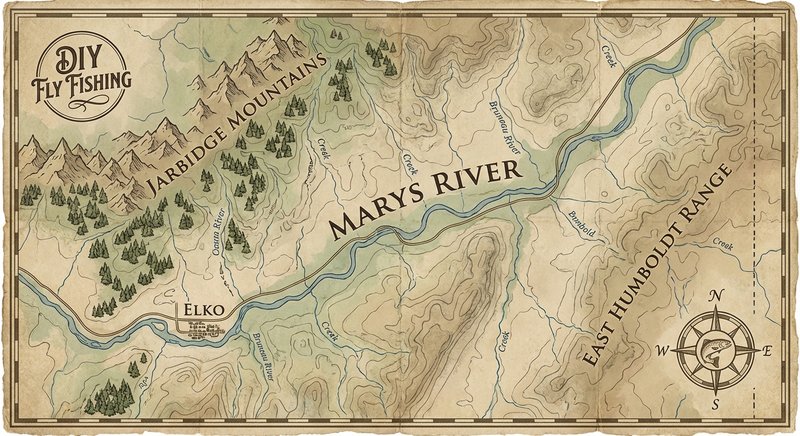
Marys River
Fly fishing in Nevada · intermediate · Best seasons: spring, summer, fall
Target Species
Lahontan Cutthroat Trout, Brown Trout
About This Water
Elko County stream with Lahontan cutthroat restoration. Quality wild trout fishing.
Fishing Recommendations
The Marys River is one of Nevada’s hidden gems, tucked away north of Wells in the high desert of Elko County. It is a place of solitude, rugged beauty, and a rare opportunity to catch native trout in a quintessential Great Basin environment.
As your guide, I’m taking you into a landscape where the mountains meet the sagebrush. Here is your comprehensive guide to fly fishing the Marys River.
🎣 Location Overview
The Marys River is a remote, high-desert spring-fed stream that originates in the Jarbidge Mountains. It meanders through wide, sagebrush-filled basins and tight willow-lined canyons.
What makes it special is its status as a stronghold for the native Lahontan Cutthroat Trout (LCT). Unlike many western rivers that have been heavily modified, the Marys still feels wild. The water is generally clear and cool, characterized by deep undercut banks, sweeping meadow bends, and occasional beaver pond complexes. This is "small water" fishing at its finest, where stealth and presentation outweigh long-distance casting.
🐟 Target Species & Behavior
The Marys River is a sanctuary for two primary species:
- Lahontan Cutthroat Trout (Native): These are the stars of the show. LCT in the Marys are opportunistic but extremely wary. They have evolved to survive in a harsh environment. They typically hold in the deepest parts of the pools, tight against undercut banks, or tucked under overhanging willows.
- Brown Trout: Found more frequently in the middle and lower reaches. They are aggressive and territorial. During the fall, the larger Browns become more active and will move out of deep holes to strike at larger profiles.
Behavior Note: Because the water is often shallow and very clear, these fish have a high "spook factor." If they see your shadow or feel the vibration of a heavy footfall on the bank, the fishing is over for that hole.
📅 Best Times to Fish
The window for the Marys River is dictated by snowmelt and road access.
- Spring (Late May – June): This is the tail-end of runoff. As the water clears and drops, the fish are hungry. High-water nymphing is effective. Note: Roads can be muddy and impassable during early spring.
- Summer (July – August): Prime Time. This is the season for dry flies and terrestrials. The mornings are cool, but midday heat can be intense. Focus on the oxygenated "riffle-into-pool" transitions.
- Fall (September – October): This is arguably the best time for seasoned anglers. The air is crisp, the willows turn gold, and the Brown Trout begin their pre-spawn aggression. The water is at its lowest, requiring the ultimate stealth.
Best Time of Day: During the summer, fish early (dawn to 11:00 AM) and late (6:00 PM to dusk). In the fall, the "banker's hours" (10:00 AM to 4:00 PM) are excellent as the sun warms the water.
🪰 Recommended Flies & Techniques
Top Fly Patterns
- Terrestrials: This is "Hopper Country."
- Dave’s Hopper or Parachute Hopper (Size 10-14)
- Ants and Beetles (Size 16-18) in black or cinnamon.
- Dry Flies:
- Parachute Adams (Size 14-18) - the ultimate searcher pattern.
- Elk Hair Caddis (Size 14-16) - great for the evening hatch.
- Yellow Humpy - high buoyancy for faster pocket water.
- Nymphs:
- Bead-head Pheasant Tail (Size 16-18)
- Hare’s Ear (Size 14-16)
- Zebra Midge (Size 18-20) in red or black.
- Streamers:
- Woolly Buggers (Size 8-12) in Olive or Black for the deeper holes and beaver ponds.
Effective Techniques
- The Hopper-Dropper: This is the bread and butter of the Marys. Use a buoyant foam hopper as your indicator and hang a Pheasant Tail nymph 18-24 inches below it.
- Stealth Approach: Fish upstream. Keep a low profile (kneeling is often necessary).
- Dapping: In the tight willow sections, you won't be able to cast. Simply poke your rod tip through the brush and "dap" your fly on the surface.
💡 Pro Tips & Local Knowledge
- Target the "Undercuts": The Marys is famous for deep undercut banks created by the meadow silt. The biggest fish aren't in the middle of the stream; they are literally under your feet. Fish the bank on the opposite side from where you are standing.
- Beaver Ponds: Don't skip the beaver ponds. They act as "fish warehouses." Use a slow-stripped streamer or a dry fly with a long leader to avoid spooking fish in the still water.
- The "Nevada Wind": The Great Basin is windy. If the wind picks up, don't go home—switch to a heavier terrestrial or a weighted streamer. The wind often knocks hoppers into the water, triggering a feeding frenzy.
- Equipment: A 3-weight or 4-weight rod (8' to 8'6") is perfect. Use a 9ft 4X or 5X leader. You don't need heavy gear here; you need delicacy.
⚠️ Important Information
Access
The Marys River is remote. Access is primarily via Deeth-Charleston Road north of I-80.
- Vehicle: A high-clearance 4WD vehicle is mandatory. The dirt roads can turn into impassable "gumbo" mud after a rainstorm.
- Supplies: There is zero cell service and no services (gas/food/water) once you leave the highway. Bring a spare tire, extra water, and a satellite messenger (like a Garmin inReach).
Regulations & Permits
- License: A valid Nevada Fishing License is required.
- Regulations: Always check the current NDOW (Nevada Department of Wildlife) regulations before heading out. Some sections may have specific bag limits or tackle restrictions (e.g., barbless hooks only) to protect the native LCT.
- Catch & Release: Because the Lahontan Cutthroat is a sensitive species, catch and release is highly encouraged. Handle fish with wet hands and keep them in the water as much as possible.
Special Considerations
- Rattlesnakes: Be mindful when walking through tall sagebrush or near rock outcroppings.
- Cattle: This is open range country. You will likely encounter cattle; give them space and leave all gates exactly as you found them.
Bug Hatches & Matching Flies
| Hatch | Type | Peak months | Time of day | Hook sizes | Matching flies |
|---|---|---|---|---|---|
| Blue-winged Olive (BWO) Baetis | mayfly | April, May, September, October | Mid-day | #18-22 | Parachute Adams #18-20, RS2 #20-22, Pheasant Tail Nymph #18-20 |
| Pale Morning Dun (PMD) Ephemerella | mayfly | June, July | Late morning to Afternoon | #14-18 | PMD Sparkle Dun #16-18, Quill Gordon #14-16, Split Case PMD #16-18 |
| Golden Stonefly Hesperoperla pacifica | stonefly | June, July | Afternoon/Evening | #6-10 | Rogue River Stone #8-10, Pat's Rubber Legs #6-10 |
| Yellow Sally Isoperla | stonefly | June, July, August | Afternoon/Evening | #14-16 | Yellow Sally Foam #14-16, Iron Lotus #16 |
| Spotted Sedge Hydropsyche | caddis | July, August | Evening | #12-16 | Elk Hair Caddis #14-16, LaFontaine's Deep Sparkle Pupa #14-16 |
| Grasshopper Acrididae | terrestrial | July, August, September | Late Morning to Afternoon | #8-12 | Morrish Hopper #10-12, Dave's Hopper #8-12 |
| Trico Tricorythodes | mayfly | August, September | Early Morning | #20-24 | Trico Spinner #22-24, Sunken Trico Spinner #22 |
| Midge Chironomidae | midge | March, April, October, November | All Day | #18-24 | Zebra Midge #18-22, Griffith's Gnat #20-22 |
| Black Ant Formicidae | terrestrial | July, August | Mid-day | #14-18 | Cinnamon Ant #16-18, Carpenter Ant #14 |