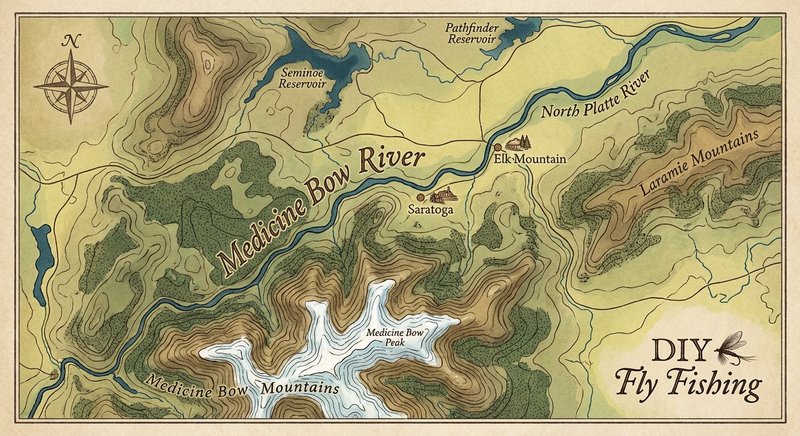
Medicine Bow River
Fly fishing in Wyoming · Beginner · Best seasons: Summer, Fall
Target Species
Brown Trout, Rainbow Trout
About This Water
Southeast Wyoming stream with brown trout. Snowy Range mountain scenery.
Fishing Recommendations
The Medicine Bow River is one of Wyoming’s best-kept secrets. Flowing from the high alpine tundra of the Snowy Range down into the sagebrush plains of Carbon County, it offers a "Dr. Jekyll and Mr. Hyde" fishing experience. It transitions from a tumbling mountain stream to a classic, meandering high-desert meadow river.
As your guide, here is the comprehensive breakdown for tackling this rugged and rewarding fishery.
🎣 Location Overview
The Medicine Bow River is a quintessential Wyoming freestone. What makes it special is its remoteness and diversity. Unlike the heavily pressured sections of the nearby North Platte, the Medicine Bow offers solitude.
- Upper Section: Located within the Medicine Bow National Forest, the water is cold, clear, and fast. It is characterized by pocket water, plunge pools, and granite boulders.
- Lower Section: As it leaves the mountains and flows toward the town of Elk Mountain and eventually Seminoe Reservoir, it becomes a classic "braided" meadow stream. Here, the river undercuts banks and winds through willow-lined private and public corridors.
- The Draw: Anglers love it for the lack of crowds and the aggressive nature of the fish. These trout aren't as "educated" as those in the Miracle Mile, but they are wary of shadows and poor presentations.
🐟 Target Species & Behavior
The river is primarily a Brown and Rainbow Trout fishery, though you will find Brook Trout in the higher elevations.
- Brown Trout: The "kings" of the Medicine Bow. They are notorious for hugging the deep undercuts in the meadow sections. During the fall, they become highly aggressive and territorial. They feed heavily on stoneflies, grasshoppers, and smaller trout.
- Rainbow Trout: More common in the swifter, oxygenated riffles and at the heads of pools. They are opportunistic feeders, often looking up for hatches or sitting in the "seams" where fast water meets slow water.
- Behavior: Because this is a high-altitude freestone (starting above 10,000 ft), the growing season is short. The fish are hungry and generally not picky about fly patterns, provided your approach is stealthy.
📅 Best Times to Fish
Optimal Seasons:
- Summer (Late June – August): This is the prime window. Once the spring runoff subsides (usually by late June), the dry fly fishing is world-class.
- Fall (September – October): This is my favorite time for "trophy" hunting. The Brown Trout begin their pre-spawn move, the colors are spectacular, and the "Hopper" fishing remains strong until the first hard freeze.
Best Times of Day:
- Summer: Early morning (6 AM – 10 AM) for nymphing; mid-afternoon for terrestrials; and the "Golden Hour" (7 PM – dark) for caddis hatches.
- Fall: Wait for the water to warm up. 10 AM to 4 PM is the sweet spot.
Prime Windows:
The "Golden Window" on the Medicine Bow is the Stonefly hatch in July. If you time the tail-end of the runoff correctly, you can catch the Salmonfly or Golden Stonefly hatches, which bring the largest fish in the river to the surface.
🪰 Recommended Flies & Techniques
Top Fly Patterns:
- Dry Flies:
- Terrestrials: Amy’s Ant (Size 10-14), Morrish Hopper (Tan/Pink), Chubby Chernobyl (Orange or Black).
- Attractors: Royal Wulff, Stimulator (Yellow/Orange).
- Hatches: Elk Hair Caddis (Tan), Parachute Adams (Size 14-18).
- Nymphs:
- Pat’s Rubber Legs (Coffee/Black) — A must-have.
- Prince Nymph, Hare’s Ear, and Pheasant Tail (Size 14-16).
- Streamers:
- Gold Ribbed Hare’s Ear (Large), Wooly Buggers (Olive/Black), and the Gold Sparkle Minnow for the deeper holes.
Effective Techniques:
- Dry-Dropper: This is the most effective way to cover the Medicine Bow. Use a buoyant Chubby Chernobyl as your indicator and hang a bead-head nymph 2-3 feet below it.
- Tight-Line Nymphing: In the upper rocky sections, "high-sticking" through the pocket water is lethal.
- Streamer Stripping: In the fall, cast streamers tight to the undercut banks in the meadow sections and strip them erratically.
💡 Pro Tips & Local Knowledge
- The Stealth Factor: The water can be crystal clear. If you can see the fish, they have likely already seen you. Wear earthy tones (olive/tan), stay low, and avoid "lining" the fish (casting your fly line directly over their heads).
- Focus on the "Shoulders": Everyone casts into the deepest part of the pool. Experienced guides know the big Browns often sit on the "shoulders"—the shallower, sloping edges at the tail of a pool—waiting for food to drift by.
- The Wind: This is Wyoming. The wind will blow. If it gets too windy for small dries, switch to a heavy streamer or a large, foam grasshopper pattern that can "splat" on the water to get the fish's attention.
⚠️ Important Information
Access Information:
- Public Access: Much of the upper river is in the Medicine Bow National Forest (accessible via Hwy 130 and Forest Service roads).
- Private Land: Large sections of the lower river flow through private ranches. Wyoming law is strict: The riverbed is private property. You cannot anchor, wade, or set foot on the bank without permission. Only fish the designated "Public Access" areas marked by Wyoming Game & Fish signs.
Regulations & Permits:
- A valid Wyoming Fishing License and a Conservation Stamp are required.
- Check the latest Wyoming Game & Fish Department (WGFD) regulations for specific creel limits, though Catch and Release is highly encouraged to preserve this fragile ecosystem.
Special Considerations:
- Wildlife: This is high-country Wyoming. Be "Bear Aware" (carry bear spray) and watch for moose, which can be aggressive if you stumble upon them in the willows.
- Weather: Storms move in fast over the Snowy Range. Always carry a rain jacket and be prepared for a 30-degree temperature drop in minutes.
Guide’s Final Word: The Medicine Bow isn't about counting fish; it's about the quality of the experience. Bring a 5-weight rod, a box of hoppers, and a sense of adventure. Tight lines!
Bug Hatches & Matching Flies
| Hatch | Type | Peak months | Time of day | Hook sizes | Matching flies |
|---|---|---|---|---|---|
| Blue Winged Olive Baetis spp. | mayfly | April, May, September, October | Late Morning/Afternoon | #18-22 | RS2 #20-22, Parachute BWO #18-22, BWO WD-40 #20-22 |
| Pale Morning Dun Ephemerella dorothea infrequens | mayfly | June, July, August | Mid-morning to Early Afternoon | #14-18 | PMD Sparkle Dun #16-18, Pheasant Tail Nymph #14-18, Split Case PMD #16-18 |
| Golden Stonefly Hesperoperla pacifica | stonefly | June, July | All Day/Afternoon | #8-12 | Pat's Rubber Legs #8-12, Rogue River Stone #8-10, Golden Chubby Chernobyl #10-12 |
| American Grannom Brachycentrus occidentalis | caddis | May | Afternoon | #14-16 | Elk Hair Caddis #14-16, Peacock Caddis Larva #14-16, LaFontaine's Deep Sparkle Pupa #14-16 |
| Yellow Sally Isoperla spp. | stonefly | July, August | Late Afternoon/Evening | #14-16 | Yellow Sally Foam Stone #14-16, Little Yellow Sloan #14-16, Stimulator (Yellow) #14-16 |
| Grasshopper Acrididae | terrestrial | July, August, September | Midday/Afternoon | #8-14 | Morrish Hopper #10-12, Dave's Hopper #8-14, Rainy's Grand Hopper #10-12 |
| Trico Tricorythodes spp. | mayfly | August, September | Early Morning | #20-24 | Trico Spinner #20-24, Sunken Trico Spinner #22-24, Griffith's Gnat #20-22 |
| Midge Chironomidae | midge | March, April, October, November | Midday | #20-24 | Zebra Midge #20-22, Morgan's Midge #22-24, Top Secret Midge #20-24 |