Methow River
Fly fishing in Washington · Intermediate · Best seasons: Summer, Fall
Target Species
Rainbow Trout, Steelhead
About This Water
Eastern Washington gem with excellent trout and summer steelhead fishing. Crystal clear mountain water.
Fishing Recommendations
Greetings, angler. It is a pleasure to guide you through the Methow River, one of the most stunning and technically rewarding free-stone rivers in the Pacific Northwest. Located in North Central Washington, the Methow carves through a dramatic landscape of ponderosa pines and granite peaks. It is a river of extremes—raging with snowmelt in the spring and dropping to a technical, crystalline playground by mid-summer.
Here is your comprehensive guide to fishing the Methow.
🎣 Location Overview
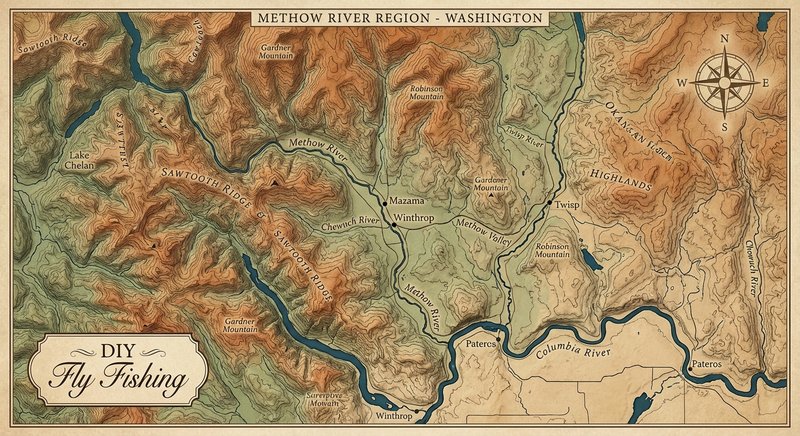
The Methow River is a tributary of the Columbia River, flowing roughly 80 miles from the North Cascades to the town of Pateros. What makes the Methow special is its wild, high-desert character. It is a classic "freestone" river, meaning its flows are dictated by snowpack and weather rather than dams.
Anglers love the Methow for its clarity and scenery. The water is remarkably transparent, often taking on a turquoise hue. It offers a variety of water types: from turbulent pocket water in the upper reaches near Mazama to broad, sweeping runs and deep emerald pools in the lower canyon near Carlton. It is a "wade-friendly" river in late summer, but its size and power require respect.
🐟 Target Species & Behavior
Westslope Cutthroat & Rainbow Trout
The Methow is home to a healthy population of wild Westslope Cutthroat and Rainbow trout (often hybridizing into "Cut-bows").
- Behavior: These fish are opportunistic but can be "skinny water" shy. They favor the heads of riffles, oxygenated pocket water, and the seams where fast water meets slow.
- Feeding: In the summer, they are look-up oriented, keyed into prolific stonefly and terrestrial activity.
Steelhead (Summer-Run)
The Methow hosts a famous run of Summer-run Steelhead.
- Behavior: These are "interior" fish, having traveled over 500 miles and passed nine dams. They are resilient and aggressive. They typically hold in tailouts of long pools or behind large boulders in mid-river.
- Feeding: While they aren't feeding for caloric intake, they strike out of predatory instinct or territorial aggression.
📅 Best Times to Fish
The Summer Window (July – August)
- Target: Rainbows and Cutthroat.
- Conditions: Fishing usually opens on the first Saturday in June, but the river is often too high from runoff until early July.
- Prime Time: Late July through August offers the best dry fly fishing.
- Time of Day: Early morning for tricos/mayflies; mid-day for hopper/dropper setups in the riffles; evening for caddis.
The Fall Window (September – October)
- Target: Trout and (Regulation Pending) Steelhead.
- Conditions: Water temperatures drop, and the "big" fish become more active. The cottonwoods turn gold, making it the most scenic time to be on the water.
- Steelhead Note: Steelhead season is highly regulated and depends on return numbers. It typically opens in October if quotas are met.
🪰 Recommended Flies & Techniques
Dry Flies (The Methow’s Bread and Butter)
- Golden Stoneflies: Size 8-10 (Chubby Chernobyl in Gold or Orange).
- Terrestrials: Size 10-14 (Morrish Hoppers, Dave’s Hopper, Black Ants).
- Caddis: Size 14-16 (Elk Hair Caddis, X-Caddis in Tan or Olive).
Nymphing
- Pat’s Rubber Legs: Size 8-12 (Olive/Brown or Black). This is the "meat and potatoes" nymph for this river.
- Prince Nymph / Pheasant Tail: Size 14-18 for technical tailouts.
Steelhead Patterns
- Swing Flies: Green Butt Skunk, Blue Charm, or Hobo Spey (Purple/Black).
- Surface: Pink or Orange Skaters (on calm mornings).
Techniques
- Hopper-Dropper: Use a buoyant Chubby Chernobyl as your indicator and hang a bead-head nymph 2–3 feet below it. This covers two water columns effectively.
- The Swing: For Steelhead, use a Spey rod or a long single-hander to swing streamers through the "seams" at a 45-degree angle.
- Skittering: For trout, don’t be afraid to give your dry fly a little "twitch" to mimic a struggling insect—Methow fish love motion.
💡 Pro Tips & Local Knowledge
- Focus on the "Braid" Water: Near the town of Twisp, the river braids into several smaller channels. These channels are often overlooked by drift boats and hold concentrated numbers of trout.
- The "Shadow" Effect: Because the canyon walls are steep, certain stretches of the river fall into shadow early. As soon as the sun leaves the water, the caddis hatch explodes. Keep your dry fly box ready for the last 60 minutes of light.
- Wade With Caution: The rocks in the Methow are notoriously "greasy" and round. Use felt soles or studs, and always carry a wading staff, especially in the swifter sections near Winthrop.
⚠️ Important Information
Regulations (Critical)
- Catch and Release ONLY: All wild trout and steelhead must be released.
- Selective Gear Rules: Only unscented artificial flies or lures with one single barbless hook are allowed. No bait.
- Steelhead Openings: You must check the WDFW Emergency Rules before you go. Steelhead fishing is only permitted via emergency opener based on wild fish return counts.
Access
- Public Access: There are numerous WDFW access sites (look for the "Green Diamond" signs). Key spots include the Winthrop Fish Hatchery, Twisp Park, and the Carlton Bridge.
- Permit: You will need a Washington State Fishing License and a Discover Pass for parking at state-managed access sites.
The Methow is a river that rewards the observant angler. Take a moment to watch the water before you cast; the fish are there, holding in the shadows of the boulders, waiting for the perfect drift. Tight lines!
Bug Hatches & Matching Flies
| Hatch | Type | Peak months | Time of day | Hook sizes | Matching flies |
|---|---|---|---|---|---|
| Skwala Stonefly Skwala americana | stonefly | March, April | Mid-day | #8-12 | Skwala Stone #10-12, Pat's Rubber Leg #8-12, Bullet Head Skwala #10 |
| Blue Winged Olive Baetis | mayfly | March, April, September, October | Mid-day/Overcast days | #16-20 | RS2 #18-20, Parachute Adams #16-20, BWO Sparkle Dun #18 |
| Salmonfly Pteronarcys californica | stonefly | May, June | All day | #4-8 | Chubby Chernobyl #6-8, Kaufmann's Stone #4-8 |
| Golden Stonefly Hesperoperla pacifica | stonefly | June, July | Morning/Evening | #8-12 | Norm Wood Special #8-10, Golden Pat's Rubber Leg #8-12 |
| Pale Morning Drake (PMD) Ephemerella excrucians | mayfly | June, July, August | Morning/Afternoon | #14-18 | PMD Sparkle Dun #16-18, Pheasant Tail #14-18, Split Case PMD #16 |
| Yellow Sally Isoperla | stonefly | June, July, August | Afternoon/Evening | #14-16 | Yellow Sally Stimulator #14-16, Little Yellow Sloan #14-16 |
| Spotted Sedge Hydropsyche | caddis | July, August | Evening | #14-16 | Elk Hair Caddis #14-16, LaFontaine's Deep Sparkle Pupa #14-16 |
| October Caddis Dicosmoecus gilvipes | caddis | September, October | Afternoon/Evening | #8-12 | Orange Stimulator #8-10, October Caddis Pupa #8-12 |
| Western Green Drake Drunella grandis | mayfly | June, July | Afternoon | #10-12 | Green Drake Paradox #10-12, Hare's Ear #10-12 |
| Grasshoppers Orthoptera | terrestrial | July, August, September | Mid-day/Afternoon | #8-12 | Morrish Hopper #8-12, Dave's Hopper #10 |