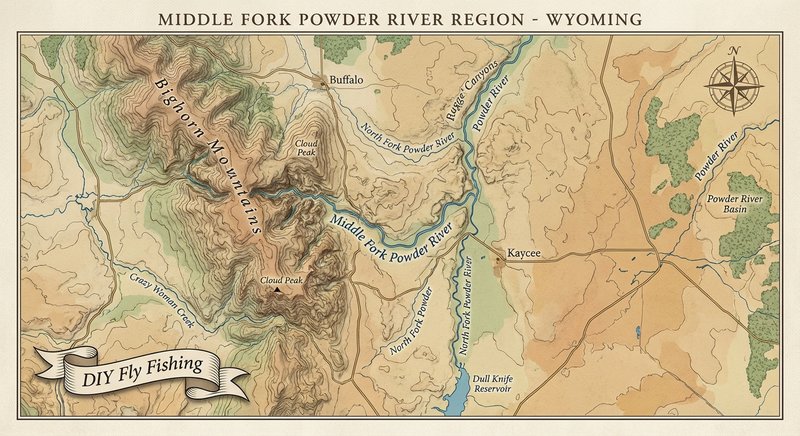
Middle Fork Powder River
Fly fishing in Wyoming · Intermediate · Best seasons: Summer, Fall
Target Species
Brook Trout, Brown Trout
About This Water
Bighorn Mountains stream with brook and brown trout. Scenic wilderness.
Fishing Recommendations
The Middle Fork of the Powder River is one of Wyoming’s best-kept secrets. Tucked away in the southern Bighorn Mountains near the legendary "Hole-in-the-Wall" country, this river flows through spectacular red-rock canyons and high-desert landscapes. It offers a true "wild west" fly fishing experience, combining rugged hiking with aggressive trout that rarely see a hook.
🎣 Location Overview
The Middle Fork is a diverse fishery that transforms from a high-mountain meadow stream into a dramatic canyon river. What makes it special is the Outlaw Canyon section—a remote, steep-walled gorge where the James Gang and Butch Cassidy once hid.
The water is characterized by classic pocket water, deep emerald pools, and long glassy runs. It is a "freestone" river, meaning its flows are dictated by snowmelt. The geology is breathtaking, with towering red sandstone cliffs contrasting against the clear water and green riparian zones. Anglers love it for the solitude; once you hike a mile into the canyon, you are unlikely to see another soul.
🐟 Target Species & Behavior
While the river holds Rainbows and some Cutthroat, your primary targets here are Brown Trout and Brook Trout.
- Brown Trout: These are the kings of the canyon. They are territorial and wary but highly opportunistic. In the Middle Fork, Browns hold in the deeper undercut banks, beneath large boulders, and at the tail-outs of deep pools. During the fall, they become extremely aggressive as they prepare to spawn.
- Brook Trout: Found more predominately in the upper reaches and the smaller tributaries, these fish are vibrant and eager. They congregate in the slower moving "frog water" and near woody debris. They aren't picky eaters but require a stealthy approach in the smaller, clearer stretches.
- Behavior: Because the nutrient load isn't as high as a tailwater, these fish are "opportunistic predators." They don't have the luxury of being overly selective; if a meal looks natural and is presented well, they will strike.
📅 Best Times to Fish
Optimal Seasons: Summer & Fall
- Summer (July – August): This is the prime window. Once the spring runoff subsides (usually by late June), the water clears and the dry fly fishing becomes world-class.
- Fall (September – October): This is "trophy time." As temperatures drop, the Brown Trout color up and begin feeding aggressively before winter. The crowds (which are already small) disappear entirely.
Best Times of Day
- Summer: Early morning and "the golden hour" before sunset. Mid-day can be productive with terrestrial patterns (hoppers/ants).
- Fall: The window shifts to 10:00 AM – 4:00 PM as the sun warms the water enough to trigger insect activity.
Prime Conditions
Look for clear to tea-colored water. If a heavy summer thunderstorm hits, the red soil can turn the river "chocolate milk" quickly. Always check the weather for the Bighorn Mountains before heading in.
🪰 Recommended Flies & Techniques
Top Fly Patterns
- Dry Flies:
- Terrestrials: Amy’s Ant (size 10-14), Morrish Hopper (tan/pink, size 10-12), and Black Foam Ants.
- Attractors: Royal Wulff, Stimulators (Orange/Yellow, size 12-16), and PMDs for summer evenings.
- Nymphs:
- The Classics: Bead-head Prince Nymphs, Pheasant Tails (size 14-18), and Copper Johns (Red or Blue).
- Stoneflies: Pat’s Rubber Legs (Tan/Brown) are essential for the deeper canyon pockets.
- Streamers:
- Gold Ribbed Hare's Ear Streamers or Wooly Buggers (Olive or Black, size 6-10). These are deadly for the big Browns in the fall.
Effective Techniques
- Dry-Dropper: This is the bread and butter of the Middle Fork. Hang a weighted nymph 18–24 inches below a high-visibility hopper or stimulator. This covers both the surface and the mid-column.
- Pocket Water Picking: Don't just fish the big pools. Cast into the "buckets" behind large rocks. High-stick your rod to keep line off the complex currents.
- Streamer Stripping: In the fall, cast streamers toward the opposite bank or into deep shadows and strip them back with erratic pauses.
💡 Pro Tips & Local Knowledge
- The "Outlaw" Hike: Accessing the best water requires a steep hike down into Outlaw Canyon. It’s about a 1,000-foot vertical drop. Pack light, bring plenty of water, and wear sturdy wading boots with studs—the rocks here are notoriously "greasy."
- Stealth is Key: The water is often crystal clear. Avoid wearing bright colors. Approach pools from downstream and keep a low profile to avoid shadowing the water.
- Wading Safety: The Middle Fork has large, round, slippery boulders. A wading staff is highly recommended, especially if you are fishing solo in the remote canyon sections.
- The "Hopper-Feast": In late August, the canyon rims are crawling with grasshoppers. If the wind blows them into the canyon, the fishing becomes legendary. Use a large foam hopper and "splat" it onto the water to get the fish's attention.
⚠️ Important Information
Access
- Access is primarily via Bachaus Road or the Outlaw Cave Campground area.
- High-clearance 4WD is strongly recommended. The roads are graded dirt but can become impassable clay "gummo" when wet.
Regulations & Permits
- A valid Wyoming Fishing License is required.
- The Middle Fork has specific regulations: Much of the canyon section is Catch and Release only or has strictly limited harvest rules. Check the current Wyoming Game & Fish Department (WGFD) booklet for "Area 3" regulations before you go.
- Check for "Special Management" zones which may require the use of artificial flies and lures only.
Special Considerations
- Wildlife: This is rattlesnake country. Watch your step on the canyon trails, especially on sunny rocks. This is also black bear and mountain lion habitat—carry bear spray.
- Cell Service: Expect zero cell service once you leave the highway. Tell someone your plan and when you expect to be back.
The Middle Fork of the Powder is a place where the history is as deep as the canyons. Respect the land, pack out what you pack in, and enjoy one of the most ruggedly beautiful fisheries in the American West.
Bug Hatches & Matching Flies
| Hatch | Type | Peak months | Time of day | Hook sizes | Matching flies |
|---|---|---|---|---|---|
| Blue-Winged Olive Baetis | mayfly | April, May, September, October | Late Morning/Afternoon | #18-22 | Parachute Adams #18-22, RS2 #20-22, Pheasant Tail #18-20 |
| Golden Stonefly Hesperoperla pacifica | stonefly | June, July | Morning/Afternoon | #8-12 | Chubby Chernobyl (Gold) #8-12, Pat's Rubber Leg #8-10, Golden Rogue Stone #10-12 |
| Pale Morning Dun Ephemerella excrucians | mayfly | June, July | Late Morning/Afternoon | #16-18 | PMD Sparkle Dun #16-18, Military Mayfly #16-18, Split Case PMD #16 |
| Yellow Sally Isoperla | stonefly | June, July, August | Afternoon/Evening | #14-16 | Yellow Sally Trude #14-16, Iron Lotus (Yellow) #16, Little Yellow Sloan #14 |
| Spotted Sedge Hydropsyche | caddis | June, July, August | Evening | #14-18 | Elk Hair Caddis (Tan) #14-18, LaFontaine's Deep Sparkle Pupa #14-16, X-Caddis #16 |
| Grasshopper Acrididae | terrestrial | August, September | Mid-day/Afternoon | #8-12 | Morrish Hopper #10-12, Parachute Hopper #12, Rainy's Grand Hopper #8-10 |
| Trico Tricorythodes | mayfly | August, September | Early Morning | #20-24 | Trico Spinner #20-24, Drowned Trico Spinner #22, Sunken Trico #20-22 |
| Midge Chironomidae | midge | March, April, October, November | All Day | #18-24 | Zebra Midge #18-22, Griffith's Gnat #20-22, Palomino Midge #20 |