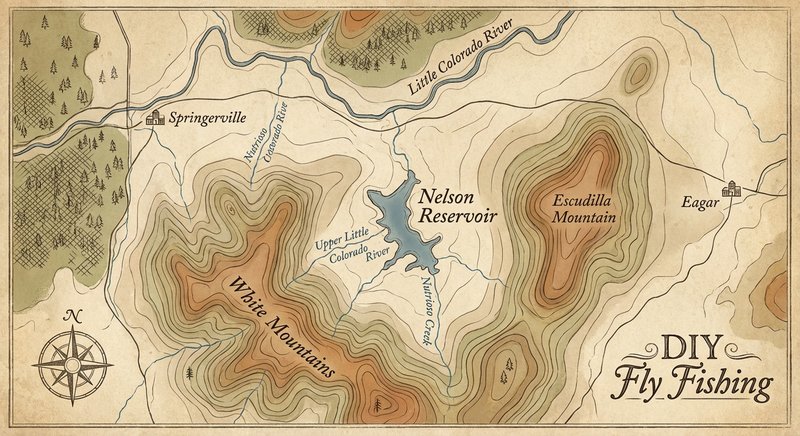
Nelson Reservoir
Fly fishing in Arizona · beginner · Best seasons: spring, summer, fall
Target Species
Rainbow Trout
About This Water
Springerville area lake with trout stocking. Grassland setting at high elevation.
Fishing Recommendations
Welcome to the high country of the Apache-Sitgreaves National Forest. As your guide, I’m excited to break down Nelson Reservoir. Located at an elevation of about 7,400 feet in the White Mountains of Arizona, this is one of the state's most consistent and accessible stillwater fisheries.
While it is an irrigation highland reservoir, for the fly angler, it offers a classic "stillwater" experience with high insect productivity and hard-fighting trout.
🎣 Location Overview
Nelson Reservoir is located between Springerville and Alpine along Highway 191. It is a roughly 60-acre impoundment of Nutrioso Creek. What makes it special is its accessibility paired with its productivity; unlike some of the more "technical" high-alpine lakes, Nelson has a high nutrient load that supports a massive biomass of aquatic insects.
The water is relatively shallow (averaging 10–20 feet), meaning the entire lake acts as a "productive zone" where trout can forage from the bottom to the surface. It is surrounded by rolling hills and provides a quintessential Arizona mountain backdrop.
🐟 Target Species & Behavior
- Rainbow Trout: The primary target. These are stocked regularly by Arizona Game and Fish (AZGFD). Because of the rich environment, "stockers" quickly transition to wild diets, becoming "holdovers" that can reach 16–20 inches.
- Behavior: In the Spring, they cruise the shallow shorelines looking for warmer water and emerging midges. In the Summer, they retreat to the deeper channel of the old Nutrioso Creek bed or huddle near the dam where the water is coolest. In the Fall, they become aggressive, patrolling the weed edges to bulk up for winter.
- Forage: The "Big Three" here are Chironomids (midges), Damselflies, and Scuds. There is also a significant population of crayfish which the larger trout target.
📅 Best Times to Fish
- Spring (April – June): This is the "Prime Time." Right after ice-out, the fish are famished. Late May brings the legendary Damselfly hatch, which can provide some of the most exciting fishing of the year.
- Summer (July – August): Focus on the "Edges of the Day." Fish early (6:00 AM – 9:00 AM) and late (6:00 PM – Sunset). Mid-day can be slow as fish move deep to escape the sun.
- Fall (September – November): As water temperatures drop, the fish move back into the shallows. The crowds disappear, and the trout are at their heaviest weight of the year.
- Conditions: Overcast, slightly breezy days are actually better than bluebird skies. A "chop" on the water breaks up the surface and makes the fish less spooky.
🪰 Recommended Flies & Techniques
Stillwater Nymphing (The High-Percentage Play)
This is the most effective way to fish Nelson. Use a long leader (12–15 feet) under a slip-indicator.
- Flies: Zebra Midges (Size 16-20 in black/silver or red/gold), Ice Buddies, or Chan’s Bomber.
- Technique: Suspend your fly 12–18 inches off the bottom. The key is a "dead slow" retrieve—literally just taking up the slack.
The "Damsel" Strip
- Flies: Marabou Damsel Nymphs (Size 12-14 in Olive or Bright Green).
- Technique: Use an intermediate (slow-sink) line. Cast toward weed edges and use a "short-short-long" twitching retrieve to mimic the swimming motion of a damselfly larva.
Streamer Stripping
- Flies: Woolly Buggers (Size 8-10 in Olive, Black, or Thin Mint), Simi Seal Leeches.
- Technique: Focus on the rocky areas near the dam. Use a sinking tip line to get the fly down 5–10 feet.
Dry Fly Action
- Flies: Griffith’s Gnat (Size 18-22) for midge clusters, or Parachute Adams (Size 16).
- Technique: Look for rising fish in the evening. If the wind dies down, look for "dimples" on the surface.
💡 Pro Tips & Local Knowledge
- Find the Creek Bed: If you are in a float tube or kayak, look for the submerged Nutrioso Creek channel. The fish use this "highway" to move through the lake. A simple fish finder or a weighted line can help you find the drop-off.
- The Wind is Your Friend: Nelson can get windy. Instead of fighting it, use it to your advantage. A "Wind Drift" technique—where you let the wind push your boat while trailing a leech or nymph—covers a lot of water and often triggers strikes.
- The North End Inlet: Early in the spring, the area where Nutrioso Creek flows in (the south/east end) can be a hotspot as it brings in fresh oxygen and nutrients.
- Weed Management: By late summer, the weeds can get thick. Don't get frustrated; the trout are in those weeds. Use "unweighted" flies or weedless patterns to fish the pockets of open water between the stalks.
⚠️ Important Information
- Access: There is a large parking area off Hwy 191 with a boat ramp and a fishing pier. Most of the western shoreline is easily walkable.
- Regulations: A valid Arizona Fishing License is required. Nelson is generally open to bait, so be aware that you will be sharing the water with gear anglers.
- Boating: Electric motors only. Internal combustion engines are prohibited. It is a perfect lake for float tubes, pontoons, kayaks, and canoes.
- Weather: High-altitude weather changes fast. Afternoon monsoons in July and August bring lightning—if you see clouds building, get off the water immediately.
- Facilities: There are vaulted toilets and picnic tables, but no developed campground directly on the lake (though plenty of dispersed camping and USFS campgrounds are within 10 miles).
Guide’s Final Word: Nelson Reservoir isn't the place for "trophy" hunting 10lb trout, but for consistent action, beautiful scenery, and a great place to hone your stillwater skills, it’s one of the best gems in the White Mountains. Tight lines!
Bug Hatches & Matching Flies
| Hatch | Type | Peak months | Time of day | Hook sizes | Matching flies |
|---|---|---|---|---|---|
| Chironomids (Midges) Family Chironomidae | midge | April, May, June | All Day | #12-22 | Zebra Midge #16-20, Chironocone #14-18, Griffith's Gnat #18-22 |
| Callibaetis (Speckled Duns) Callibaetis ferrugineus | mayfly | June, July, August | Morning to Afternoon | #12-16 | Pheasant Tail Nymph #14-16, Callibaetis Spinner #14-16, Parachute Adams #12-16 |
| Damselflies Enallagma spp. | terrestrial | June, July | Late Morning to Afternoon | #10-14 | Marabou Damsel Nymph #10-12, Adult Damsel #12-14, Woolly Bugger (Olive) #10-14 |
| Cinnamon Caddis Hesperophylax designatus | caddis | July, August | Evening | #12-16 | Elk Hair Caddis #12-16, LaFontaine's Deep Sparkle Pupa #14-16, Godzilla Caddis #12-14 |
| Dragonflies Anax junius | terrestrial | July, August | All Day | #6-10 | Dragonfly Nymph (Olive/Brown) #6-10, Gummi Bugger #8-10 |
| Water Boatmen & Backswimmers Family Corixidae / Notonectidae | terrestrial | September, October | Afternoon | #14-16 | Water Boatman #14-16, Prince Nymph #14-16 |
| Terrestrial Grasshoppers Melanoplus spp. | terrestrial | August, September | Midday to Evening | #8-12 | Joe's Hopper #8-12, Dave's Hopper #10-12, Chernobyl Ant #8-10 |
| Scuds (Freshwater Shrimp) Gammarus lacustris | terrestrial | April, May, October | All Day | #12-18 | Ray Charles #14-18, Scud (Olive/Orange) #12-16 |