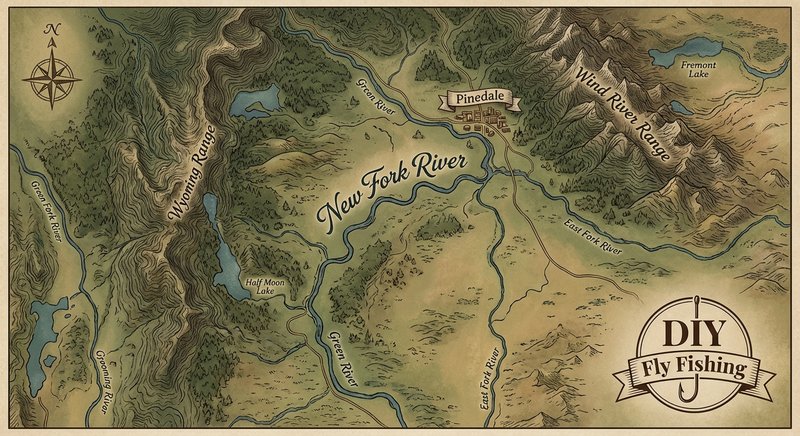
New Fork River
Fly fishing in Wyoming · Beginner · Best seasons: Summer, Fall
Target Species
Rainbow Trout, Brown Trout, Cutthroat Trout
About This Water
Less-pressured alternative with excellent populations of rainbow, brown, and cutthroat trout.
Fishing Recommendations
The New Fork River is a hidden gem of the Rocky Mountains, often overshadowed by its more famous sibling, the Green River. However, for those in the know, the New Fork offers some of the most productive and exciting trout fishing in the West. Meandering through the high-sage desert near Pinedale, Wyoming, this river is a classic "cowboy" stream—winding, undercut, and full of aggressive, wild trout.
🎣 Location Overview
The New Fork is a tributary of the Green River, fed by the snowmelt of the massive Wind River Range. What makes it special is its character: it is a technical, winding river characterized by deep undercut banks, tight willow-lined bends, and expansive gravel bars.
Unlike the wider, more open Green, the New Fork feels intimate. It is primarily a "float-fisher’s river" because much of the land surrounding it is private ranch land. However, the Wyoming "reach-around" laws (allowing floating through private property as long as you don't touch the bottom or banks) make it a prime destination for drift boats and rafts. Anglers love it for the density of fish and the legitimate chance at a trophy Brown Trout in relatively small water.
🐟 Target Species & Behavior
- Brown Trout: The stars of the New Fork. They are predatory and love the river’s deep undercut banks and submerged woody debris. They are most active during low-light hours and in the fall during their pre-spawn.
- Rainbow Trout: Found more frequently in the faster riffles and at the heads of pools. They are acrobatic and tend to be less "structure-oriented" than the Browns.
- Cutthroat Trout (Colorado River): These are the natives. You’ll find them in the cleaner, cooler oxygenated runs. They are often less picky than the Browns and will rise to a well-presented terrestrial in mid-summer.
Behavior: These fish are opportunistic but wary. Because the river is narrow, stealth is key. Fish hold tight to the banks—if your fly isn't within six inches of the willow line, you’re often out of the strike zone.
📅 Best Times to Fish
Optimal Seasons
- Summer (July – August): This is the "Golden Era" on the New Fork. Once the spring runoff subsides (usually by late June or early July), the dry fly fishing becomes world-class.
- Fall (September – October): My personal favorite time. The crowds thin out, the Brown Trout become aggressive and colorful, and the streamer bite turns electric.
Prime Windows
- The Hopper Window: Late July through August. When the Wyoming wind kicks up, it blows grasshoppers into the water, triggering a feeding frenzy.
- The Trico Morning: In August/September, early morning Trico hatches can provide technical dry fly action for those with 6X tippet and patience.
- The Fall Streamer Swing: Late September through October, especially on overcast days.
🪰 Recommended Flies & Techniques
Dry Flies (The Summer Staple)
- Terrestrials: Chernobyl Ants (Size 8-12), Pink Pookas, and Dave’s Hoppers.
- Mayflies: Parachute Adams (14-18), PMDs, and Purple Hazes.
- Attractors: Royal Wulffs and Stimulators for the faster pocket water.
Nymphing (The Consistency King)
- Point Flies: Pat’s Rubber Legs (Tan/Brown) or San Juan Worms.
- Droppers: Bead-head Pheasant Tails (16-18), Zebra Midges (18-20), or Prince Nymphs.
- Technique: Use a "hopper-dropper" rig to cover both the surface and the subsurface column simultaneously.
Streamers (The Trophy Hunter)
- Patterns: Sex Dungeon (Olive or Black), Goldy’s, and Sparkle Minnows.
- Technique: "Pound the banks." Cast as close to the willows as possible and give the fly aggressive strips immediately.
💡 Pro Tips & Local Knowledge
- The "Willow Whack": On the New Fork, the fish live under the willows. Don't be afraid to lose a few flies. If you aren't risking a snag, you aren't fishing where the big Browns live.
- Focus on the Bends: Every sharp bend in the New Fork creates a deep "scour hole." These are honey pots. Slow your boat down and pick these apart—don't just float through them.
- Wind is your Friend: While most fly fishers hate wind, a stiff breeze on the New Fork knocks hoppers into the water. If the wind picks up, put on the biggest, foamist grasshopper pattern you have.
- The "Upper" vs. "Lower": The upper reaches (near Cora) are more scenic and have more Cutthroats. The lower reaches (below Pinedale) get warmer and siltier but hold the truly massive "alligator" Browns.
⚠️ Important Information
Access
- Public Access Points: Major access points include the Airport Access, Hwy 351 Bridge, and Gas Wells.
- Wading: Wading is difficult due to private property laws. In Wyoming, you cannot walk on the riverbed if it is private land. Stay in your boat unless you are at a designated public access site.
Regulations & Permits
- A valid Wyoming Fishing License and an Invasive Species Decal (if bringing your own boat) are required.
- Check current Wyoming Game & Fish regulations for seasonal closures or specific "limit" rules, though most serious anglers here practice 100% catch and release.
Special Considerations
- Moose Safety: The New Fork is thick with Willows and heavily populated by Moose. They can be aggressive, especially if you are wading. Give them a very wide berth.
- Sun & Hydration: At 7,000+ feet, the sun is brutal. Wear polarized sunglasses (essential for spotting sub-surface structure) and plenty of SPF.
Bug Hatches & Matching Flies
| Hatch | Type | Peak months | Time of day | Hook sizes | Matching flies |
|---|---|---|---|---|---|
| Blue Winged Olive Baetis | mayfly | April, May, September, October | Late Morning/Afternoon | #18-22 | Parachute Adams #18-22, RS2 #20-22, Pheasant Tail #18-20 |
| Gray Drake Siphlonurus | mayfly | June, July | Evening | #10-12 | Gray Drake Spinner #10-12, Hare's Ear #10-12, Gray Drake Cripple #12 |
| Golden Stonefly Hesperoperla pacifica | stonefly | June, July | All Day | #8-12 | Chubby Chernobyl (Gold) #8-12, Pat's Rubber Leg #8-12, Rogue Foam Stone #10 |
| Pale Morning Dun Ephemerella invaria | mayfly | July, August | Late Morning/Afternoon | #16-18 | PMD Sparkle Dun #16-18, Split Case PMD #16-18, Quigley Cripple #16 |
| Spotted Sedge Hydropsyche | caddis | July, August, September | Evening | #14-18 | Elk Hair Caddis #14-18, LaFontaine's Deep Sparkle Pupa #14-16, Holy Grail #16 |
| Yellow Sally Isoperla | stonefly | July | Afternoon/Evening | #14-16 | Yellow Sally Foam Dry #14-16, Iron Sally #14-16 |
| Salmonfly Pteronarcys californica | stonefly | June | All Day | #4-8 | Sofa Pillow #6-8, Kaufmann's Stone #4-8, Cat Puke #6 |
| Grasshoppers Orthoptera | terrestrial | August, September | Late Morning/Afternoon | #8-12 | Morrish Hopper #8-12, Rainy's Grand Hopper #10-12 |
| Midges Chironomidae | midge | March, April, October, November | Morning | #18-24 | Zebra Midge #18-22, Griffith's Gnat #20-24, Top Secret Midge #20-22 |