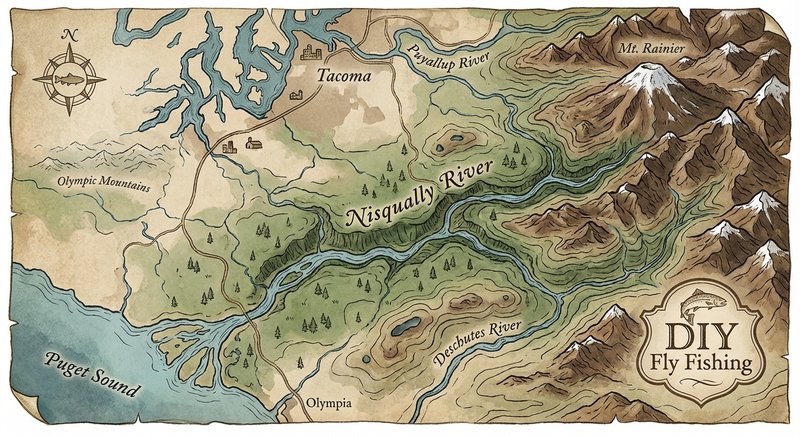
Nisqually River
Fly fishing in Washington · Intermediate · Best seasons: Winter, Fall
Target Species
Steelhead, Chinook Salmon
About This Water
South Puget Sound river originating at Mt. Rainier. Steelhead and salmon in glacier-fed water.
Fishing Recommendations
The Nisqually River is a powerful, glacial-fed system that flows from the heights of Mount Rainier down to the Puget Sound. For the fly angler, it is a river of high stakes and high rewards. Known for its distinct "glacial flour" (which gives the water a milky, turquoise hue), the Nisqually offers a true Pacific Northwest "big water" experience.
Here is your guide to mastering the Nisqually.
🎣 Location Overview
The Nisqually is a river of contrasts. Below the LaGrande and Alder dams, the river winds through lush forests and tribal lands. Because it is fed by a glacier, the water temperature stays cool, but the clarity can be fickle.
Anglers love the Nisqually because it feels wild despite being relatively close to the Olympia and Tacoma metro areas. It is a wide river with large cobble and heavy flows, making it a premier destination for Spey casting. The lower reaches are influenced by the tides, while the middle stretches offer classic "swing" water with walking-speed runs and deep, seductive tailouts.
🐟 Target Species & Behavior
Chinook Salmon (Fall)
The Nisqually Chinook (King Salmon) are notoriously powerful. They enter the river in late summer and peak through the fall.
- Behavior: They hold in deep, oxygenated slots and the "gut" of the pool. While they aren't actively feeding, they are highly territorial.
- Trigger: Aggression. Large, bright profiles that "annoy" the fish into a strike are key.
Steelhead (Winter)
The winter-run Steelhead is the "Holy Grail" of the Nisqually. These are hard-fighting fish that enter the system from December through March.
- Behavior: Steelhead follow the path of least resistance. In the heavy flows of the Nisqually, look for them in "inside" seams and the transition water at the tail of a run.
- Feeding: They react to movement and silhouette. They are more likely to move a distance for a fly than a Chinook.
📅 Best Times to Fish
- Chinook: September through October is the prime window. Focus on the early morning hours before the sun hits the water, as Chinook are notoriously light-sensitive.
- Winter Steelhead: January and February are the peak months.
- The "Glacial Factor": In the fall, warm rains can cause glacial melt, turning the river into "chocolate milk." The best fishing occurs when the river is "dropping and clearing"—look for 2 to 3 feet of visibility.
🪰 Recommended Flies & Techniques
Techniques
- The Swing (Spey): This is the preferred method. Use a 7-weight or 8-weight Spey rod to cover the wide runs. A Skagit head with various T-series sink tips (T-11 to T-17) is essential to get the fly down to the fish's level in the heavy current.
- Nymphing: While less common for Chinook, heavy indicator rigs with large beads or "Egg Loop" flies can be effective in the deeper holes.
Top Fly Patterns
- For Chinook:
- The Comet: (Orange or Pink) A classic for glacial water.
- Alaskabou: Large, marabou-heavy flies in Chartreuse or Cerise that move a lot of water.
- Prom Dress: Flashy, large-profile streamers.
- For Steelhead:
- The Dirty Ho: (Blue/Black or Pink/White) An intruder-style fly that holds its shape in fast water.
- Hobo Spey: (Purple or Black) Perfect for lower light conditions.
- Egg-Stasy Patterns: In "dead drift" scenarios during the salmon spawn.
💡 Pro Tips & Local Knowledge
- The Two-Foot Rule: If you can’t see your boots when wading knee-deep, the visibility is likely too low for fly fishing. Go home or wait for the freeze-up in the mountains to stop the glacial silt.
- Swing it Deep: Nisqually fish are rarely "on the ceiling." If you aren't feeling your fly tick the occasional rock, you aren't deep enough. Lengthen your sink tip or cast more upstream to allow the fly to sink before the swing begins.
- Respect the Tribe: The Nisqually Indian Tribe has deep ancestral ties to this river. Be aware of tribal netting schedules (usually mid-week). If nets are in, the fishing will be slow; if the nets just came out, a fresh push of fish is usually right behind them.
- Wading Safety: The Nisqually has "moving" bottom—silt and sand can shift under your feet. Always wear a wading belt and use a staff.
⚠️ Important Information
- Access:
- McKenna Park: Good for shore access and launching small rafts.
- Nisqually Park (near Roy): Offers several miles of bank access.
- Luhr Beach: For the very lowest tidewater sections (boat access).
- Regulations:
- Barbless Hooks: Mandatory for all salmon and steelhead fishing.
- Check the WDFW Pamphlet: The Nisqually has very specific "emergency" closures depending on fish counts. Always check the WDFW Emergency Rules page before heading out.
- Steelhead: Wild Steelhead must be released with zero encounter (keep them in the water).
- Permits: You need a Washington Freshwater Fishing License and a "Catch Record Card" for Salmon/Steelhead.
Guide’s Final Word: The Nisqually is a "blue-collar" river. It won't give up its secrets easily, and you will work for every hookup. But when a fresh-run Winter Steelhead grabs your fly in the heavy mist of a January morning, you'll understand why this river is legendary.
Bug Hatches & Matching Flies
| Hatch | Type | Peak months | Time of day | Hook sizes | Matching flies |
|---|---|---|---|---|---|
| Blue Winged Olive Baetis | mayfly | March, April, October, November | Afternoon | #16-20 | Parachute Adams #16-18, RS2 #18-20, Pheasant Tail Nymph #16-20 |
| March Brown Rhithrogena morrisoni | mayfly | March, April | Afternoon | #12-14 | March Brown Dry #12-14, Gold Ribbed Hare's Ear #12-14, March Brown Wet Fly #12-14 |
| Grannom Caddis Brachycentrus | caddis | April, May | All Day | #14-16 | Elk Hair Caddis #14-16, Deep Sparkle Pupa #14-16, Peeping Caddis #14 |
| Golden Stonefly Hesperoperla pacifica | stonefly | June, July | Daytime | #8-12 | Pat's Rubber Legs #8-12, Kaufmann's Stimulator #10-12, Golden Stone Nymph #8-10 |
| Pale Morning Dun Ephemerella | mayfly | June, July, August | Morning/Afternoon | #16-18 | PMD Sparkle Dun #16-18, Mercer's Poxy Back PMD #16-18, Quigley's PMD Hackle Stacker #16-18 |
| October Caddis Dicosmoecus gilvipes | caddis | September, October | Daytime/Evening | #8-10 | Orange Stimulator #8-10, October Caddis Pupa #8-10, Morrish's October Caddis #10 |
| Little Black Stonefly Capniidae | stonefly | February, March | Mid-day | #16-18 | Black Stimulator #16-18, Little Black Stone Nymph #16-18, Zebra Midge #18 |
| Midges Chironomidae | midge | January, February, December | Afternoon | #18-24 | Griffith's Gnat #18-22, Zebra Midge #18-22, Top Secret Midge #20-22 |