Nooksack River
Fly fishing in Washington · Intermediate · Best seasons: Winter, Fall
Target Species
Steelhead, Chinook Salmon
About This Water
North Cascades river near Bellingham with steelhead and salmon. Three forks offer diverse fishing.
Fishing Recommendations
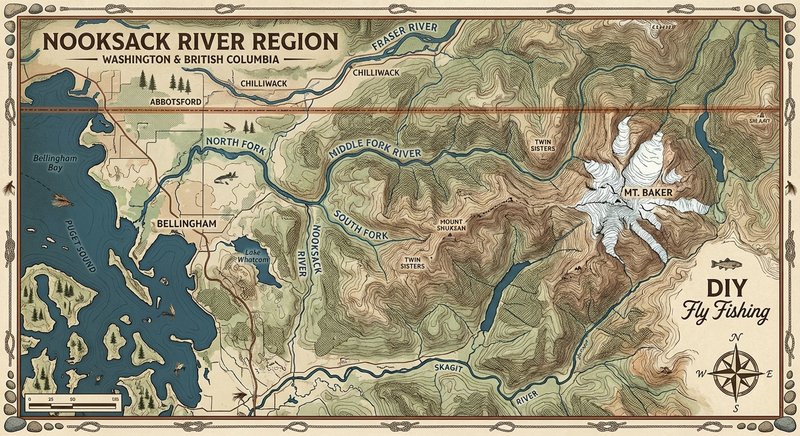
The Nooksack River, flowing from the glaciers of Mt. Baker down to Bellingham Bay, is a quintessential Pacific Northwest river. It is a system defined by its three distinct forks (North, Middle, and South), each offering a different character, though the main stem and the North Fork are the primary targets for fly anglers seeking chrome.
🎣 Location Overview
The Nooksack is one of the most northern river systems in the lower 48, offering a rugged, dramatic backdrop of the North Cascades. What makes it special is its glacial influence; the river is known for its "milky" or "glacial flour" tint, which demands specific tactical adjustments from the angler.
The river transitions from high-gradient, boulder-strewn water in the upper reaches to classic "swing" water in the lower reaches. It is a river that rewards the persistent angler. While it doesn't always have the massive runs of the Columbia, it offers a more intimate, wild experience for those targeting legendary PNW salmonids.
🐟 Target Species & Behavior
Winter Steelhead
These are the "ghosts of the coast." They enter the river starting in late November through March.
- Behavior: They are aggressive but temperature-dependent. In cold winter water, they hold in "soft" water—slower walking-speed glides where they don't have to burn calories.
- Feeding: They aren't actively feeding, but they strike out of territorial aggression or instinctual memory.
Chinook (King) Salmon
The Nooksack hosts both Spring and Fall runs, but the Fall run is the primary target for many.
- Behavior: These are the heavyweights. They hold in deep pools and at the "tail-outs" of runs before moving up through rapids.
- Feeding: They are notorious for "sulking." You need to get your fly deep—right in their faces—to trigger a strike.
📅 Best Times to Fish
Optimal Seasons
- Fall (September – November): This is the prime window for Chinook and the beginning of the Coho run. The water is usually lower and clearer before the heavy autumn rains begin.
- Winter (December – March): The window for Winter Steelhead. January and February are often the peak, provided the river isn't "blown out" by heavy rain or rapid snowmelt.
Conditions & Timing
- The "Drop and Clear": The best fishing occurs as the river level is dropping after a rain event and the water visibility improves to at least 2–3 feet (the "steelhead green" color).
- Time of Day: Early morning and late evening are best for Chinook. For Winter Steelhead, the water temperature often peaks in the mid-afternoon, which can "turn on" the fish.
🪰 Recommended Flies & Techniques
Techniques
- Spey Casting (The Swing): This is the preferred method on the Nooksack. Using a two-handed Spey rod allows you to cover large amounts of water and manage heavy sink tips to get flies down in the glacial flow.
- Indicator Nymphing: Effective in the pocket water of the North Fork, using heavy beads or glo-bugs for steelhead.
Recommended Fly Patterns
- For Steelhead:
- Intruders (Pink/Orange or Blue/Black): Large profiles that create vibration in murky water.
- Hobo Spey: A classic PNW pattern that moves beautifully in the current.
- For Chinook:
- Comets (Orange or Red): A simple, heavy fly that gets down fast.
- Bunny Leeches: In chartreuse, cerise, or black. The movement of rabbit fur is irresistible to Kings.
Presentation Tips
- Depth is King: If you aren't occasionally "ticking" the bottom, you aren't deep enough. Use Skagit heads with T-11 or T-14 sink tips.
- Slow the Swing: In winter, try to "dangle" the fly at the end of the swing. Steelhead will often follow a fly all the way to the bank before committing.
💡 Pro Tips & Local Knowledge
- The "Glacial Green" Factor: Because the Nooksack can be silty, use flies with high contrast. Black/Blue is excellent for low light or murky water, while Cerise/Orange works well when the sun is out.
- Focus on the North Fork: The North Fork (above the confluence in Deming) generally stays fishable longer than the main stem during rain events because it lacks the mud-prone banks of the lower river.
- The "Hang Down": Many fish are hooked on the Nooksack right at the end of the swing when the fly is stationary in the current. Wait 5–10 seconds before stripping in for your next cast.
⚠️ Important Information
Access
- Nugents Corner: A popular access point for the main stem.
- Welcome Bridge: Provides good access to the North Fork.
- South Fork: Primarily accessed near the town of Acme (Note: Check specific seasons as the South Fork has more restrictive closures).
Regulations & Permits
- Washington Department of Fish and Wildlife (WDFW): Regulations on the Nooksack can change weekly based on fish counts and emergency closures. Always check the WDFW "Emergency Rules" website before heading out.
- License: You need a Washington Freshwater Fishing License and a Catch Record Card (CRC).
- Selective Gear Rules: Many parts of the river are "barbless hook only." Ensure you pinch your barbs to stay legal and protect the fish.
Safety
The Nooksack is a cold, powerful glacial river. Always wear a wading belt, and if you are unfamiliar with the run, use a wading staff. The "milky" water hides drop-offs and large boulders.
Bug Hatches & Matching Flies
| Hatch | Type | Peak months | Time of day | Hook sizes | Matching flies |
|---|---|---|---|---|---|
| March Brown Rhithrogena morrisoni | mayfly | March, April, May | Midday to Afternoon | #12-14 | March Brown Para-Wulff #12-14, Gold Ribbed Hare's Ear #12-14, March Brown Wet #12-14 |
| Skwala Stonefly Skwala americana | stonefly | March, April | Late Morning to Afternoon | #8-12 | Skwala Stone Dry #10-12, Pat's Rubber Leg (Olive/Brown) #8-12, Skwala Nymph #10 |
| Blue Winged Olive (BWO) Baetis | mayfly | March, April, September, October | Midday | #16-20 | Parachute Adams #16-20, RS2 #18-20, Pheasant Tail Nymph #16-20 |
| Golden Stonefly Hesperoperla pacifica | stonefly | June, July | All Day/Evening | #6-10 | Chubby Chernobyl (Gold) #8-10, Golden Stone Nymph #6-10, Kaufmanns Stone #8-10 |
| Pale Morning Dun (PMD) Ephemerella | mayfly | June, July, August | Late Morning to Afternoon | #14-18 | PMD Sparkle Dun #16-18, Quill Gordon #14-16, Military Mayfly #16 |
| October Caddis Dicosmoecus | caddis | September, October | Afternoon/Evening | #8-12 | Orange Stimulator #8-10, October Caddis Pupa #8-10, Morrish October Caddis #10 |
| Mother's Day Caddis (Grannom) Brachycentrus | caddis | April, May | Evening | #14-16 | Elk Hair Caddis (Dark) #14-16, Peacock Caddis #16, LaFontaine's Deep Sparkle Pupa #14-16 |
| Little Yellow Stonefly (Yellow Sally) Isoperla | stonefly | June, July, August | Evening | #14-16 | Yellow Sally Dry #14-16, Iron Lotus #16, Little Yellow Stone Nymph #14-16 |