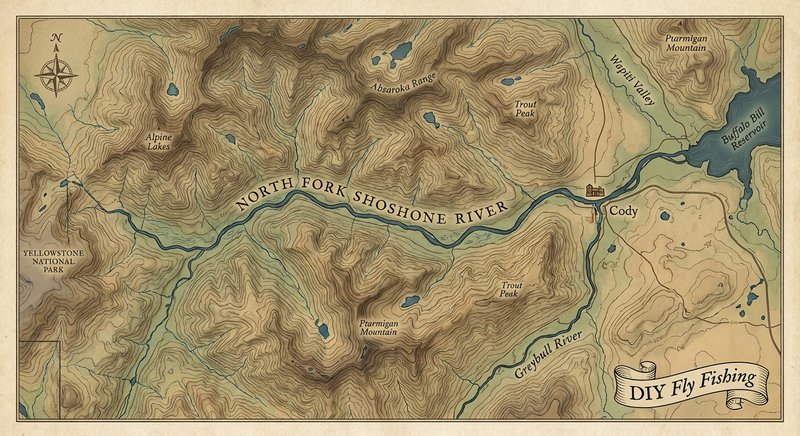
North Fork Shoshone River
Fly fishing in Wyoming · Intermediate · Best seasons: Summer, Fall
Target Species
Rainbow Trout, Brown Trout, Cutthroat Trout
About This Water
Buffalo Bill Reservoir tailwater with rainbow and brown trout. Scenic canyon drive.
Fishing Recommendations
The North Fork of the Shoshone River is often described as one of the most scenic and productive freestone rivers in the American West. Flowing from the high Absaroka Mountains down to Buffalo Bill Reservoir just west of Cody, Wyoming, this river offers a classic Rocky Mountain fly fishing experience.
Here is your comprehensive guide to fishing the North Fork.
🎣 Location Overview
The North Fork Shoshone is a high-gradient, freestone river famous for its "pocket water" and stunning volcanic rock formations. Teddy Roosevelt famously called the road alongside this river (Highway 14/16/20) "the 50 most beautiful miles in America."
What makes it special is its connectivity to Buffalo Bill Reservoir. Large, lake-run trout migrate into the river to spawn and feed, meaning you have the chance to hook a 20-inch-plus fish in a river that otherwise looks like a small mountain stream. It is wild, rugged, and offers dozens of miles of public access within the Shoshone National Forest.
🐟 Target Species & Behavior
- Yellowstone Cutthroat Trout: The native prize. They are often found in the slower seams and "soft" water near the banks. They are notorious for being opportunistic surface feeders.
- Rainbow Trout: Known for their aerial acrobatics, they prefer the faster "heavy" water, riffles, and the heads of pools.
- Brown Trout: Found primarily in the lower reaches near the reservoir and in deep, undercut banks or under large boulders. They become highly aggressive in the fall.
- Hybrids (Cut-Bows): Many fish in the system are a mix, offering the beauty of a cutthroat with the fighting power of a rainbow.
Behavioral Note: These fish are adapted to fast water. They have to make quick decisions before the current sweeps food away, making them generally less "selective" than fish on a spring creek, provided your drift is natural.
📅 Best Times to Fish
- Summer (July – August): This is the "Golden Era" on the North Fork. Once the spring runoff subsides (usually late June or early July), the river clears, and the dry fly fishing is world-class.
- Fall (September – October): This is the best time for trophy hunters. Large Brown Trout move up from the reservoir to spawn. The crowds thin out, the cottonwoods turn gold, and the water levels are easily wadeable.
- Prime Window: 10:00 AM to 4:00 PM is generally the sweet spot as the sun warms the water and triggers insect activity.
🪰 Recommended Flies & Techniques
1. The "Hopper-Dropper" (The Local Bread & Butter)
Because the water is fast and rocky, a high-buoyancy dry fly with a weighted nymph underneath is the most effective way to cover water.
- Top: Chubby Chernobyl (Size 8-12) in gold, purple, or tan.
- Bottom: A Bead-head Prince Nymph, Pheasant Tail, or Copper John (Size 14-16).
2. Dry Flies
- Attractors: Royal Wulff, Stimulators, and Humpy patterns.
- Hatches: PMDs (Pale Morning Duns) in July; Blue Winged Olives in the fall.
- Caddis: Elk Hair Caddis (tan/olive) for late evening rises.
3. Nymphing
- Pat’s Rubber Legs: The go-to stonefly imitation for deeper runs.
- San Juan Worm: Highly effective after a summer rain shower when the water gets a "tea" stain.
4. Streamers
- For the big lake-run fish, swing or strip Galloup’s Dungeon or Woolly Buggers (Olive/Black) through deep holes and behind large mid-river boulders.
💡 Pro Tips & Local Knowledge
- Fish the Pocket Water: Don't just look for big pools. On the North Fork, a "pocket" the size of a hula hoop behind a rock can hold a 17-inch trout. High-stick your rod and keep as much fly line off the water as possible to avoid drag.
- The "Reservoir Run": In early July, keep an eye on the lower sections of the river near the reservoir. There are often huge Rainbows still hanging around after their spring spawn before they drop back to the lake.
- Mind the Rocks: The rocks in the North Fork are notoriously slick and often "round." Studded wading boots and a wading staff are highly recommended.
- Wade Carefully: The river drops quickly. What looks like knee-deep water can have surprising pushing power.
⚠️ Important Information
Access
- Public Land: Most of the river flows through the Shoshone National Forest. There are numerous well-marked pull-offs and campgrounds (like Clearwater or Hanging Bridge) that offer easy river access.
- Private Property: Be cautious near the lower end toward Wapiti; there are pockets of private ranch land. Always look for WGFD (Wyoming Game & Fish) access signs.
Regulations
- License: A valid Wyoming fishing license and a Conservation Stamp are required.
- Invasive Species: If you are bringing your own waders or boat from out of state, you must have an AIS (Aquatic Invasive Species) decal and potentially an inspection.
🐻 Bear Safety (Crucial)
The North Fork Shoshone is prime Grizzly Bear habitat.
- Carry Bear Spray: Keep it on your person (not in your pack) at all times.
- Make Noise: Especially when walking through thick willows to get to the river.
- Cleanliness: If you are camping, keep a "bear-clean" camp.
Weather
Mountain weather changes in minutes. Even in August, a sunny 80°F day can turn into a 50°F thunderstorm by 3:00 PM. Always pack a high-quality rain shell.
Bug Hatches & Matching Flies
| Hatch | Type | Peak months | Time of day | Hook sizes | Matching flies |
|---|---|---|---|---|---|
| Salmonfly Pteronarcys californica | stonefly | June, July | All Day | #4-8 | Rogue River Stone #4-6, Pat's Rubber Leg #6-8, Cat Puke #6-8 |
| Blue Winged Olive Baetis | mayfly | April, May, September, October | Late Morning/Afternoon | #18-22 | RS2 #20-22, Parachute Adams #18-22, Pheasant Tail #18-20 |
| Golden Stonefly Hesperoperla pacifica | stonefly | July | All Day | #8-12 | Chubby Chernobyl (Gold) #8-12, Golden Twenty-Incher #10-12, Water Walker #10-12 |
| Pale Morning Dun Ephemerella excrucians | mayfly | July, August | Morning/Early Afternoon | #14-18 | Sparkle Dun #16-18, PMD Parachute #14-18, Military Mayfly #16-18 |
| Spotted Sedge Hydropsyche | caddis | July, August | Evening | #14-16 | Elk Hair Caddis #14-16, Holy Grail #14-16, LaFontaine's Deep Sparkle Pupa #14-16 |
| Yellow Sally Isoperla | stonefly | July | Afternoon/Evening | #14-16 | Little Yellow Sloan #14-16, Iron Sally #14-16 |
| Grasshoppers Orthoptera | terrestrial | August, September | Late Morning/Afternoon | #8-12 | Morrish Hopper #10-12, Rainy's Grand Hopper #8-12 |
| Midge Chironomidae | midge | March, April, October | Late Morning | #18-24 | Zebra Midge #18-22, Griffith's Gnat #18-22, Top Secret Midge #20-24 |