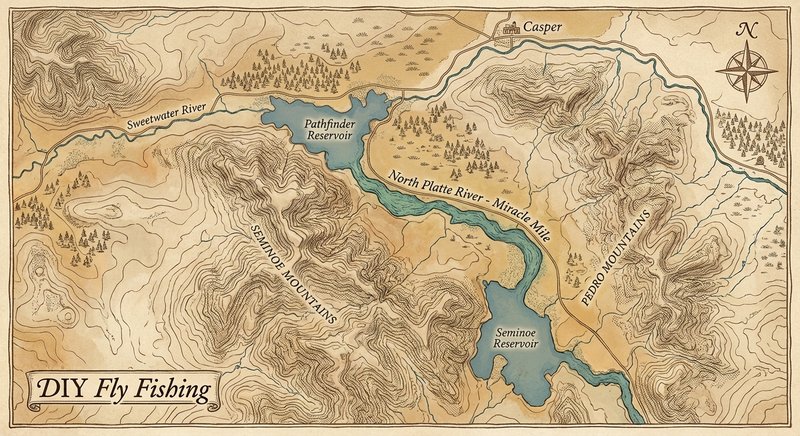
North Platte River - Miracle Mile
Fly fishing in Wyoming · Intermediate · Best seasons: Spring, Summer, Fall, Winter
Target Species
Rainbow Trout, Brown Trout
About This Water
World-class tailwater fishing for trophy trout. Year-round fishery below Kortes Dam.
Fishing Recommendations
As an expert guide who has spent countless days navigating the winds and currents of the Cowboy State, I can tell you that the Miracle Mile of the North Platte River is legendary for a reason. Located in a remote, high-desert canyon between Kortes Dam and Pathfinder Reservoir, this stretch of water is a "bucket list" destination for any serious trout angler.
Here is your comprehensive guide to fishing the Mile.
🎣 Location Overview
The "Miracle Mile" is a bit of a misnomer; depending on the water level of Pathfinder Reservoir, it is actually about 5.5 to 8 miles of blue-ribbon trout water. This is a rugged, tailwater-style environment set against the backdrop of the Pedro and Seminoe Mountains.
What makes it special: The Mile is a transition zone. It serves as a massive nursery and feeding ground for trout that migrate up from Pathfinder Reservoir. Because of the nutrient-rich water and high insect biomass, the fish here grow exceptionally large, heavy, and powerful. It’s not uncommon to hook a 20-inch fish that fights like it’s 25 inches. The scenery is desolate, wild, and quintessentially Wyoming.
🐟 Target Species & Behavior
- Rainbow Trout: These are the primary residents. They are incredibly thick-bodied and acrobatic. During the spring (March–May), huge numbers of lake-run rainbows migrate up from the reservoir to spawn.
- Brown Trout: While present year-round, the "brutes" show up in the fall. These fish move into the river to spawn and are known for their aggression. A 24-inch Brown is a very real possibility here.
Behavior: These fish are built for current. They hold in deep, walking-speed runs, behind the numerous submerged boulders, and in the "seams" where fast and slow water meet. They are opportunistic feeders but can be very depth-sensitive.
📅 Best Times to Fish
The Miracle Mile is a year-round fishery, but each season offers a different experience.
- Spring (March – May): Prime Time. This is the rainbow spawn. The river is crowded, but the fishing is prolific. Look for "redds" (spawning beds) and fish the deep water behind them.
- Summer (June – August): Great for consistent dry-fly action (Caddis and PMDs) and heavy nymphing. Water temperatures remain cool due to the dam release.
- Fall (September – November): The Trophy Hunt. This is when the big Brown trout move up. The weather can be volatile, but the streamer fishing is world-class.
- Winter (December – February): For the hardy soul. The crowds vanish. Focus on the warmest part of the day (11 AM – 3 PM) with midges and small nymphs.
Pro Timing Tip: High wind is the norm in Wyoming. If you find a day with winds under 15 mph, drop everything and go.
🪰 Recommended Flies & Techniques
Nymphing (The Bread and Butter)
90% of the fish at the Mile are caught on nymphs. Use a 9ft 6wt or 7wt rod to handle the wind and heavy indicators.
- Patterns:
- Attractors: Pine Squirrel Leeches (Red/Natural), San Juan Worms, Hot Bead Sowbugs.
- Imitators: RS2s (Grey/Olive), Chocolate Foam Wing Emergers, Pheasant Tails, and Pat’s Rubber Legs.
- Eggs: During the spring and fall, egg patterns (McFlyFoam) are essential.
Streamer Fishing
If you want a trophy Brown, pull a big fly.
- Patterns: Goldie, Sex Dungeon (Olive or Black), Peanut Envy, and Sparkle Minnows.
- Technique: Use a sink-tip line. Cast toward the banks or into deep slots and use an aggressive "strip-strip-pause" retrieve.
Dry Fly Fishing
Less common than nymphing, but explosive when it happens.
- Patterns: Chubby Chernobyls (as a hopper-dropper), Elk Hair Caddis, and Parachute Adams.
💡 Pro Tips & Local Knowledge
- The "Miracle Mile Rig": Use a heavy weight (split shot) to get your flies down fast. The current is deceptively heavy. If you aren't ticking the bottom occasionally, you aren't deep enough.
- Mind the Redds: Please do not walk on or fish directly over spawning beds (bright gravel patches). Fish the deeper holes downstream where the "feeders" are waiting for dislodged eggs.
- The Wind is Your Enemy and Friend: Use the wind to help your cast, but be careful of "wind knots." Heavy fluorocarbon tippet (2X or 3X) is recommended because these fish aren't particularly leader-shy, and they are extremely strong.
- Mobility: Don't just stay at the bridge. Walk the banks. Some of the best "honey holes" are a 20-minute hike from the main parking areas.
⚠️ Important Information
- Access: The Mile is remote. It is a roughly 40-50 mile drive on gravel roads from Casper or Sinclair. Ensure you have a full tank of gas and a spare tire. If it rains or snows heavily, these roads can become impassable "bentonite" mud.
- Regulations: Wyoming fishing license is required. Be sure to check the current Wyoming Game & Fish regulations, as some areas have specific limits on kept fish (though most anglers here practice 100% catch and release).
- Camping: There are several primitive campsites with pit toilets managed by the BLM. There are no hotels, restaurants, or shops at the Mile. Bring all the food, water, and gear you need.
- Safety: This is rattlesnake country in the summer. Keep an eye on the ground when hiking the banks.
Guide’s Final Word: The Miracle Mile is not a "manicured" fishing experience. It is raw, windy, and challenging. But when you hook into a 22-inch Rainbow that peels 40 yards of line off your reel in five seconds, you'll understand why we keep coming back.
Bug Hatches & Matching Flies
| Hatch | Type | Peak months | Time of day | Hook sizes | Matching flies |
|---|---|---|---|---|---|
| Midges Chironomidae | midge | January, February, March, April, October, November, December | All day | #18-24 | Zebra Midge #18-22, Top Secret Midge #20-24, Griffith's Gnat #18-22 |
| Blue Winged Olive (BWO) Baetis | mayfly | April, May, September, October | Late Morning/Afternoon | #18-22 | RS2 (Grey or Olive) #18-22, JujuBaetis #18-22, Parachute Adams #18-22 |
| Pale Morning Dun (PMD) Ephemerella excrucians | mayfly | June, July, August | Late Morning/Early Afternoon | #16-18 | Barr's PMD Emerger #16-18, Sparkle Dun #16-18, Frenchie #14-18 |
| Caddis Brachycentrus & Hydropsyche | caddis | May, June, July | Late Afternoon/Evening | #14-18 | Elk Hair Caddis #14-18, LaFontaine's Deep Sparkle Pupa #14-16, Peeping Caddis #14-16 |
| Golden Stonefly Hesperoperla pacifica | stonefly | June, July | Afternoon | #8-12 | Pat's Rubber Legs #8-12, Chubby Chernobyl #8-12, Gold Bead 20-Incher #10-14 |
| Yellow Sally Isoperla | stonefly | June, July | Afternoon/Evening | #14-16 | Little Yellow Sloan #14-16, Yellow Sally Nymph #14-16, Stimulator (Yellow) #14-16 |
| Trico Tricorythodes | mayfly | August, September | Early Morning | #20-24 | Trico Spinner #20-24, Sunken Trico Spinner #20-22, Drowned Trico #20-22 |
| Crane Fly Tipulidae | other | August, September | Afternoon | #10-14 | Crane Fly Larva #10-12, Daddy Long Legs #10-14 |
| Grasshoppers Orthoptera | terrestrial | August, September | Afternoon | #8-12 | Morrish Hopper #8-12, Amy's Ant #10-14, Rainy's Grand Hopper #10-12 |