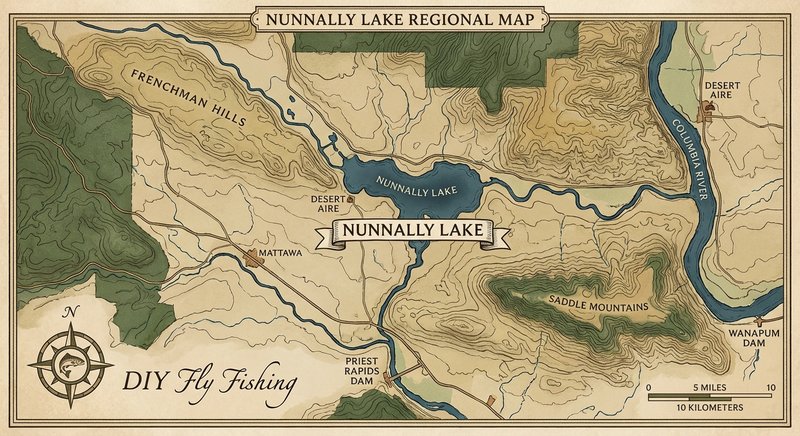
Nunnally Lake
Fly fishing in Washington · Intermediate · Best seasons: Spring, Fall
Target Species
Rainbow Trout
About This Water
Eastern Washington seep lake near Lenice. Trophy potential rainbow trout with selective gear rules.
Fishing Recommendations
Welcome to the high desert of Central Washington. As your guide, I can tell you that Nunnally Lake is one of the crown jewels of the "Seep Lakes" region near the Columbia River. This isn't your average "stocker" pond; Nunnally is a destination for serious stillwater anglers looking for quality over quantity in a rugged, basalt-rimmed setting.
🎣 Location Overview
Nunnally Lake is located within the Colockum/Quincy Wildlife Area (specifically the Desert Wildlife Area) south of I-90. It is a desert "seep" lake, meaning it is fed by underground seepage from the surrounding irrigation projects and Coulee systems.
What makes Nunnally special is its alkaline water chemistry. Like many desert lakes, it is incredibly nutrient-rich, acting like a giant "trout factory" that produces massive amounts of biomass. The water is often crystal clear, surrounded by dramatic sagebrush plateaus and basalt cliffs. Anglers love it because it offers a true "big fish" experience in a quiet, motor-free environment where technical skill is rewarded.
🐟 Target Species & Behavior
The primary target here is the Rainbow Trout. These aren't just any rainbows; Nunnally is managed for quality. You will find fish ranging from 16 to 24 inches, often with deep girths and vibrant colors.
- Behavior: These fish are highly nomadic. Because the lake has varying depths and underwater weed beds, the trout move constantly to follow hatch cycles.
- Holding Zones: Look for "drop-offs" where the shallow flats meet the deep center channel. During the heat of the day, they retreat to the cooler, deeper water, but they move into the "chironomid gardens" (weed beds in 8–15 feet of water) to feed.
- Diet: The menu is dominated by Chironomids (midges), Scuds (freshwater shrimp), Damselflies, and Water Boatmen.
📅 Best Times to Fish
Nunnally is a classic shoulder-season fishery.
- Spring (Late March – May): This is the prime window. As the ice melts and the water hits 45–50°F, the chironomid hatches begin. This is when the largest fish are caught.
- Fall (Late September – November): As water temperatures drop, trout move back into the shallows to gorge themselves before winter. This is the best time for aggressive streamer stripped along the reeds.
- Time of Day: In the spring, the "magic hour" is often 10:00 AM to 2:00 PM when the sun warms the water enough to trigger midge pupae to rise. In the fall, early morning and late evening are most productive.
🪰 Recommended Flies & Techniques
Top Fly Patterns
- Chironomids: Size 12–18. Patterns like the "Chromie," "Tiger Midge," or "Ice Man." Red, black/silver, and olive are essential colors.
- Scuds: Size 14–16 in olive or "dead grass" orange. Nunnally fish are obsessed with scuds year-round.
- Damselfly Nymphs: Size 10–12. Long, wiggly olive patterns (like a Marabou Damsel).
- Balanced Leeches: Size 8–12 in black, bruiser (black/blue), or olive.
- Water Boatmen: Size 14–16 (Essential for late fall).
Effective Techniques
- The "Indicator Rig": This is the bread and butter of Nunnally. Use a long leader (12–18 feet) to hang a chironomid or balanced leech just 12 inches off the bottom. Subtle wind-induced movement is often better than a manual retrieve.
- Sinking Lines: Use a Type 3 or Type 5 sinking line to pull bugger patterns or scuds along the edges of the weed beds.
- The "Naked" Midge: On calm days, fish a long fluorocarbon leader with a single midge pupa and no indicator, using a slow "figure-eight" retrieve.
💡 Pro Tips & Local Knowledge
- Bring a Craft: You cannot effectively fish Nunnally from the shore. The banks are marshy and the best water is out of reach. A float tube, pontoon, or kayak is mandatory.
- The "Nunnally/MarDon" Connection: The lake is sensitive to water levels. If the water is high, the fish will be deep in the flooded sagebrush at the margins—don't be afraid to cast right against the brush.
- Watch the Wind: The desert can get windy fast. Always have an anchor system for your float tube, or you’ll spend your whole day paddling against the gusts instead of fishing.
- The "Drop-Shot" Trick: If the weeds are particularly thick, use a "Balanced Leech" under an indicator. The horizontal presentation keeps the hook from fouling in the vegetation while staying in the "strike zone" just above the weeds.
⚠️ Important Information
- Access: Access is via a gravel road that can be rough; high-clearance vehicles are recommended. There is a short walk from the parking area to the water.
- Regulations: Nunnally is strictly Selective Gear Rules. This means:
- Unscented artificial flies or lures only.
- Single barbless hooks only.
- No internal combustion motors (electric motors are allowed).
- Permits: You must have a valid Washington State Freshwater Fishing License and a Discover Pass for parking on WDFW lands.
- Special Note: Nunnally is often grouped with nearby Hansen and Lenice lakes. If the fishing is slow at Nunnally, these sister lakes are within walking distance and often fish similarly.
Final Guide Advice: Keep your stealth high and your leaders long. Nunnally trout are smart, but once you hook into one of those 20-inch desert rainbows, you'll be hooked for life. Tight lines!
Bug Hatches & Matching Flies
| Hatch | Type | Peak months | Time of day | Hook sizes | Matching flies |
|---|---|---|---|---|---|
| Chironomids Chironomidae | midge | March, April, May, September, October | All Day | #10-22 | Chanter's Chironomid #12-16, Ice Tube Midge #14-18, Griffith's Gnat #18-22 |
| Callibaetis Callibaetis ferrugineus | mayfly | May, June, September | Late Morning/Afternoon | #12-16 | Pheasant Tail Nymph #14-16, Callibaetis Cripple #14-16, Parachute Adams #14-16 |
| Damselfly Enallagma | terrestrial | June, July | Morning/Afternoon | #10-12 | Marabou Damsel Nymph #10-12, Adult Damsel #12 |
| Scuds Gammarus | midge | March, April, October, November | All Day | #12-16 | Flashback Scud #14-16, Olive Ray Charles #14-16 |
| Traveling Sedge Hesperophylax | caddis | June, July | Evening | #8-12 | Mikulak Sedge #8-10, Goddard Caddis #10-12 |
| Dragonfly Nymph Anisoptera | terrestrial | May, June, July | All Day | #4-10 | Gummi Bugger #6-10, Carey Special #8-12 |
| Water Boatman Corixidae | terrestrial | September, October | Afternoon | #14-18 | Water Boatman #14-16, Prince Nymph #14-18 |
| Terrestrial Ants and Beetles Formicidae/Coleoptera | terrestrial | July, August | Afternoon | #12-18 | Black Foam Ant #14-18, Peacock Beetle #14-16 |