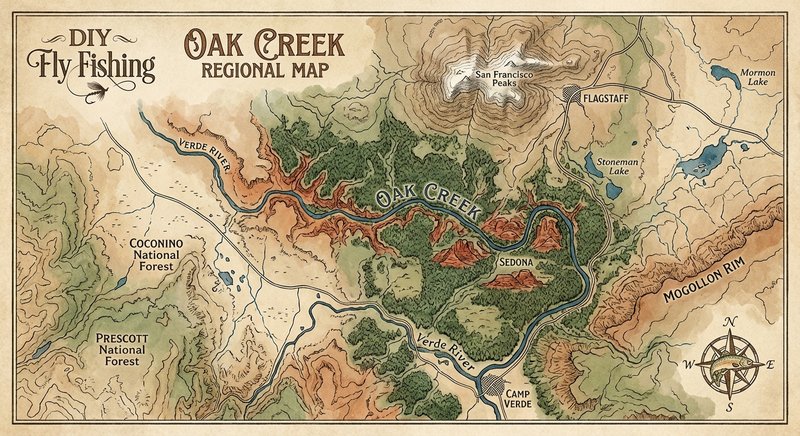
Oak Creek
Fly fishing in Arizona · intermediate · Best seasons: spring, fall
Target Species
Brown Trout, Rainbow Trout
About This Water
Scenic stream through Sedona's red rock country. Wild brown and rainbow trout in beautiful desert oasis.
Fishing Recommendations
As a guide who has spent many seasons navigating the red rocks and pocket water of the Desert Southwest, I can tell you that Oak Creek is a true gem. It is one of the most scenic trout streams in the United States, flowing through the heart of Sedona’s Coconino National Forest. It offers a unique "canyon fishing" experience where the contrast between the lush riparian corridor and the towering red sandstone cliffs is nothing short of breathtaking.
Here is your comprehensive guide to fly fishing Oak Creek.
🎣 Location Overview
Oak Creek is a spring-fed perennial stream that carves a 12-mile-long gorge through the Mogollon Rim. It is characterized by high-gradient pocket water, deep emerald pools, and long, technical "slick" runs.
What makes it special is the diversity of the water. In the upper sections (above the bridge at Encinoso), you’ll find classic mountain stream characteristics with plunge pools and riffles. As you move downstream toward Sedona, the creek widens and slows, offering more technical sight-fishing opportunities. Anglers love it because it feels like a piece of the Rockies dropped into the middle of the Arizona desert.
🐟 Target Species & Behavior
The creek is home to two primary species, each requiring a different approach:
- Wild Brown Trout: These are the "ghosts" of Oak Creek. They are wild, self-sustaining, and notoriously spooky. They hold in the undercut banks, beneath submerged logs, and in the dark shadows of the canyon walls. They are opportunistic but wary; one bad shadow or a heavy footfall will send them scurrying.
- Rainbow Trout: The Arizona Game and Fish Department (AZGFD) stocks Rainbows regularly in the "Put-and-Take" sections (mostly near the bridges and campgrounds). However, you will find "holdover" Rainbows that have survived several seasons and become quite savvy. They tend to hold in the faster oxygenated riffles and at the heads of pools.
Feeding Behavior: In the spring, they focus on aquatic larvae (nymphs) and the first hatches of the year. In the fall, they become aggressive as they prepare for the winter and the Brown Trout pre-spawn.
📅 Best Times to Fish
While you can fish Oak Creek year-round, the "Sweet Spots" are:
- Spring (March – May): This is the prime window. As the water warms, insect activity spikes. You'll see Blue Winged Olives (BWO) and Caddy hatches. Note: Keep an eye on snowmelt; if the winter was heavy, the creek can "blow out" in late March.
- Fall (Late September – November): This is my personal favorite. The crowds of swimmers disappear, the Sycamore leaves turn gold, and the Brown Trout become aggressive. Terrestrials are still active in early fall, and streamer fishing picks up.
- Best Time of Day: During the spring, 10:00 AM to 3:00 PM is the "Golden Window" for hatches. In the fall, early morning and late evening are best for the bigger, predatory Browns.
🪰 Recommended Flies & Techniques
Top Fly Patterns
- Nymphs: Zebra Midges (black/silver, red #18-22), Pheasant Tails (#16-20), Gold-Ribbed Hare’s Ear (#14-18), and Pat’s Rubber Legs (coffee/black) for higher water.
- Dry Flies: Parachute Adams (#14-18), Elk Hair Caddis (Tan/Olive #14-16), and Stimulators (#12-14) for the pocket water.
- Streamers: Woolly Buggers (Olive or Black #8-12) and Simi Seal Leeches (a local Arizona favorite).
- Terrestrials: Dave’s Hopper or Foam Beetles (late summer/early fall).
Techniques
- High-Stick Nymphing: In the plunge pools and riffles, use a light tactical nymphing setup (Euro or indicator) to keep your line off the complex currents.
- The "Stealth" Dry Fly: In the slow, clear pools, use a long leader (9ft - 12ft) tapered down to 6X or 7X fluorocarbon. You must be able to present a dry fly without a splash.
- Stripping Leeches: In the deeper pools, cast a Simi Seal Leech toward the shadows and use a slow, erratic strip.
💡 Pro Tips & Local Knowledge
- Avoid the "Swim Holes": During the day, tourists flock to Slide Rock State Park and other easy-access spots. To catch fish, you must hike away from the road. A 15-minute walk through the brush will put you in water that sees 90% less pressure.
- Shadow Management: Because the canyon walls are high, the sun hits the water at sharp angles. Always fish from the "sunny" side toward the "shady" side if possible, so your shadow doesn't fall across the fish's field of vision.
- The "Crayfish" Factor: Oak Creek has a high population of crayfish. If you are hunting for a trophy Brown Trout, swinging a rusty-orange streamer or a large weighted nymph through the deep holes can trigger a "meat-eater" strike.
- Casting: This is a tight-quarters creek. Master the Roll Cast and the Bow-and-Arrow Cast. Overhead casting is often impossible due to the dense canopy of Arizona Sycamores and Alders.
⚠️ Important Information
Access & Parking
- Red Rock Pass: You will need a Red Rock Pass (or an America the Beautiful Pass) to park at most trailheads along Highway 89A.
- Key Access Points: Cave Springs, Pine Flat, and the West Fork confluence are popular. For more solitude, explore the Call of the Canyon area.
Regulations
- Catch & Release: While some sections allow harvesting, I strongly recommend Catch and Release for all wild fish to preserve this fragile desert ecosystem.
- License: A valid Arizona fishing license is required. You can buy these online via the AZGFD website.
- Check the Gauge: Check the USGS streamflow for "Oak Creek near Sedona." Ideal flows for wading and fishing are between 20 cfs and 60 cfs. Anything over 150 cfs is getting dangerous to wade.
Special Considerations
- Water Quality: Oak Creek can occasionally have elevated E. coli levels during peak summer monsoon season due to heavy swimmer traffic. Always check local forest service advisories.
- Rattlesnakes: Be mindful when bushwhacking along the banks, especially in the spring and fall. Black-tailed and Western Diamondback rattlesnakes call this canyon home.
Tight lines, and enjoy the red rocks!
Bug Hatches & Matching Flies
| Hatch | Type | Peak months | Time of day | Hook sizes | Matching flies |
|---|---|---|---|---|---|
| Blue Winged Olive (BWO) Baetis spp. | mayfly | March, April, October, November | Late Morning/Afternoon | #18-22 | Parachute Adams #18-22, RS2 #20-22, Pheasant Tail #18-20 |
| Pale Morning Dun (PMD) Ephemerella excrucians | mayfly | June, July | Morning/Early Afternoon | #14-18 | PMD Sparkle Dun #16-18, Mercer's Poxyback PMD #16-18, Rusty Spinner #16-18 |
| Spotted Sedge / Tan Caddis Hydropsyche spp. | caddis | May, June, September | Evening | #14-18 | Elk Hair Caddis (Tan) #14-16, LaFontaine's Deep Sparkle Pupa #14-16, Caddis Variant #16-18 |
| Golden Stonefly Hesperoperla pacifica | stonefly | May, June | All Day | #8-12 | Pats Rubber Legs (Gold/Brown) #8-12, Stimulator (Orange/Yellow) #10-12, Golden Stone Nymph #10 |
| Midges Chironomidae | midge | January, February, December | All Day | #20-24 | Zebra Midge (Black/Red) #20-24, Griffith's Gnat #20-22, Top Secret Midge #22-24 |
| Terrestrials (Hopper/Ant/Beetle) Various | terrestrial | July, August, September | Late Morning/Afternoon | #10-16 | Dave's Hopper #10-12, Black Foam Ant #14-16, Fat Albert #12 |
| Yellow Sally Isoperla spp. | stonefly | June, July | Afternoon/Evening | #14-16 | Yellow Sally Stone #14-16, Iron Lotus #16, Little Yellow Sloan #14 |
| Trico Tricorythodes spp. | mayfly | August, September | Early Morning | #20-24 | Trico Spinner #22-24, Sunray Trico #22, Black Sparkle Dun #20 |