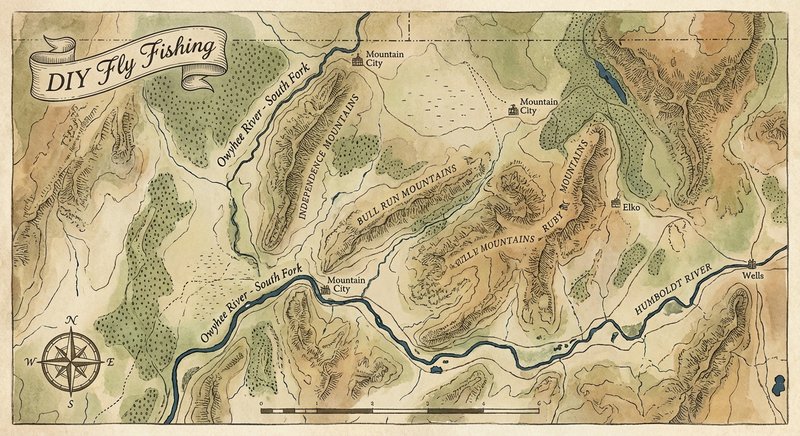
Owyhee River - South Fork
Fly fishing in Nevada · advanced · Best seasons: spring, summer, fall
Target Species
Redband Trout, Brown Trout
About This Water
Northeastern Nevada stream with wild redband trout. Remote canyon fishing.
Fishing Recommendations
The South Fork of the Owyhee River in Nevada is a hidden gem for the adventurous angler. Unlike its famous cousin, the tailwater section in Oregon, the Nevada stretch is a rugged, remote, and wild freestone-style river flowing through dramatic high-desert canyons. This is "big country" fishing where solitude is guaranteed, but the terrain demands respect.
🎣 Location Overview
The South Fork of the Owyhee originates in the high desert of Elko County, Nevada. It is characterized by deep basalt canyons, sagebrush plateaus, and a riverbed filled with volcanic "pocket water," deep pools, and long riffles.
What makes this water special is the isolation. You are far from any major city, often fishing in total solitude. The river is wild and unregulated by large dams in this stretch, meaning it behaves like a true mountain freestone. Anglers love it for the hardy, hard-fighting native Redband trout and the chance to hook into wild Brown trout in a spectacular wilderness setting.
🐟 Target Species & Behavior
- Interior Redband Trout: These are the stars of the Owyhee. Redbands are a subspecies of rainbow trout adapted to the harsh, fluctuating temperatures of the high desert. They are incredibly opportunistic, aggressive, and known for their aerial acrobatics when hooked.
- Brown Trout: Found primarily in the deeper holes and undercut banks. The Browns here can grow to impressive sizes by feeding on smaller trout and large crayfish.
Behavior:
- Redbands love fast, highly oxygenated water. Look for them in the "pocket water" behind boulders and in the bubbly "heads" of pools.
- Browns are more secretive. They hold in the shadows of canyon walls or deep under overhanging brush. During the heat of the day, they retreat to the deepest slots.
📅 Best Times to Fish
- Spring (Late May - June): This is the prime window once the spring runoff (freshet) begins to recede. This coincides with the legendary Salmonfly and Golden Stonefly hatches. If you hit this right, the largest fish in the river will rise to massive dries.
- Summer (July - August): The water drops and clears. This is Terrestrial Season. While the afternoons can be hot, the fishing remains excellent with grasshopper patterns. Stick to early mornings and late evenings to avoid the desert heat.
- Fall (September - October): Perhaps the most beautiful time. The air cools, the brush turns gold, and the Brown trout become aggressive as they prepare for the spawn. Water levels are at their lowest, making the river very easy to wade and read.
🪰 Recommended Flies & Techniques
Top Fly Patterns
- Dry Flies:
- Chubby Chernobyl (Size 6-10): The gold standard here. Works as a Salmonfly imitation or a general attractor.
- Morrish Hopper (Size 8-12): Lethal in late summer.
- Elk Hair Caddis (Size 14-18): For the evening hatches.
- Nymphs:
- Pat’s Rubber Legs (Tan/Brown): Represents the stonefly nymphs that crawl the bottom.
- Copper John (Red or Blue): A great "flashy" attractor in the riffles.
- Bead-head Pheasant Tail: Best for mimicking the smaller mayflies.
- Streamers:
- Sculpzilla or Woolly Bugger (Olive/Black): Large Browns love to chase sculpin and crayfish imitations in the deep pools.
Effective Techniques
- Dry-Dropper: This is the most effective way to cover the Owyhee. Use a large, buoyant Hopper or Chubby Chernobyl as your "indicator" and hang a weighted nymph (like a Pheasant Tail) 2–3 feet below it.
- High-Sticking: In the rocky canyon stretches, use short casts to "flick" your flies into small pockets of calm water behind rocks.
- Pound the Banks: When the wind blows (which it often does in Nevada), fish the hoppers right against the grass edges.
💡 Pro Tips & Local Knowledge
- The Canyon Factor: The best fishing is often found by hiking away from the road access points. The further you are willing to trek into the canyon, the less pressured the fish are.
- Crayfish are Key: The Owyhee is loaded with crayfish. If the dry fly action is slow, swinging a rust-colored streamer through deep slots can produce the biggest fish of the day.
- Watch the Water Temp: Because this is a desert river, water temperatures can spike in August. If the water hits 70°F, stop fishing to protect the trout—they are hardy, but high temps are lethal.
- Stealth Matters: The water is often crystal clear in the fall. Wear earthy tones and avoid "lining" the fish (casting your fly line directly over their heads).
⚠️ Important Information
- Access: Much of the river is on BLM (Bureau of Land Management) land, but there are patches of private ranch land. Always check a map (like OnX) to ensure you are on public water.
- Vehicle Prep: Many access roads are rugged dirt tracks. A high-clearance 4WD vehicle is highly recommended, and always carry a spare tire.
- Safety: This is Rattlesnake country. Be extremely careful when walking through tall grass or climbing over boulders. Also, there is virtually no cell service in the canyons—tell someone where you are going.
- Regulations: A valid Nevada fishing license is required. Always check the current Nevada Department of Wildlife (NDOW) regulations for bag limits, though Catch and Release is strongly encouraged to preserve the wild Redband population.
Bug Hatches & Matching Flies
| Hatch | Type | Peak months | Time of day | Hook sizes | Matching flies |
|---|---|---|---|---|---|
| Blue Winged Olive Baetis spp. | mayfly | March, April, September, October | Late Morning/Afternoon | #18-22 | RS2 #18-22, Parachute Adams #18-22, Baetis Nymph #18-20 |
| Midges Chironomidae | midge | January, February, March, November, December | All Day | #20-26 | Zebra Midge #20-24, Griffith's Gnat #20-22, Top Secret Midge #22-24 |
| Pale Morning Dun Ephemerella excrucians | mayfly | June, July | Late Morning/Early Afternoon | #16-18 | PMD Sparkle Dun #16-18, Pheasant Tail #16-18, Quigley Cripple #16-18 |
| Spotted Sedge Hydropsyche | caddis | June, July, August | Late Afternoon/Evening | #14-18 | Elk Hair Caddis #14-18, LaFontaine's Deep Sparkle Pupa #14-16, Hydropsyche Larva #14-16 |
| Grasshoppers Orthoptera | terrestrial | July, August, September | Late Morning/Afternoon | #8-12 | Morrish Hopper #10-12, Dave's Hopper #8-12, Thunder Thighs Hopper #10-12 |
| Golden Stonefly Hesperoperla pacifica | stonefly | June, July | All Day | #8-12 | Pats Rubber Legs #8-12, Chubby Chernobyl #10-12, Golden Stone Nymph #10-12 |
| Trico Tricorythodes | mayfly | August, September | Early Morning | #20-24 | Trico Spinner #20-24, Sunken Trico Spinner #22-24 |
| Mormon Cricket Anabrus simplex | terrestrial | June, July | All Day | #4-8 | Mormon Cricket Crickets #6-8, Black Fat Albert #6-8 |