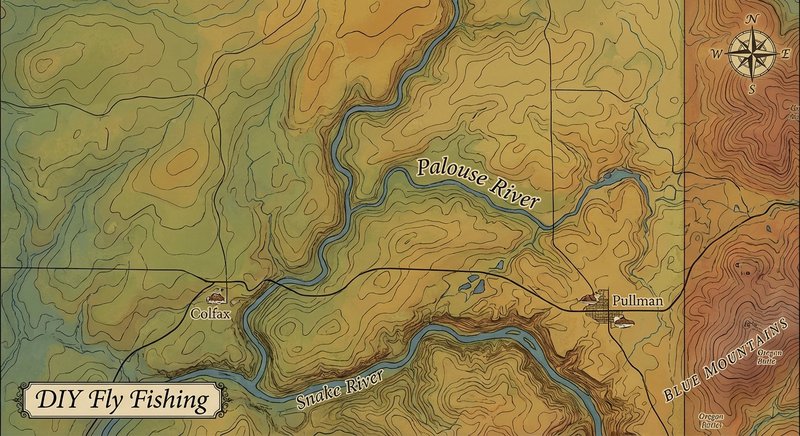
Palouse River
Fly fishing in Washington · Beginner · Best seasons: Spring, Fall
Target Species
Rainbow Trout, Brown Trout
About This Water
Eastern Washington river with rainbow trout. Flows through agricultural Palouse country.
Fishing Recommendations
As an expert guide who has spent years navigating the basalt-rimmed canyons and rolling hills of the Inland Northwest, I can tell you that the Palouse River is a unique, often overlooked gem. While many anglers rush to the Spokane or the Clearwater, the Palouse offers a gritty, rewarding experience for those who know how to read its moody waters.
Here is your comprehensive guide to fly fishing the Palouse River for Rainbow and Brown Trout.
🎣 Location Overview
The Palouse River is a tale of two rivers. While the lower reach is famous for the massive Palouse Falls and its confluence with the Snake River (Smallmouth Bass territory), the Upper Palouse and the North Fork are where trout anglers find their sanctuary.
Flowing through the iconic rolling loess hills of southeastern Washington, the river is characterized by slow-moving glides, deep silt-bottomed pools, and dramatic stretches where it cuts through ancient basalt bedrock. It is not a classic "mountain freestone" stream; it is a productive, nutrient-rich fishery. The water often has a "tea" stain or slight turbidity due to the surrounding agricultural landscape, which allows trout—especially large Browns—to grow quickly and stay hidden.
🐟 Target Species & Behavior
Brown Trout
The Brown Trout are the kings of the Palouse. They are hardy, wary, and often reach impressive sizes for a river of this volume.
- Behavior: They are highly piscivorous (fish-eaters). They love structure—look for them under overhanging willows, tucked against basalt walls, or in deep undercut banks.
- Feeding: They move into the shallows to feed during low-light conditions (dawn/dusk) but spend the day buried in deep, slow holes.
Rainbow Trout
The Rainbows here are often more opportunistic and found in the swifter "pocket water" or at the heads of pools where oxygen levels are higher.
- Behavior: They are more likely to rise for a hatch than the Browns. Look for them in the riffles and the transitions between fast and slow water.
📅 Best Times to Fish
Optimal Seasons
- Spring (Late April – June): This is prime time, provided the spring runoff hasn't turned the river to "chocolate milk." As the water clears and warms to the 50°F range, the insect life explodes.
- Fall (September – November): My personal favorite. The water cools, the weeds die back, and the Brown Trout become aggressive as they prepare for the spawn. The colors of the Palouse hills against the water are spectacular.
Best Times of Day
- Spring: Mid-day (11 AM – 4 PM) when the sun warms the water enough to trigger hatches.
- Fall: Morning and late evening. On overcast days, the "streamer bite" for big Browns can stay active all day.
🪰 Recommended Flies & Techniques
Nymphing (The Bread & Butter)
Because the Palouse can be turbid, fly visibility is key.
- Patterns:
- Pats Rubber Legs (Size 8-12) in Black or Tan: A staple for mimicking the large stoneflies.
- Bead-head Prince Nymphs or Flashback Pheasant Tails: The extra flash helps fish spot the fly in stained water.
- San Juan Worms: Highly effective after a light rain.
Streamer Fishing (For the Trophy Browns)
If you want a Palouse "Wall Hanger," you have to throw meat.
- Patterns:
- Sculpzilla (Olive or Black): Mimics the sculpins that hide in the basalt rocks.
- Woolly Buggers (Size 6-10) in Black or Dark Olive.
- Technique: "Pounding the banks." Cast tight to the structure and use an erratic strip-and-pause retrieve.
Dry Flies
- Patterns:
- Caddis (Elk Hair or Goddard): Best in the late spring evenings.
- Hopper Patterns (August/Sept): The Palouse is "hopper heaven." A foam-bodied grasshopper dropped near a grassy bank is deadly.
💡 Pro Tips & Local Knowledge
- The "Mud" Factor: If the river looks too muddy to fish, don't give up. Look for the tributary mouths or the North Fork. The North Fork often clears faster than the main stem.
- The "Slow Glide" Secret: Don't bypass the slow, froggy-looking water. In many rivers, this is "dead water," but in the Palouse, these deep glides often hold the largest Brown Trout. Use a slow-sinking tip and a streamer.
- Stealth is Key: Because the river isn't huge, vibration travels. Avoid wading heavy; stay on the banks where possible and keep a low profile.
- Focus Areas: The stretch between Colfax and Elberton is classic trout water. The area near the Palouse Divide on the Idaho/Washington border offers more of a forested, mountain-stream feel.
⚠️ Important Information
Access
- Much of the Palouse runs through private agricultural land. Always ask for permission if you aren't at a public bridge crossing or a designated fishing access site.
- The Palouse River Canyon sections are rugged; be prepared for steep hikes and rattlesnakes during the warmer months.
Regulations & Permits
- License: You need a valid Washington State freshwater fishing license.
- Rules: Always check the current WDFW (Washington Department of Fish and Wildlife) pamphlet. Generally, the river is open year-round, but specific sections may have "selective gear rules" (no bait, barbless hooks).
- Conservation: I strongly recommend Catch and Release for all wild Brown Trout to maintain the quality of this fragile fishery.
Safety
- Cell Service: It is spotty to non-existent in the canyons. Let someone know where you are going.
- Ticks & Snakes: In the spring, ticks are thick in the tall grass. In the summer/fall, keep an eye out for Western Rattlesnakes sunning on the basalt rocks.
Bug Hatches & Matching Flies
| Hatch | Type | Peak months | Time of day | Hook sizes | Matching flies |
|---|---|---|---|---|---|
| Blue Winged Olive Baetis tricaudatus | mayfly | March, April, October, November | Late Morning/Afternoon | #18-22 | RS2 #18-22, Parachute Adams #18-20, WD-40 #20-22 |
| Mother's Day Caddis Brachycentrus occidentalis | caddis | May | Afternoon/Evening | #14-16 | Elk Hair Caddis #14-16, Peacock Caddis #14-16, Deep Sparkle Pupa #14-16 |
| Pale Morning Dun Ephemerella excrucians | mayfly | June, July | Morning | #14-18 | PMD Sparkle Dun #16-18, Pheasant Tail Nymph #14-18, Hare's Ear Nymph #14-16 |
| Golden Stonefly Hesperoperla pacifica | stonefly | June, July | All Day | #8-12 | Pat's Rubber Leg #8-12, Chubby Chernobyl #10-12, Golden Rogue Foam Stone #10-12 |
| Midges Chironomidae | midge | January, February, March | Late Morning | #18-24 | Zebra Midge #18-22, Griffith's Gnat #20-22, Morgan's Midge #20-24 |
| Grasshoppers Acrididae | terrestrial | July, August, September | Afternoon | #8-12 | Morrish Hopper #10-12, Dave's Hopper #10-12, Joe's Hopper #8-12 |
| Trico Tricorythodes | mayfly | August, September | Early Morning | #20-24 | Trico Spinner #20-24, Sunken Trico #22-24 |
| October Caddis Dicosmoecus atripes | caddis | September, October | Evening | #8-12 | Orange Stimulator #8-10, Peeking Caddis #10-12, October Caddis Pupa #10 |