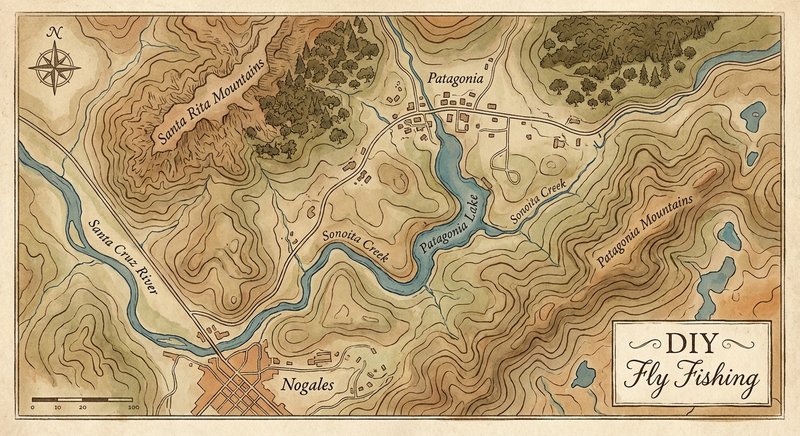
Patagonia Lake
Fly fishing in Arizona · beginner · Best seasons: fall, winter, spring
Target Species
Rainbow Trout
About This Water
State park lake with year-round trout stocking. Winter fishing excellent.
Fishing Recommendations
Welcome to the high desert of Southern Arizona. As your guide, I’m excited to walk you through Patagonia Lake State Park. While Arizona is often associated with cactus and heat, Patagonia Lake serves as a vital winter "cool water" fishery. Nestled in the rolling hills near the Mexican border, it offers a unique opportunity to catch Rainbow Trout in a Sonoran Desert setting.
🎣 Location Overview
Patagonia Lake is a 265-acre man-made reservoir created by damming Sonoita Creek. It is the crown jewel of Patagonia Lake State Park. What makes this area special is the contrast: you are surrounded by mesquite trees and saguaros, yet you are casting for trout.
The water is generally stained (low visibility) compared to high-mountain lakes, and it is characterized by heavy cattail shorelines, submerged mesquite brush, and a few deep channels near the dam. For the fly angler, it is a "tactical" lake—it’s not about long, beautiful river casts, but rather about finding where the stocked trout are schooling and presenting flies effectively in murky water.
🐟 Target Species & Behavior
The primary target for fly anglers in the cooler months is the Rainbow Trout.
- Behavior: These are stocked fish, brought in by the Arizona Game and Fish Department (AZGFD). Upon release, they tend to congregate near the boat ramps and marina. Within a few days, they move toward the deeper, cooler water near the dam or follow the old creek channel.
- Feeding: Because they are hatchery-raised, they are initially "pellet-focused." However, they quickly adapt to the lake's natural snacks: Chironomids (midges), Leptophlebia mayflies, and Threadfin Shad. They also cruise the cattail edges looking for damselfly nymphs.
📅 Best Times to Fish
- Optimal Months: November through March. This is the only window for trout, as the water temperatures become too high for salmonids during the rest of the year.
- Best Time of Day: Unlike summer fishing, you don't need to be there at the crack of dawn. In the winter, the "bite" often turns on between 10:00 AM and 2:00 PM as the sun warms the surface slightly, activating insect life.
- Prime Windows: Check the AZGFD Stocking Schedule online. The 48 hours following a stocking truck's visit are the most productive, though the fish are less "wild" in their behavior then.
🪰 Recommended Flies & Techniques
Top Fly Patterns
- Simi Seal Leech (Olive, Black, or "Peacock"): This is the legendary Arizona stillwater fly. It imitates leeches, damselflies, and small baitfish.
- Zebra Midge (Size 16-20, Red or Black): The most consistent producer. Use a silver bead to catch what little light penetrates the water.
- Woolly Bugger (Size 8-12, White or Chartreuse): White works exceptionally well here because it mimics the flash of a stressed Threadfin Shad.
- Egg Patterns (Pink or Orange): Highly effective for recently stocked trout that are still looking for high-protein, brightly colored drift.
Techniques
- Indicator Nymphing: Suspend a Zebra Midge or a small pheasant tail 4 to 8 feet under a slip-indicator. Fish this along the edges of the cattails.
- Stripping Streamers: Use an intermediate sinking line. Cast toward the shore or structure, let it sink for 5–10 seconds, and use a slow, erratic "strip-strip-pause" retrieve.
- The "Float Tube" Advantage: Because the shoreline is thick with cattails, shore access for fly casting is limited. A float tube or kayak is the "secret weapon" here, allowing you to fish the spots shore anglers can't reach.
💡 Pro Tips & Local Knowledge
- Find the Channel: Use a depth finder or a topographical map to locate the submerged Sonoita Creek channel. Trout use this "highway" to move from the marina toward the dam.
- The "Inflow" Spot: At the eastern end of the lake, where Sonoita Creek enters, the water is shallower and often carries more oxygen and nutrients. If there has been recent rain, trout will congregate here to feed on washed-in terrestrial insects.
- Avoid the Crowd: The area near the main boat ramp is often crowded with bait fishermen. Take a kayak or hike the "Birding Trail" to reach the quieter northern banks where the fish are less pressured.
- Color Matters: Because the water is often turbid (cloudy), don't be afraid to use flies with flash (Krystal Flash) or hot spots (fluorescent beads).
⚠️ Important Information
- Access: Entry requires a State Park day-use fee (usually $15–$20 per vehicle).
- Regulations: You must have a valid Arizona Fishing License. There are no "trout stamps" anymore; a standard license covers all species.
- Boating: Gas motors are allowed, but there is a "no-wake" restriction on the upper half of the lake.
- Special Note: This is a "put-and-take" fishery. While many fly anglers practice catch-and-release, be aware that most people around you will be keeping their limit (currently 4 trout per day).
- Waders: Even in the desert, winter water is cold. 5mm neoprene or breathable waders with warm layers underneath are essential if you are in a float tube.
Guide’s Final Word: Patagonia Lake isn't a "wild" experience, but on a crisp January afternoon when the sun is out and the trout are rising to midges against a backdrop of desert bluffs, it is one of the most pleasant places in the Southwest to have a fly rod in your hand.
Bug Hatches & Matching Flies
| Hatch | Type | Peak months | Time of day | Hook sizes | Matching flies |
|---|---|---|---|---|---|
| Chironomids (Midges) Family Chironomidae | midge | January, February, March, November, December | All day | #18-24 | Zebra Midge #18-22, Griffith's Gnat #20-22, Blood Worm #14-18 |
| Damselflies Suborder Zygoptera | terrestrial | May, June, July | Morning/Afternoon | #10-14 | Marabou Damselfly Nymph #10-12, Adult Damselfly #12-14 |
| Callibaetis Mayfly Callibaetis spp. | mayfly | April, May, September, October | Morning | #12-16 | Callibaetis Spinner #14-16, Hare's Ear Nymph #12-16, Parachute Adams #14-16 |
| Dragonflies Suborder Anisoptera | terrestrial | June, July, August | Afternoon | #4-10 | Dragonfly Nymph #6-10, Foam Dragonfly #6-8 |
| Grasshoppers Family Acrididae | terrestrial | July, August, September | Afternoon | #6-12 | Dave's Hopper #8-12, Parachute Hopper #10-12 |
| Water Boatmen Family Corixidae | terrestrial | September, October | All day | #14-16 | Water Boatman #14-16, Prince Nymph #14-16 |
| Crayfish Orconectes spp. | terrestrial | April, May, June, July | Evening/Night | #2-8 | Clouser Minnow (Crayfish colors) #4-6, Near Nuff Crayfish #6-8 |
| Scuds Order Amphipoda | terrestrial | February, March, April | All day | #14-18 | Ray Charles #14-18, Scud (Olive or Pink) #14-16 |