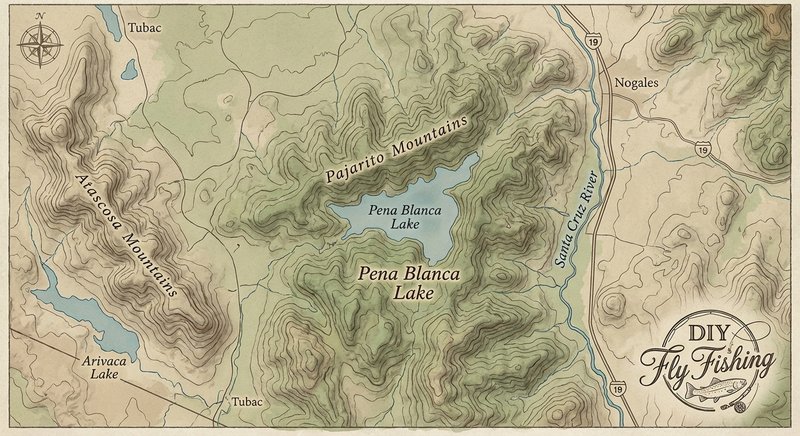
Pena Blanca Lake
Fly fishing in Arizona · beginner · Best seasons: fall, winter, spring
Target Species
Rainbow Trout
About This Water
Coronado National Forest lake with trout. Scenic canyon setting near Nogales.
Fishing Recommendations
Pena Blanca Lake is a hidden gem tucked into the Pajarito Mountains of the Coronado National Forest, just a stone's throw from the Mexican border. As a guide who has fished the arid Southwest extensively, I can tell you that this 49-acre "canyon lake" offers a unique experience: catching trout in a rugged, high-desert environment surrounded by dramatic rock bluffs and oak-juniper woodlands.
Here is your comprehensive guide to fly fishing for Rainbow Trout at Pena Blanca Lake.
🎣 Location Overview
Pena Blanca is a narrow, deep reservoir that feels more like a flooded canyon than a traditional lake. Its name, "White Rock," comes from the stunning white limestone cliffs that line its shores.
What makes it special is the contrast. You are fishing in the desert, yet the Arizona Game and Fish Department (AZGFD) stocks it heavily with Rainbow Trout from roughly October through March. Because the lake is relatively small and protected from the wind by high canyon walls, it is an ideal spot for float tubes, kayaks, and bank anglers alike. The water clarity varies from stained to remarkably clear, depending on recent monsoon runoff or winter rains.
🐟 Target Species & Behavior
While the lake holds "warm water" species like Largemouth Bass and Crappie year-round, the Rainbow Trout are the stars of the winter season.
- Behavior: These are hatchery-raised fish. Upon initial stocking, they tend to cruise the upper water column in schools. As they acclimate, they begin to hold near structure—specifically the steep canyon walls and the submerged brush in the "fingers" of the lake.
- Feeding: In the winter, their metabolism slows, but they remain opportunistic. They focus on the abundant midge (chironomid) hatches, small crustaceans (scuds), and the occasional terrestrial that falls from the overhanging oaks.
📅 Best Times to Fish
- Optimal Seasons: November through March. This is the "trout window." Once the water temperature rises above 70°F in late spring, the trout will stop feeding and eventually perish, making way for the bass season.
- Best Times of Day:
- Early Morning (Dawn to 10 AM): Trout will be in the shallows and near the surface.
- Late Afternoon/Dusk: The "evening rise" can be spectacular if there is a midge hatch.
- Prime Conditions: Overcast days are the "secret weapon" here. The low light brings the fish out from the depths and makes them much less wary of leaders and shadows.
🪰 Recommended Flies & Techniques
Top Fly Patterns
- Streamers:
- Woolly Buggers (Size 8-12) in Olive, Black, or White. White is surprisingly effective here due to the light-colored rock reflections.
- Simi Seal Leeches (Size 10-12) in Blood Leech or Peacock.
- Nymphs:
- Zebra Midges (Size 18-22) in Red/Silver or Black/Silver. This is the most consistent producer.
- Gold-Ribbed Hare’s Ear (Size 14-16) to mimic general nymphs.
- Dry Flies:
- Griffith’s Gnat (Size 18-22) for midge clusters.
- Parachute Adams (Size 16-18) for general prospecting during a rise.
Effective Techniques
- The "Slow Strip": Using a slow, rhythmic pull-pull-pause retrieve with a Woolly Bugger on an intermediate sinking line is the deadliest way to cover water.
- Indicator Nymphing: Suspend a Zebra Midge 4 to 8 feet below a small indicator. Focus on the drop-offs where the shallow flats meet the deep canyon channel.
- The "Count Down": If fishing from the shore, cast out, count to 10 to let your fly sink to the "thermocline" where trout are holding, and then begin a slow retrieve.
💡 Pro Tips & Local Knowledge
- Work the Shadows: Because of the steep canyon walls, parts of the lake stay in the shade longer. Trout feel safer in the shadows; follow the shade lines as they move across the water throughout the day.
- The "Upper Fingers": Most people fish near the boat ramp or the fishing pier. If you have a float tube or kayak, head to the narrow northern "fingers" of the lake. The water is shallower here, and the fish often congregate where the creek beds enter the lake.
- Go Small: If the bite is tough, drop your tippet size to 6X and use the smallest Zebra Midge in your box. These fish see a lot of "PowerBait" from shore anglers; a tiny, realistic midge often triggers a strike from a wary trout.
- The Dam Wall: The water is deepest near the dam. During mid-day when the sun is high, trout often retreat here. Use a full-sink line to get down to them.
⚠️ Important Information
- Access: Located about 15 miles northwest of Nogales via Ruby Road (Hwy 289). The road is paved all the way to the lake.
- Regulations: An Arizona Fishing License is required for all anglers 10 years and older. You can purchase these online via the AZGFD website.
- Mercury Advisory: There is a long-standing mercury advisory for Pena Blanca Lake. While it is safe to catch and release, check the current AZGFD guidelines before consuming any fish (especially warm-water species).
- Safety & Surroundings: This is a border region. While the lake area is generally very safe and popular with families, always be aware of your surroundings and keep your vehicle locked.
- Tonto Pass: Note that you may need a Tonto Daily Pass or a Coronado National Forest day-use fee (check local kiosks as requirements change).
Guide’s Final Word: Pena Blanca is all about the atmosphere. There's nothing quite like watching a Rainbow Trout rise while a Coati scampers along the white cliffs nearby. Bring a 4-weight or 5-weight rod, a box of midges, and enjoy one of the most unique trout fisheries in the American West.
Bug Hatches & Matching Flies
| Hatch | Type | Peak months | Time of day | Hook sizes | Matching flies |
|---|---|---|---|---|---|
| Chironomids Chironomidae | midge | February, March, October, November | All Day | #18-24 | Zebra Midge #18-22, Griffith's Gnat #20-24, Chironobone #18-20 |
| Damselflies Enallagma | other | May, June, July | Mid-morning to Afternoon | #10-14 | Marabou Damsel Nymph #10-14, Adult Damsel #12-14 |
| Callibaetis Callibaetis ferrugineus | mayfly | April, May, September | Morning | #14-16 | Callibaetis Nymph #14-16, Parachute Callibaetis #14-16 |
| Water Boatmen Corixidae | other | September, October | Afternoon | #14-18 | Water Boatman #14-16, Prince Nymph (small) #16-18 |
| Dragonflies Anisoptera | other | June, July, August | All Day | #4-10 | Dragon Leary #6-10, Woolly Bugger (Olive) #4-10 |
| Cinnamon Caddis Hydropsyche | caddis | May, June | Evening | #14-16 | Elk Hair Caddis (Cinnamon) #14-16, Pupa #14-16 |
| Terrestrial Ants Formicidae | terrestrial | July, August, September | Afternoon | #12-18 | Black Foam Ant #14-18, Cinnamon Ant #14-16 |
| Grasshoppers Acrididae | terrestrial | August, September | Afternoon | #8-12 | Dave's Hopper #10-12, Joe's Hopper #8-12 |