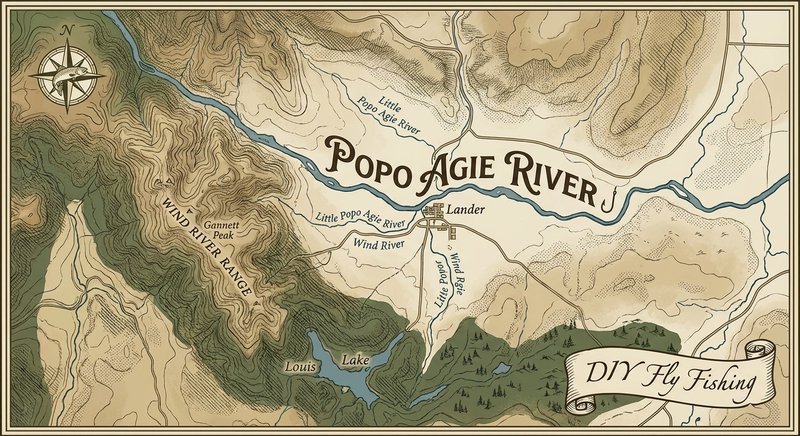
Popo Agie River
Fly fishing in Wyoming · Beginner · Best seasons: Summer, Fall
Target Species
Rainbow Trout, Brown Trout, Brook Trout
About This Water
Wind River Range stream near Lander with rainbow and brown trout. Sinks Canyon access.
Fishing Recommendations
The Popo Agie River (pronounced puh-POH-shuh) is one of Wyoming’s most enchanting and underrated fisheries. Tucked away in the foothills of the Wind River Range near the town of Lander, it offers a quintessential freestone experience. Whether you are fishing the high-gradient pocket water of Sinks Canyon or the meandering braids closer to town, the Popo Agie provides diverse water for every skill level.
🎣 Location Overview
The Popo Agie consists of three main forks—North, Middle, and South—that eventually converge. The Middle Fork is the most famous, flowing through the dramatic Sinks Canyon State Park. Here, the river literally disappears into a limestone cavern (The Sinks) and reappears 1/4 mile downstream in a giant pool (The Rise).
Anglers love this river because it feels intimate. It isn't a massive "big rig" drift boat river; it is a technical, beautiful wade-fishing paradise. The water is gin-clear, the scenery is dominated by towering limestone and granite cliffs, and the fish are wild and spunky.
🐟 Target Species & Behavior
The Popo Agie is a "grand slam" kind of river where you can catch multiple species in a single session.
- Brown Trout: The kings of the lower sections and the deeper holes in the canyon. They are wary and love undercut banks, submerged logs, and the dark shadows of boulders.
- Rainbow Trout: Found throughout the Middle Fork. They tend to hold in the faster riffles and the "seams" where fast and slow water meet. They are aggressive feeders during hatches.
- Brook Trout: Primarily found in the higher elevations and the smaller tributaries of the North and South Forks. They are opportunistic and will often rise to a dry fly even when no hatch is present.
📅 Best Times to Fish
Optimal Seasons
- Summer (Late June – August): Once the spring runoff subsides (usually by late June), the fishing explodes. This is prime time for dry fly action and high-country exploration.
- Fall (September – October): My personal favorite. The crowds vanish, the Cottonwoods turn gold, and the Brown Trout become aggressive as they prepare to spawn. Flows are low and stable, making the water very easy to wade.
Best Times of Day
- Summer: Early morning (6 AM – 10 AM) and "the magic hour" before sunset.
- Fall: Mid-day is best. Wait for the sun to warm the water slightly to trigger insect activity (11 AM – 4 PM).
🪰 Recommended Flies & Techniques
Top Fly Patterns
- Dries:
- Stimulators (Size 12-16) in orange or yellow—great for the high-gradient water.
- Parachute Adams (Size 14-18)—the ultimate generalist.
- Elk Hair Caddis (Size 14-16)—a staple for evening rises.
- Hopper patterns (Size 10-12) in August/September.
- Nymphs:
- Prince Nymph (Size 14-16)—the "bead-head" version is deadly here.
- Pheasant Tail (Size 16-20)—perfect for technical tailwaters or slow glides.
- Pats Rubber Legs (Size 8-12)—essential for high water or targeting big Browns.
- Streamers:
- Gold Ribbed Hare’s Ear or Woolly Buggers (Olive or Black, Size 8-12).
Effective Techniques
- The Dry-Dropper: This is the "bread and butter" of the Popo Agie. Use a high-visibility foam hopper or Stimulator as your indicator and hang a small Pheasant Tail or Hare's Ear 18–24 inches below it.
- Pocket Water Nymphing: In Sinks Canyon, the water moves fast. Use a "high-sticking" technique to keep your line off the conflicting currents and drop your nymphs directly behind large boulders.
- Streamer Stripping: In the deeper pools below Lander, a slow-stripped Woolly Bugger can entice the larger, more territorial Brown Trout.
💡 Pro Tips & Local Knowledge
- The "Rise" Exception: You cannot fish at "The Rise" inside Sinks Canyon State Park (where the massive trout congregate for tourists to feed). However, you can fish just outside the park boundaries where those same fish eventually migrate.
- Stealth is Key: Because the water is so clear, the fish can see you from a distance. Wear earthy tones (no bright white hats) and approach the banks slowly.
- Explore the North Fork: If the Middle Fork feels crowded, head to the North Fork. It’s smaller water but offers incredible solitude and high catch rates for smaller, eager Brookies and Rainbows.
- The "Lander Loop": Don’t overlook the water running right through the town of Lander. The city parks offer great access and surprisingly good fishing for decent-sized Browns.
⚠️ Important Information
- Access: Much of the river near town and downstream is private. Always look for WGFD (Wyoming Game and Fish Department) Public Access signs. Sinks Canyon State Park and the Shoshone National Forest offer the best public access.
- Regulations: A valid Wyoming fishing license is required. Be sure to check the current Wyoming Fishing Regulations booklet for any seasonal closures or tackle restrictions (though most of the Popo Agie is open to general regulations).
- Wildlife Safety: This is bear country. While Grizzly sightings are rarer here than in Yellowstone, Black Bears are common. Carry bear spray if you are hiking into the more remote forks.
- Rattlesnakes: In the dry, rocky sections of Sinks Canyon during mid-summer, keep an eye out for Western Rattlesnakes near the water's edge.
Guide’s Final Word: The Popo Agie isn't about trophy hunting for 30-inch fish; it’s about the joy of the sport in a spectacular setting. Bring a 4-weight or 5-weight rod, a box of attractors, and a sense of adventure. Tight lines!
Bug Hatches & Matching Flies
| Hatch | Type | Peak months | Time of day | Hook sizes | Matching flies |
|---|---|---|---|---|---|
| Blue Winged Olive Baetis | mayfly | April, May, September, October | Midday | #18-22 | Parachute Adams #18-22, RS2 #20-22, Pheasant Tail #18-20 |
| Pale Morning Drake Ephemerella excrucians | mayfly | June, July, August | Late Morning/Afternoon | #14-18 | PMD Sparkle Dun #16-18, Split Case PMD #16, Hare's Ear #14-16 |
| Golden Stonefly Hesperoperla pacifica | stonefly | June, July | All Day | #6-10 | Chubby Chernobyl (Gold) #8-12, Pat's Rubber Legs #6-10, Golden Stimulator #10-12 |
| Yellow Sally Isoperla | stonefly | June, July, August | Afternoon/Evening | #14-16 | Yellow Stimulator #14-16, Iron Lotus (Yellow) #16, Little Yellow Stone #14 |
| Grannom Caddis Brachycentrus | caddis | May | Afternoon | #14-16 | Elk Hair Caddis (Olive/Green) #14-16, Peeping Caddis #14, Holy Grail #16 |
| Spotted Sedge Hydropsyche | caddis | July, August | Evening | #14-18 | Goddard Caddis #14-16, Deep Sparkle Pupa #16-18, LaFontaine Emerger #16 |
| Midges Chironomidae | midge | March, April, September | Morning | #18-24 | Zebra Midge #18-22, Griffith's Gnat #20-22, Palomino Midge #20-22 |
| Grasshoppers Orthoptera | terrestrial | August, September | Midday/Afternoon | #8-12 | Morrish Hopper #10-12, Dave's Hopper #8-12, Thunder Thighs Hopper #10 |
| Trico Tricorythodes | mayfly | August, September | Early Morning | #20-24 | Trico Spinner #22-24, Sunken Trico Spinner #22, Trico Parachute #20-22 |