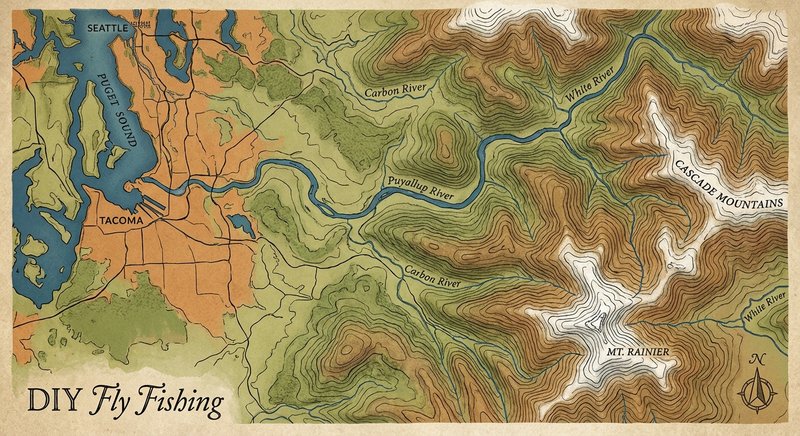
Puyallup River
Fly fishing in Washington · Beginner · Best seasons: Fall, Winter
Target Species
Steelhead, Chinook Salmon, Pink Salmon
About This Water
Mt. Rainier watershed river with salmon and steelhead. Accessible fishing south of Seattle.
Fishing Recommendations
The Puyallup River is one of Washington’s most unique and challenging fly fishing destinations. Flowing from the glaciers of Mt. Rainier to the industrial heart of Tacoma, it is a river of contrasts. For the fly angler, the Puyallup requires a specific mindset: it is a high-turbidity, glacial system where "reading the water" becomes an exercise in understanding flow rather than sight.
Here is your comprehensive guide to fly fishing the Puyallup River.
🎣 Location Overview
The Puyallup is a "working" river. Unlike the crystal-clear streams of the Cascades, the Puyallup is heavily influenced by glacial flour (silt). For much of the year, it looks like "chocolate milk" or a milky slate grey.
Why anglers love it: Despite the murky water, it hosts massive runs of salmon and steelhead. Because the fish cannot see you easily, they are often less "spooky" than in clearer rivers. When the visibility hits that magic "18 inches to 2 feet" mark, the fishing can be lights-out. It offers accessible bank fishing close to the Seattle-Tacoma metro area, making it a favorite for "before work" swings.
🐟 Target Species & Behavior
Chinook (King) Salmon
- Behavior: These are the titans of the river. They are notoriously moody in the Puyallup. They tend to hug the deepest parts of the main channel and move during low-light hours or on a rising tide in the lower reaches.
- Holding Water: Deep holes, the heads of pools, and just behind large woody debris.
Pink Salmon (Odd Years Only)
- Behavior: Known as "Humpies," they arrive in staggering numbers every odd-numbered year (2025, 2027). They are aggressive and will move to hit a fly.
- Holding Water: They prefer slower "frog water" or soft seams along the edges of the main current. They travel in massive schools; if you find one, you’ve found a thousand.
Steelhead (Winter Run)
- Behavior: The "Fish of a Thousand Casts." Winter Steelhead in the Puyallup are chrome-bright and powerful. They are cold-blooded, so they won't move far to chase a fly in winter temperatures.
- Holding Water: "Walking speed" water. Look for tail-outs and the soft inside of a bend where they can rest out of the heavy glacial push.
📅 Best Times to Fish
- Fall (August – September): This is the peak for Chinook and Pink Salmon. The river is often crowded, but the fish are plentiful.
- Late Fall (October – November): The Coho (Silver) salmon move in. They are much more aggressive toward flies than Chinook.
- Winter (December – March): This is the window for Winter Steelhead. This is "Steelhead weather"—rainy, cold, and gray.
- The "Visibility Window": The best time to fish the Puyallup is 24–48 hours after a heavy rain has peaked and the river level is dropping. As the silt settles, visibility improves, and fish become active.
🪰 Recommended Flies & Techniques
Top Fly Patterns
Because of the low visibility, contrast and vibration are more important than exact imitation.
- For Steelhead: Intruders in Black/Blue or Pink/Orange. Use large profiles with plenty of ostrich herl or rubber legs to move water.
- For Pinks: The "Pink Meany" or any small, pink marabou streamer (#4–#6). Flash is your friend here.
- For Chinook/Coho: Large Comets or Bunny Leeches in Chartreuse, Cerise, or Purple.
Techniques
- Spey / Skagit Casting: This is the gold standard for the Puyallup. Using a Spey rod with a heavy sink tip (T-11 to T-17) is essential to get the fly down through the heavy glacial flow to where the fish are holding.
- The "Puyallup Swing": Cast 45 degrees downstream, mend heavy to get the fly deep, and let it swing through the seam.
- Indicator Nymphing: In the upper reaches (near Orting), dead-drifting large beads or "yarn balls" under a slip-indicator can be deadly for Steelhead.
💡 Pro Tips & Local Knowledge
- The "Boot Test": In a glacial river, you need to know if the fish can see your fly. Wade in until the water is mid-calf. If you can still see your boots, the fishing conditions are "Prime." If you can't see your knees, it’s "Tough." If you can't see your boots at all, go get a coffee and wait for the river to drop.
- Focus on the Confluences: Where the Carbon River or White River meets the Puyallup, you often find "seams" of clearer water. Fish will stack up in these visibility breaks to clear their gills of silt.
- Vary the Retrieve: For Coho and Pinks, don't just let the fly swing. Give it short, erratic strips at the end of the swing. The "hang down" at the end of the cast is often when the strike happens.
- Short Leaders: In murky water, use a short leader (3–4 feet of 12lb or 15lb Maxima Ultragreen). You want the sink tip to pull the fly down immediately; a long leader will allow the fly to float above the fish's strike zone.
⚠️ Important Information
Access Information
- The Orting Area: Excellent gravel bar access and more "river-like" feel.
- The Sumner/Puyallup Stretch: More urban, with easy access near the Sportsmen's Club or Riverside Park.
- The Lower River: Tidal influenced; check tide charts as fish move in on the high tide.
Regulations & Permits
- License: You need a Washington Freshwater Fishing License and a Catch Record Card (CRC).
- Hooks: Barbless hooks are mandatory for all salmon and steelhead fishing in WA.
- Emergency Rules: The WDFW often closes the Puyallup on short notice due to escapement numbers. Always check the WDFW Emergency Rules page before you head out.
- Selective Gear Rules: Some sections are "Selective Gear Rules" only (no bait, scent, or internal weights).
Safety Note
The Puyallup is a "powerful" river. The silt masks the depth, and the bottom can shift. Always wade with a wading staff and wear a wading belt. The glacial mud can be like quicksand in some areas—if a bar feels "spongy," back out immediately.
Bug Hatches & Matching Flies
| Hatch | Type | Peak months | Time of day | Hook sizes | Matching flies |
|---|---|---|---|---|---|
| Blue Winged Olive Baetis | mayfly | March, April, September, October | Late Morning/Afternoon | #16-22 | RS2 #18-22, Parachute Adams #16-20, BWO Sparkle Dun #18-22 |
| March Brown Rhithrogena morrisoni | mayfly | March, April, May | Mid-day | #12-14 | March Brown Wet Fly #12-14, Gold Ribbed Hare's Ear #12-14, Western March Brown #12-14 |
| Golden Stonefly Hesperoperla pacifica | stonefly | June, July | All Day/Evening | #8-12 | Pat's Rubber Leg #8-12, Chubby Chernobyl (Gold/Tan) #8-12, Golden Stone Nymph #10-12 |
| October Caddis Dicosmoecus | caddis | September, October | Afternoon/Evening | #8-12 | Orange Stimulator #8-10, Morrish October Caddis Pupa #8-12, Peeking Caddis #10-12 |
| Mother's Day Caddis Brachycentrus | caddis | April, May | Afternoon/Evening | #14-16 | Elk Hair Caddis #14-16, Holy Grail #14-16, LaFontaine's Deep Sparkle Pupa #14-16 |
| Little Black/Brown Stonefly Capniidae/Taeniopterygidae | stonefly | February, March | Late Morning | #14-18 | Little Black Sloan #16-18, Zebra Midge (Black) #18-20, Prince Nymph #14-16 |
| Pale Morning Dun Ephemerella | mayfly | June, July, August | Morning/Early Afternoon | #16-18 | PMD Sparkle Dun #16-18, Pheasant Tail Nymph #16-18, Split Case PMD #16-18 |
| Salmonfly Pteronarcys californica | stonefly | May, June | All Day | #4-8 | Kaufmanns Stone #4-8, Rogue Foam Stone #6-8, Bitch Creek #6-8 |