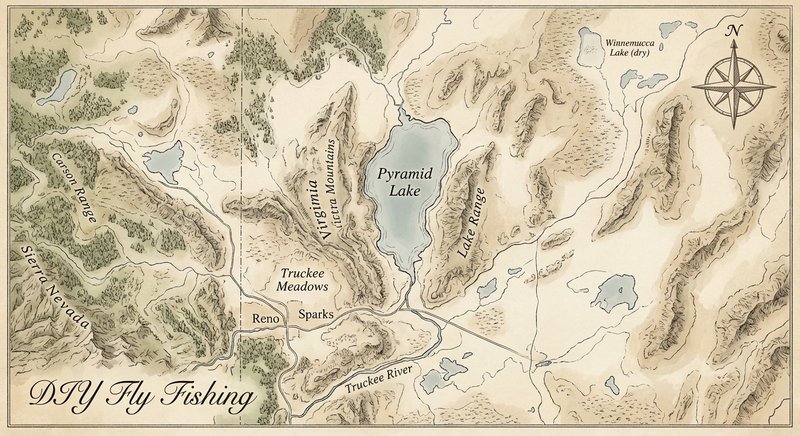
Pyramid Lake
Fly fishing in Nevada · intermediate · Best seasons: fall, winter, spring
Target Species
Lahontan Cutthroat Trout
About This Water
Desert terminus of Truckee River with trophy Lahontan cutthroat trout. Unique alkaline lake fishery.
Fishing Recommendations
Welcome to the "Land of the Giants." As your guide, I can tell you that Pyramid Lake is unlike any other fly fishing destination on the planet. Located on the Paiute Indian Reservation in Nevada, this high-desert terminal lake is the only place in the world where you have a legitimate chance to land a 20-pound-plus trout from the shore.
Here is your comprehensive guide to conquering the "Galapagos of the Desert."
🎣 Location Overview
Pyramid Lake is a remnant of the ancient Lake Lahontan. It is a terminal lake, meaning water flows in (via the Truckee River) but never flows out, escaping only through evaporation. This creates a highly alkaline, "salty" environment that supports a unique ecosystem.
The scenery is stark and prehistoric, characterized by jagged "Tufa" rock formations and barren hills. What makes this water special is the shore-bound accessibility. Because the lake floor drops off quickly near the beaches, anglers use step-ladders to stand in waist-deep water, allowing them to cast over the "shelf" into the deep haunts of massive trout.
🐟 Target Species & Behavior
The crown jewel here is the Lahontan Cutthroat Trout (LCT). There are two primary strains:
- The Summit Strain: Known for being hard fighters and reaching impressive sizes.
- The Pilot Peak Strain: These are the true monsters. Reintroduced in the mid-2000s, this strain was once thought extinct. They are genetically programmed to eat other fish, allowing them to grow to weights exceeding 20, 30, and even 40 pounds.
Behavior: LCT are "cruisers." They patrol the drop-offs where the shallow flats meet the deep blue water. They follow schools of Tui Chub (the primary forage) and feed heavily on Chironomids (midges). Unlike river trout, they don't hold in one spot; they are constantly on the move.
📅 Best Times to Fish
Pyramid is a cold-weather fishery. The lake is closed to fishing from July 1st to September 30th.
- Fall (Oct – Nov): As water temperatures drop, fish move from the depths toward the shore. This is prime "stripping" season with streamers.
- Winter (Dec – Feb): This is for the hardcore. The air is freezing, but this is when the biggest Pilot Peak fish are often caught. The fish are sluggish but congregate in the shallows.
- Spring (March – May): Peak season. The fish are in "spawn mode" and congregate in massive numbers near the beaches. The weather is more temperate, but the crowds are larger.
- The "Pyramid Chop": Regardless of the month, the best fishing occurs during stormy, windy days. When the water is "glassy," the fish move deep. You want 10–20 mph winds creating waves (the "chop") to stir up the bottom and mask your presence.
🪰 Recommended Flies & Techniques
1. The Indicator Rig (Nymphing)
This is the most productive method for most anglers.
- Flies: Balanced Leeches (Olive, Black/Chartreuse, "Bruised") and Chironomids (Albino Wino, Red Butcher, White Knight).
- Technique: Suspend your flies under a large slip-indicator. The leech should be 12–18 inches off the bottom, with a chironomid dropper.
- Pro Tip: Let the wave action move your indicator. The "heave" of the lake gives the balanced leech a natural swimming motion.
2. The Shooting Head (Stripping)
- Flies: Booby Flies (with large foam eyes) and Midnight Cowboys or Popcorn Beetles.
- Technique: Use a fast-sinking line (Type 5 or 7). Cast out, let it sink to the bottom, and use short, erratic strips.
- Why Boobies? Because the fly floats, it hovers just above the rocks while your sinking line drags it down. This prevents snags and keeps the fly in the "strike zone."
💡 Pro Tips & Local Knowledge
- The Ladder Strategy: Buy or build a sturdy folding ladder. It serves two purposes: it gets you further out to the drop-off and keeps you out of the bone-chilling water, preventing hypothermia and keeping your cast clear of the waves behind you.
- The "Pyramid Twitch": If fishing an indicator on a calm day, give your line a slight tug every 30 seconds. Often, the strike happens the moment the fly moves.
- Beaches to Know:
- Pelican Point: Great for beginners, lots of room.
- Windless: Deep water close to shore.
- Warrior Point: Known for holding massive fish in the spring.
- The Nets: High traffic but very productive during the spawn.
⚠️ Important Information
- Permits: You do not need a Nevada state fishing license. You must purchase a Tribal Fishing Permit from the Paiute Tribe (available online or at the local ranger station/store in Sutcliffe).
- Barbless Only: Strict enforcement of barbless hooks. No bait or scent allowed. One rod per angler (unless you buy a second-rod stamp).
- Gear Strength: Do not bring a 5-weight rod. You need a 7, 8, or 9-weight rod to handle the wind and the size of these fish. Large arbor reels with high-quality drags are mandatory.
- Safety: The weather changes in minutes. If you see a "Wall of Dust" coming across the lake from the north, get off the water immediately. The wind can gust to 60+ mph, creating dangerous swells.
- Wader Belts: If you fall off your ladder in chest waders without a belt, it is a life-threatening situation. Wear your safety gear.
Pyramid Lake is a test of endurance and patience, but when that indicator buried and a 15-pound Cutthroat starts peeling line, you’ll understand why we call this the holy grail of stillwater fly fishing. Tight lines!
Bug Hatches & Matching Flies
| Hatch | Type | Peak months | Time of day | Hook sizes | Matching flies |
|---|---|---|---|---|---|
| Large Black Midge Chironomus tentans | midge | February, March, April | All Day | #8-12 | Albino Wino #10-12, Zebra Midge #8-12 |
| Bloodworm Chironomidae | midge | January, February, March | Morning | #10-14 | Yankee Buzzers #12-14, Red Maholo Midge #10-12 |
| Albino Midge Chironomidae | midge | March, April, May | Afternoon | #10-12 | Albino Wino #10-12, White Beadhead Midge #12 |
| Olive Midge Chironomidae | midge | April, May, June | All Day | #12-16 | Wine/Olive Maholo Midge #12-14, Olive Copper John #14-16 |
| Damselfly Enallagma | terrestrial | May, June, July | Morning/Afternoon | #10-14 | Marabou Damsel #10-12, Balanced Damsel #12-14 |
| Scud Gammarus lacustris | terrestrial | January, February, March, April, May, June, July, August, September, October, November, December | All Day | #12-16 | Ray Charles #12-16, Olive Scud #14-16 |
| Water Boatman Corixidae | terrestrial | September, October, November | Afternoon | #14-16 | Prince Nymph #14-16, Water Boatman Pattern #16 |
| Pyramid Beetle Coleoptera | terrestrial | April, May, June | All Day | #8-12 | Pyramid Lake Beetle #8-12, Midnight Cowboy Beetle #10 |