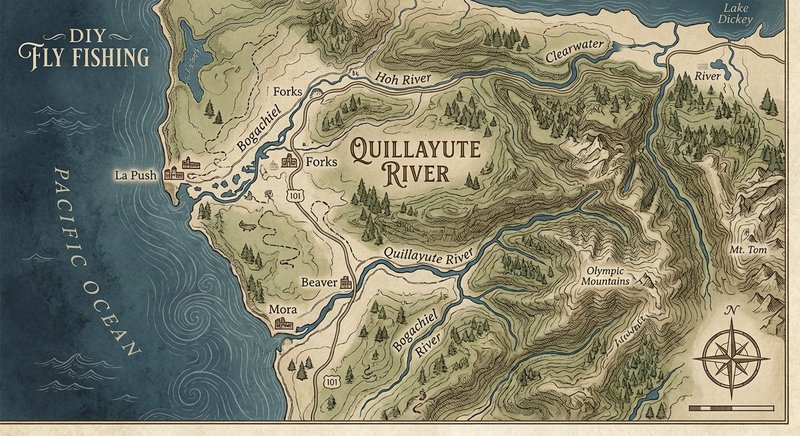
Quillayute River
Fly fishing in Washington · Intermediate · Best seasons: Fall, Winter
Target Species
Steelhead, Chinook Salmon
About This Water
Short but productive Olympic Peninsula river. Excellent steelhead and salmon near the Pacific coast.
Fishing Recommendations
The Quillayute River is the short but mighty crown jewel of the Olympic Peninsula (OP) in Washington State. Formed by the confluence of the Bogachiel and Sol Duc rivers, and joined shortly after by the Dickey, the Quillayute flows only about six miles before emptying into the Pacific Ocean at La Push. Because it acts as the singular "bottleneck" for four major river systems, nearly every fish destined for the Sol Duc, Bogachiel, Calawah, and Dickey must pass through this stretch, making it one of the most target-rich environments in the Pacific Northwest.
🎣 Location Overview
The Quillayute is a broad, powerful, and majestic river. Unlike its narrower tributaries, the "Q" is characterized by deep tidewater reaches, massive gravel bars, and heavy woody debris.
What makes it special is the proximity to the salt. You are often fishing for "chrome" fish—creatures that may have been in the Pacific Ocean only hours prior. The water has a classic glacial emerald tint but can turn to "chocolate milk" rapidly during the Olympic Peninsula’s famous rain events. Anglers love it for the sheer size of the fish and the dramatic, misty backdrop of the Olympic National Park.
🐟 Target Species & Behavior
Chinook Salmon (King Salmon)
- Behavior: These are the heavyweights. They enter the river looking for deep, cool "holding" water. They are notoriously moody but highly aggressive when fresh from the salt.
- Holding: Look for the "guts" of deep pools, the soft water just ahead of a heavy rapid, or deep slots behind large root wads.
Steelhead (Winter Run)
- Behavior: The Olympic Peninsula is world-famous for wild winter Steelhead. These fish are aggressive, powerful, and built for speed.
- Holding: Steelhead prefer "walking pace" water—about 3 to 5 feet deep. They often sit in the tailouts of runs or along the seam lines where fast and slow water meet. Unlike Chinook, they are more likely to move to a fly.
📅 Best Times to Fish
Fall (September – November)
- Species: Chinook and Coho Salmon.
- Windows: October is the "sweet spot." Watch the river gauges; you want to fish as the river is dropping and clearing after a rain.
Winter (December – April)
- Species: Winter Steelhead.
- December/January: Prime time for hatchery-origin Steelhead.
- February/March/April: The legendary window for wild Steelhead. These are the 20lb+ trophies the OP is famous for.
Daily Conditions
- The Tide: In the lower Quillayute, the tide matters immensely. A rising tide pushes fresh fish into the river; a falling tide often triggers fish to move upstream or settle into holding lies.
🪰 Recommended Flies & Techniques
The Swing (Spey Casting)
This is the preferred method for the Quillayute's broad runs.
- Technique: Use a 7-9 weight Spey rod with a Skagit head and a variety of sink tips (T-11 to T-17) depending on water speed.
- Steelhead Flies: Large "Intruder" style flies. Colors: Pink/Orange, Blue/Black, or "Black & Blue" (a local favorite).
- Chinook Flies: Heavy, weighted flies with a lot of movement. Colors: Chartreuse, Cerise, or Purple.
Nymphing (Indicator Fishing)
Highly effective when fish are tucked into tight slots or behind wood.
- Technique: A 9nd or 10ft single-handed rod.
- Patterns: Large "beaded" stones, Glow Bugs (beads), or Aero-brads in various shades of orange and pink.
💡 Pro Tips & Local Knowledge
- The "Mouth of the Rivers": The confluence where the Sol Duc and Bogachiel meet to form the Quillayute is legendary. It is a massive area with multiple channels. Focus on the "seams" where the two rivers merge.
- Tidal Awareness: If you are fishing the lower three miles, you are in a tidal zone. If the bite dies, it’s often because the fish have moved with the tide. Don’t be afraid to move with them.
- Confidence in the Hang Down: When swinging a fly, let it hang in the current for at least 10 seconds at the end of the swing. Steelhead will often follow a fly across the current and strike only when it stops and dangles straight downstream.
- The "OP" Rain: Bring the best rain gear you can afford. This is a temperate rainforest; if you aren't dry, you won't stay on the water long enough to find the fish.
⚠️ Important Information
Access
- Boat Access: The most common way to fish the Quillayute is by drift boat or raft, launching at Leyendecker Park (on the Bogachiel) or Maxfield (on the Sol Duc) and taking out at the Richwine Bar or the Mora boat launch.
- Bank Access: Limited but available near the Mora bridge and certain gravel bars reachable via logging roads.
Regulations & Permits
- WDFW Rules: Washington Department of Fish and Wildlife (WDFW) regulations for the "Q" change frequently. Barbless hooks are mandatory.
- Wild Steelhead: There is a strict no-retention policy for wild Steelhead. They must remain in the water at all times—lifting a wild Steelhead out of the water for a photo is illegal in this region.
- Tribal Lands: Portions of the lower river run through the Quileute Indian Reservation. You must respect tribal boundaries. Fishing on reservation land requires a specific Tribal Permit, which is separate from your Washington State license.
Safety
The Quillayute is a "big wood" river. Massive cedar and spruce trees frequently shift during floods, creating "sweepers" and "strainers." If you are rowing, maintain extreme vigilance.
Bug Hatches & Matching Flies
| Hatch | Type | Peak months | Time of day | Hook sizes | Matching flies |
|---|---|---|---|---|---|
| Blue Winged Olive Baetis tricaudatus | mayfly | March, April, September, October | Midday | #16-20 | BWO Sparkle Dun #18-20, RS2 #18-22, Pheasant Tail #16-20 |
| March Brown Rhithrogena morrisoni | mayfly | March, April, May | Afternoon | #12-14 | Western March Brown #12-14, Gold Ribbed Hare's Ear #12-14, March Brown Wet #12 |
| Golden Stonefly Hesperoperla pacifica | stonefly | June, July | Morning/Evening | #6-10 | Chubby Chernobyl (Gold) #8-12, Pat's Rubber Leg #6-10, Golden Stone Nymph #8-12 |
| October Caddis Dicosmoecus atripes | caddis | September, October, November | Late Afternoon/Evening | #8-10 | Orange Stimulator #8-10, October Caddis Pupa #8-10, Peahead Caddis #8-10 |
| Grannom Caddis Brachycentrus occidentalis | caddis | April, May | Afternoon | #14-16 | Peacock Caddis #14-16, Deep Sparkle Pupa #14-16, Elk Hair Caddis (Dark) #14-16 |
| Little Black Stonefly Capniidae | stonefly | February, March | Midday | #16-18 | Little Black Sloat #16-18, Zebra Midge (Black) #18-20, Iron Lotus #16-18 |
| Pale Morning Dun Ephemerella excrucians | mayfly | June, July, August | Morning/Afternoon | #14-18 | PMD Sparkle Dun #16-18, Quill Gordon #14-16, Split Case PMD #16-18 |
| Chironomids Chironomidae | midge | January, February, March, December | All Day | #18-24 | Griffith's Gnat #18-22, Zebra Midge (Red/Black) #18-22, Black Beauty #20-24 |