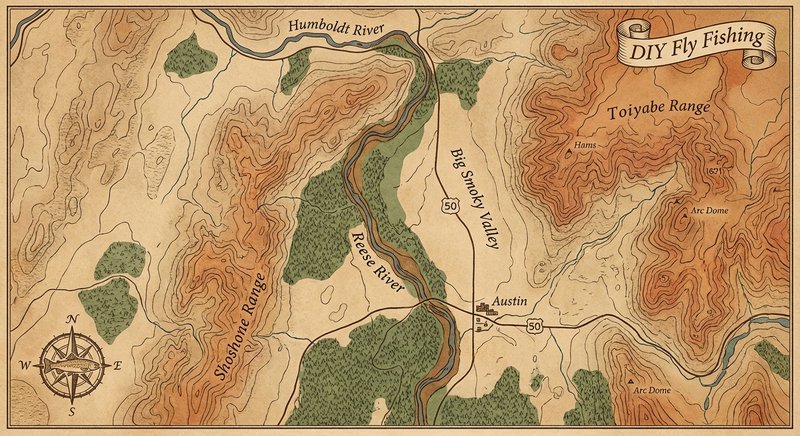
Reese River
Fly fishing in Nevada · intermediate · Best seasons: spring, summer, fall
Target Species
Brown Trout, Rainbow Trout
About This Water
Central Nevada stream with brown trout. Historic mining district waters.
Fishing Recommendations
The Reese River is one of Nevada’s true hidden gems for the adventurous angler. Tucked away in the Toiyabe Range of central Nevada near the town of Austin, it is a high-desert stream that offers a rugged, "off-the-beaten-path" experience. Unlike the famous tailwaters of the West, the Reese is a small, intimate creek that requires stealth and a sense of adventure.
🎣 Location Overview
The Reese River is unique because it is an endorheic river—it flows north through the high desert and eventually disappears into the desert floor (the Reese River Sinks) rather than reaching the ocean. For fly anglers, the "fishable" water is primarily in the upper reaches within the Toiyabe National Forest.
What makes this water special is its isolation. You won't find crowds here. The river is characterized by tight willow-lined banks, deep undercut bends, and small plunges. It feels like stepping back in time to the Old West. The water is generally clear and cool near the headwaters, transitioning into a meandering meadow stream as it flows through the Reese River Valley.
🐟 Target Species & Behavior
- Brown Trout: These are the "kings" of the Reese. They are wild, spooky, and highly territorial. They love the undercut banks and the deep shadows beneath the willows.
- Rainbow Trout: Found in the faster oxygenated riffles and deeper pools. Many are wild, though some stocking may occur near easier access points.
- Brook Trout: You may encounter these in the highest elevation tributaries.
Behavior: Because this is a small system with limited biomass compared to a massive river, these fish are opportunistic. They aren't usually "selective" about exact fly matches, but they are extremely sensitive to vibration and shadows. If they see you, the fishing is over for that hole.
📅 Best Times to Fish
- Spring (Late April – June): This is the prime window after the snowmelt begins to stabilize. The valley starts to green up, and the fish are hungry after a long winter. Note: Watch for high runoff in May if the snowpack was heavy.
- Summer (July – August): Excellent for "dry-dropper" rigs. The water levels drop, concentrating fish in the deeper pools. Morning and late evening are essential to avoid the high desert heat.
- Fall (September – October): This is arguably the best time for Brown Trout. As they prepare for the spawn, they become more aggressive and will hit larger streamers or terrestrial patterns. The fall colors in the Toiyabe Range are spectacular.
🪰 Recommended Flies & Techniques
Top Fly Patterns
- Dry Flies:
- Parachute Adams (Size 14-18) – The gold standard.
- Elk Hair Caddis (Size 14-16) – Great for skittering across riffles.
- Hopper Patterns (Size 10-12) – Massive in late summer (Joe’s Hopper or Dave’s Hopper).
- Nymphs:
- Pheasant Tail (Size 16-18) – Mimics the natural mayflies.
- Hare’s Ear (Size 14-16) – Effective in the deeper pools.
- Copper John (Size 16) – Good for getting down deep quickly in the plunges.
- Streamers:
- Woolly Bugger (Olive or Black, Size 8-10) – Twitch these through undercut banks to provoke the big Browns.
Techniques
- The "Dap & Drop": Because of the thick willows, a standard overhead cast is often impossible. Use a "bow-and-arrow" cast or simply drop your fly over the bushes into the current.
- Upstream Approach: Always fish moving upstream. The water is small and clear; if you fish downstream, the silt and your shadow will alert every fish before you get there.
- Dry-Dropper: A buoyant hopper pattern with a small Pheasant Tail nymph tied 18 inches below is the most effective way to cover the Reese.
💡 Pro Tips & Local Knowledge
- Stealth is Everything: Wear earthy colors (tans and greens) to blend into the sagebrush and willows. Crawling on your knees to reach a pool is often necessary.
- Focus on the Under-cuts: The Reese is famous for its deep, carved-out banks. Even a tiny section of the river that looks 6 inches deep might have a 2-foot deep undercut where a 14-inch Brown is hiding.
- The "Austin" Factor: Stop in the town of Austin for gas and supplies. It’s one of the most remote towns in the lower 48. Local knowledge can be found at the small shops there, but be prepared to be self-sufficient.
- Gear: Use a 3-weight or 4-weight rod, ideally 7.5 to 8.5 feet long. A shorter rod is much easier to maneuver through the brush.
⚠️ Important Information
- Access: Access is primarily via State Route 305 and various forest service roads. Many of these roads are dirt/gravel and can become impassable after heavy rain. A high-clearance vehicle is strongly recommended.
- Regulations: A valid Nevada Fishing License is required. Always check the current Nevada Department of Wildlife (NDOW) regulations for seasonal closures or special limits.
- Safety: This is remote country. There is little to no cell service. Bring plenty of water, a spare tire, and be aware of rattlesnakes during the summer months.
- Private Property: While much of the upper river is on National Forest land, the lower valley contains private ranch land. Always respect "No Trespassing" signs and stick to public access points.
Guide’s Final Word: The Reese River isn't about catching 50 fish a day; it’s about the solitude of the Great Basin and the challenge of outsmarting wild trout in a harsh desert environment. Bring your camera—the scenery is as good as the fishing.
Bug Hatches & Matching Flies
| Hatch | Type | Peak months | Time of day | Hook sizes | Matching flies |
|---|---|---|---|---|---|
| Blue-Winged Olive Baetis spp. | mayfly | March, April, September, October | Late Morning/Afternoon | #18-22 | Parachute Adams #18-22, RS2 #20-22, Pheasant Tail Nymph #18-20 |
| Pale Morning Dun Ephemerella excrucians | mayfly | June, July | Late Morning/Early Afternoon | #14-18 | PMD Sparkle Dun #16-18, Hare's Ear Nymph #14-16, Quigley Cripple #16 |
| Spotted Sedge Hydropsyche | caddis | June, July, August | Evening | #14-18 | Elk Hair Caddis (Tan) #14-18, LaFontaine's Deep Sparkle Pupa #16, Z-Wing Caddis #14-16 |
| Golden Stonefly Hesperoperla pacifica | stonefly | June, July | Morning/Evening | #8-12 | Rogue River Stone #8-10, Pat's Rubber Leg #8-12, Golden Stimulator #10-12 |
| Little Yellow Sally Isoperla spp. | stonefly | June, July | Afternoon/Evening | #14-16 | Yellow Stimulator #14-16, Little Yellow Sally Nymph #14-16 |
| Grasshoppers Melanoplus spp. | terrestrial | July, August, September | Midday | #8-14 | Hopper Juan #10-12, Morrish Hopper #8-12, Dave's Hopper #10-14 |
| Trico Tricorythodes | mayfly | August, September | Early Morning | #20-24 | Trico Spinner #20-24, Griffith's Gnat #20-22 |
| Midge Chironomidae | midge | January, February, March, December | Anytime | #18-24 | Zebra Midge #18-22, Morgan's Midge #20-22, Top Secret Midge #20-24 |
| Cinnamon Ant Formicidae | terrestrial | July, August | Midday | #16-18 | Cinnamon Ant #16-18, Chernobyl Ant #12-14 |