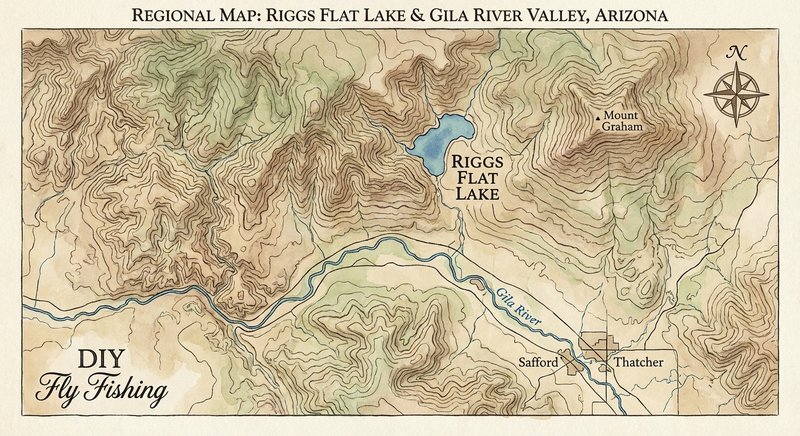
Riggs Flat Lake
Fly fishing in Arizona · intermediate · Best seasons: summer, fall
Target Species
Brook Trout, Rainbow Trout
About This Water
High elevation lake in Pinaleno Mountains. Remote setting with brook trout.
Fishing Recommendations
Welcome to the "Sky Islands" of Arizona. As a guide, I can tell you that Riggs Flat Lake is one of the most unique high-altitude fishing experiences in the Southwest. Perched at nearly 9,000 feet atop the Pinaleño Mountains (Mount Graham), it offers a cool, alpine escape from the desert heat below.
Here is your comprehensive guide to fly fishing Riggs Flat Lake.
🎣 Location Overview
Riggs Flat is a small, 11-acre reservoir that feels more like a high-mountain tarn in the Rockies than a typical Arizona lake. Because it is located at the end of the Swift Trail (Hwy 366), it is isolated and surrounded by a dense forest of Douglas fir and ponderosa pine.
The water is generally clear but can develop significant weed growth along the margins as the summer progresses. What makes this spot special is the elevation. While the valley floor in Safford might be 105°F, it will be a crisp 75°F at Riggs Flat. For the fly angler, this means active trout even in the dead of July.
🐟 Target Species & Behavior
- Rainbow Trout: These are the most common residents. They are frequently stocked and tend to cruise the open water near the dam and the center of the lake. They respond well to classic attractor patterns.
- Brook Trout: This is the real prize of Riggs Flat. The Brookies here are stunning, especially in the fall. They are more "structure-oriented" than the Rainbows. Look for them near the submerged timber, rocky drop-offs, and the vegetated shoreline.
- Behavior: In the mornings and evenings, fish move into the shallows to feed on midge hatches and terrestrials. During the bright midday sun, they retreat to the deeper channel near the dam or hide under the shade of overhanging trees and logs.
📅 Best Times to Fish
- Optimal Seasons:
- Summer (June–August): This is prime time. While other AZ lakes get too warm for trout, Riggs Flat remains oxygenated and cool.
- Fall (September–November): My personal favorite. The Brook Trout begin to spawn and display vibrant orange colors. They become more aggressive and territorial.
- Best Times of Day:
- The "Magic Hour": The 60 minutes before sunset is legendary here. The wind usually dies down, and the lake turns into a mirror, triggering a massive surface rise.
- Dawn: Early morning light before the sun hits the water is excellent for stripping streamers.
- Note: The road (Swift Trail) usually closes from mid-November to mid-April due to heavy snow.
🪰 Recommended Flies & Techniques
Top Fly Patterns
- Nymphs:
- Hare's Ear (size 14-18): A great generalist.
- Bead-head Zebra Midge (size 18-22): Black or Red. Essential for the morning hatch.
- Scuds (size 14-16): Olive or Pink. The lake has a high crustacean count.
- Dry Flies:
- Parachute Adams (size 16-20): The gold standard for the evening rise.
- Ants & Beetles (size 14-16): High-altitude forests are full of terrestrials. A foam ant dropped near the shore is deadly in August.
- Streamers:
- Woolly Bugger (size 10-12): Olive, Black, or Thin Mint. Fish these on a sinking tip line or with a weighted head near the dam.
Effective Techniques
- Indicator Nymphing: Suspend a midge or scud 4–6 feet under a small indicator. Cast near the weed edges and let the wind provide the movement.
- The "Slow Crawl": If using a Woolly Bugger or Leech, don't strip aggressively. Use a very slow "figure-eight" retrieve. These mountain trout often prefer a subtle presentation.
- Dry-Dropper: A Hopper or large Parachute Adams with a small Zebra Midge dropped 18 inches below is the most efficient way to prospect the shoreline.
💡 Pro Tips & Local Knowledge
- Focus on the Dam: The deepest water is near the dam. If the sun is high and the fish aren't rising, go deep with a sinking line.
- The "Log Jam" Area: The northern end of the lake often has downed timber. This is classic Brook Trout territory. Be precise with your casts; if you can land a fly 6 inches from a log, you'll likely get a strike.
- Watch the Wind: The wind usually blows from the west. This pushes insects toward the dam and the eastern shore. Fish the "leeward" side if you want easy casting, but fish the "windward" side if you want where the food is concentrated.
- Float Tubes: While you can fish from the bank, a float tube or kayak is a game-changer here. It allows you to reach the deeper pockets and fish back toward the shore, avoiding the trees that love to eat back-casts.
⚠️ Important Information
- Access: Access is via Hwy 366 (Swift Trail). It is a long, winding road with many switchbacks. It takes about an hour to drive up from Safford. Ensure your vehicle has good brakes.
- Regulations: A valid Arizona Fishing License is required. Riggs Flat is managed under general statewide regulations, but always check the current AZGFD Fishing Regulations booklet for any seasonal changes or bag limits.
- Wildlife: This is Black Bear country. If you are camping or keeping fish, use the bear-proof containers provided in the campground.
- The Mount Graham Red Squirrel: This is an endangered species habitat. Stay on designated trails and be respectful of the environment.
- Permits: There is a small day-use fee for parking/access in the Coronado National Forest.
Guide’s Final Word: Bring a light 3-weight or 4-weight rod to maximize the fun. These aren't trophy-sized monsters, but they are some of the most beautiful, wild-looking trout you will ever catch in the state of Arizona. Tight lines!
Bug Hatches & Matching Flies
| Hatch | Type | Peak months | Time of day | Hook sizes | Matching flies |
|---|---|---|---|---|---|
| Chironomids Chironomidae | midge | May, June, September | All Day | #16-22 | Zebra Midge #18-20, Ice Cream Cone #16-18, Griffith's Gnat #18-22 |
| Callibaetis Callibaetis ferrugineus | mayfly | June, July, August | Late Morning | #12-16 | Adams #14-16, Hare's Ear Nymph #12-16, Callibaetis Spinner #14-16 |
| Damselfly Enallagma | terrestrial | June, July | Late Morning/Afternoon | #10-14 | Marabou Damsel #10-12, Adult Damsel #12-14 |
| Scuds Gammarus | midge | May, October | All Day | #12-16 | Ray Charles #14-16, Flashback Scud #12-16 |
| Cinnamon Caddis Hydropsyche | caddis | July, August | Evening | #14-18 | Elk Hair Caddis #14-16, Pupa-Zilla #16 |
| Terrestrial Ants Formicidae | terrestrial | August, September | Afternoon | #14-18 | Cinnamon Ant #14-16, Black Foam Ant #16-18 |
| Water Boatmen Corixidae | midge | September, October | Afternoon | #14-16 | Water Boatman #14-16, Prince Nymph #14-16 |
| Dragonfly Nymphs Anisoptera | terrestrial | June, July, August | Morning/Afternoon | #6-10 | Olive Wooly Bugger #8-10, Dragon Nymph #6-10 |