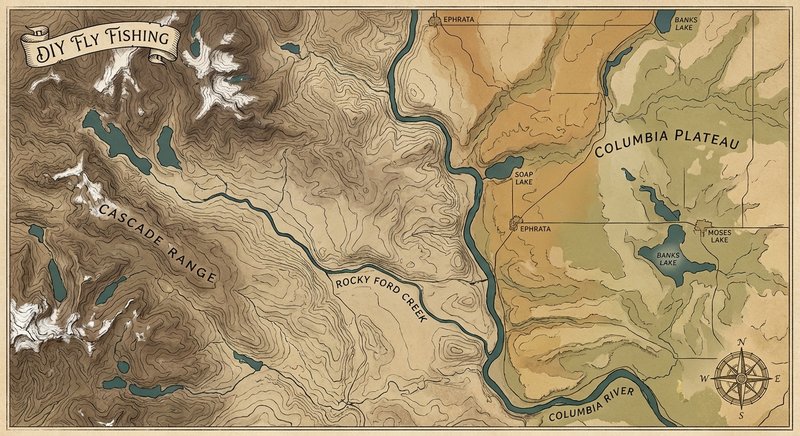
Rocky Ford Creek
Fly fishing in Washington · Advanced · Best seasons: Spring, Summer, Fall, Winter
Target Species
Rainbow Trout
About This Water
Eastern Washington spring creek with trophy rainbow trout. Catch-and-release, fly fishing only water.
Fishing Recommendations
Welcome to one of the most unique and challenging fly fishing destinations in the Pacific Northwest. As a guide, I often tell clients that Rocky Ford Creek is a "love-hate" relationship. It is a spring-fed creek in the middle of the high desert of Eastern Washington, known for its massive trout and its ability to humble even the most experienced anglers.
Here is your comprehensive guide to tackling the "Ford."
🎣 Location Overview
Rocky Ford Creek is a classic limestone-style spring creek located near Ephrata, Washington. Fed by cold underground aquifers, the water remains a constant temperature (around 50-55°F) year-round.
What makes it special is the clarity and the growth rate of the fish. Because the water is nutrient-rich and stable, the weed growth is prolific, creating a "trout factory" full of scuds and midges. The creek is relatively short and slow-moving, resembling a long series of glassy glides and deep holes. There are no trees for shade, and the banks are lined with cattails and tall grass. It is a selective fishery—the water is gin-clear, and the fish have seen every fly in the catalog.
🐟 Target Species & Behavior
- Species: Exclusively Triploid Rainbow Trout.
- Size: These aren't your average creek fish. Specimens range from 18 to 28 inches, often weighing between 3 and 10 pounds.
- Behavior: Because they are "Triploids" (sterile), they don't spawn, meaning they spend 100% of their energy eating and growing.
- Holding Patterns: They hold in the "lanes" between thick beds of Elodea (river weed). They are notorious "cruisers," patrolling specific beats in the slower sections. If you see a shadow moving slowly along the reeds, that’s your target.
📅 Best Times to Fish
Rocky Ford is a year-round fishery, which is its greatest draw.
- Winter (Dec–Feb): This is arguably the best time. When other rivers are frozen or blown out, the Ford is stable. Midges are the primary hatch.
- Spring (March–May): Excellent blue-winged olive (BWO) hatches. The fish are active as the desert warms up.
- Summer (June–Aug): Can be very hot (100°F+). Fish early or late. Scuds and damselflies are the main course. Beware of the "muck" and tall stinging nettles.
- Fall (Sept–Nov): Fantastic fishing. Cooler air temperatures make for comfortable days, and the trout are aggressive before the winter sets in.
Prime Window: Overcast, slightly breezy days are best. The wind ripples the surface, which helps hide your presence from the eagle-eyed trout.
🪰 Recommended Flies & Techniques
Top Fly Patterns
- Scuds: The staple diet. Olive, Gray, or Orange (dead) in sizes 12–18.
- Midges: Zebra Midges (black/silver, red/gold) in sizes 18–22. Griffith’s Gnat for surface feeders.
- Blue Winged Olives: Parachute Adams or Sparkle Duns (sizes 18–20).
- Damselflies: Olive marabou damsel nymphs (sizes 10–14).
- Streamers: Black or Olive Woolly Buggers (size 8–10). Use these with a "strip-and-drop" method.
Techniques
- Sight Fishing: Do not blind cast. Walk slowly, use polarized glasses, and spot a fish first.
- The "No-Indicator" Nymph: Because the water is so clear and still, a plastic bobber/indicator will often spook the fish. Use a long leader (12–15 feet) and watch the tip of your fly line or the fish’s mouth.
- The "Drying" Technique: If a fish is rising, you must be precise. Use a 6X or 7X tippet. One micro-drag and the fish will ghost you.
💡 Pro Tips & Local Knowledge
- The Stealth Factor: Treat this like hunting. Stay low, wear drab colors (tans/browns to match the desert), and avoid "lining" the fish (casting the fly line directly over their heads).
- Bridge Tactics: There are several footbridges. While tempting to fish from them, the fish know people stand there. Try casting from 20 feet back from the bank instead.
- The "Rocky Ford Twitch": When fishing a scud, let it sink to the bottom near a weed edge. Give it a tiny, 1-inch twitch. This often triggers a reflex strike from a cruising rainbow.
- Landing the Giants: These fish are heavy and the weeds are thick. Use a minimum of a 5-weight or 6-weight rod. Once hooked, keep the fish's head up; if they dive into the weeds, you will likely lose them.
⚠️ Important Information
- Regulations: Fly Fishing Only. Catch and Release Only. Single barbless hooks are mandatory.
- Access: There are two main parking areas (Upper and Lower). There is a well-maintained trail system between the two.
- No Wading: Wading is prohibited at Rocky Ford to protect the fragile spring creek ecosystem and the weed beds where the bugs live. You must fish from the bank or the bridges.
- License: A Washington State freshwater fishing license is required. No Discovery Pass is needed for the primary WDFW parking lots, but check signage.
- Creature Comforts: Bring water and rattlesnake protection in the summer. There is zero shade, so sunblock is a must.
Guide’s Final Word: Rocky Ford is a "PhD" water. If you can catch fish here consistently, you can catch trout anywhere in the world. Be patient, stay stealthy, and enjoy the sight of a 24-inch trout sipping a size 20 midge. Tight lines!
Bug Hatches & Matching Flies
| Hatch | Type | Peak months | Time of day | Hook sizes | Matching flies |
|---|---|---|---|---|---|
| Midges Chironomidae | midge | January, February, March, December | All Day | #18-24 | Zebra Midge #18-22, Griffith's Gnat #20-22, Palomino Midge #20-24 |
| Scuds Gammarus | crustacean | March, April, May, October | All Day | #12-18 | Ray Charles #14-18, Olive Scud #12-16, Rainbow Scud #14-18 |
| Blue-Winged Olive Baetis | mayfly | March, April, September, October | Mid-day | #18-22 | RS2 #18-22, Parachute Adams #18-22, Pheasant Tail Nymph #18-20 |
| Damselfly Enallagma | terrestrial | June, July, August | Late Morning/Afternoon | #10-14 | Marabou Damsel #10-12, Braided Butt Damsel #12-14, Adult Damsel #12-14 |
| Trico Tricorythodes | mayfly | July, August, September | Early Morning | #22-26 | Trico Spinner #22-24, Sunken Trico Spinner #22-24 |
| Callibaetis Callibaetis | mayfly | May, June, September | Late Morning | #14-16 | Callibaetis Spinner #14-16, Hare's Ear Nymph #14-16, Mercer's Missing Link #14-16 |
| Terrestrials Formicidae / Gryllidae | terrestrial | July, August, September | Afternoon | #10-16 | Cinnamon Ant #14-16, Chernobyl Ant #10-12, Black Beetle #14-16 |
| Water Boatman Corixidae | terrestrial | September, October | All Day | #14-18 | Water Boatman #14-18, Prince Nymph (Small) #16-18 |