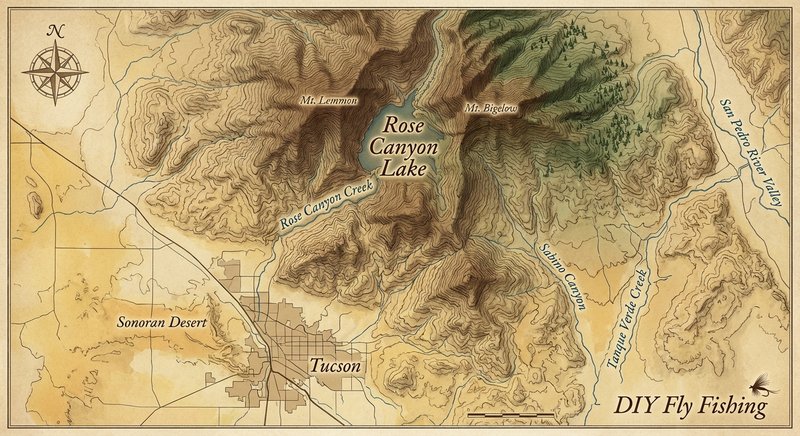
Rose Canyon Lake
Fly fishing in Arizona · beginner · Best seasons: spring, fall, winter
Target Species
Rainbow Trout
About This Water
Santa Catalina Mountains lake near Tucson. Popular escape from desert heat.
Fishing Recommendations
Welcome to the "Sky Islands" of Southern Arizona. As an expert guide, I’ve spent many seasons navigating the unique high-altitude fisheries of the Southwest. Rose Canyon Lake is a true gem—a 7-acre alpine oasis perched at 7,000 feet in the Santa Catalina Mountains, just a short drive from the desert heat of Tucson.
Here is your comprehensive guide to fly fishing Rose Canyon Lake.
🎣 Location Overview
Rose Canyon Lake is the only cold-water lake in the Santa Catalina Mountains. Surrounded by a dense forest of Ponderosa pines, it offers a dramatic contrast to the Saguaro-covered valley below.
What makes it special is the "Sky Island" effect—the elevation creates a cool, temperate climate that supports trout in a region otherwise dominated by desert. The water is generally clear but can take on a slight green tea stain depending on the season and algae growth. Because it is small and easily accessible, it is a "put-and-take" fishery heavily managed by the Arizona Game and Fish Department (AZGFD), but it holds enough holdover fish to keep things interesting for the technical angler.
🐟 Target Species & Behavior
The primary target here is the Rainbow Trout.
- Behavior: These fish are predominantly hatchery-reared, meaning they can be opportunistic and occasionally "naive" shortly after a stocking. However, because the lake receives significant pressure, the fish that survive more than a week become surprisingly "tippet-shy" and selective.
- Holding Areas: In the early morning, trout cruise the shallow shorelines looking for midges. As the sun rises, they retreat to the deeper water near the dam or hold in the shadows of the large granite boulders and overhanging pines on the southern shore.
- Feeding: Their diet consists of heavy midge hatches, small crustaceans (scuds), and terrestrial insects that fall from the pines (ants, beetles, and grasshoppers).
📅 Best Times to Fish
- Spring (April – June): This is the prime window. The ice has melted, the road is open to vehicles, and the fish are extremely active as the water warms into the 50s.
- Fall (September – November): As the air cools, the trout move back into the shallows. The "Fall Bite" is excellent as fish feed aggressively before the winter freeze.
- Winter (December – March): The main gate to the Rose Canyon Campground usually closes to vehicles in late autumn. Pro Tip: You can still fish! It requires a roughly 1-mile hike or bike ride from the highway. This is when you’ll find the most solitude and the biggest holdover trout.
- Time of Day: Early morning (dawn until 10:00 AM) is best for dry fly action. Evening "power hours" occur right as the sun dips behind the ridge.
🪰 Recommended Flies & Techniques
1. The "Indy" Rig (Nymphing)
Since midges are the primary biomass, a suspended nymph rig is most effective.
- Flies: Zebra Midges (Size 18-22) in black/silver or red; Pheasant Tails (Size 16-18); Gold-ribbed Hare’s Ears.
- Technique: Use a small, sensitive strike indicator. Set your depth so the fly hangs about 12-18 inches off the bottom.
2. Stripping Streamers
For the larger holdover trout or recently stocked aggressive fish.
- Flies: Woolly Buggers (Size 8-12) in Olive, Black, or Cinnamon. Semi-Seal Leeches are also local favorites.
- Technique: Use a slow, erratic "strip-strip-pause" retrieve. Often the hit comes on the pause.
3. Dry Fly Action
Best during the morning midge hatches or summer monsoons.
- Flies: Parachute Adams (Size 18-20), Griffith’s Gnat (Size 20), and Foam Ants or Beetles (Size 14-16) in late summer/fall.
- Technique: Use a long, fine leader (9ft 6X) to avoid spooking fish in the clear water.
💡 Pro Tips & Local Knowledge
- The Dam Area: The deepest water is near the dam. If the sun is high and the fishing feels slow, concentrate your efforts here with a sinking tip line or a long leader.
- The "Shadow Line": Because the lake is in a canyon, parts of the south shore stay in the shade longer. Trout will hold in these shadows to stay cool and hidden from aerial predators (Ospreys are common here).
- Stealth Matters: Despite being a stocked lake, the water is small. Avoid wearing bright colors and try to stay low when fishing the banks.
- Float Tubes: While you can fish from the shore, a float tube or kayak is a game-changer here. It allows you to reach the center of the lake and the far banks that are inaccessible by foot due to thick brush.
⚠️ Important Information
- Access: A daily parking fee is required (usually through the Coronado National Forest/concessionaire). If the gate is closed, you must park at the turnoff and hike in.
- Regulations: An Arizona Fishing License is mandatory for anyone 10 years or older. You can purchase these online at the AZGFD website.
- Special Note on Water Levels: In very dry years, the lake level can drop significantly by late June. Always check local forest service reports for fire closures or water level warnings before heading up.
- Gear Recommendation: A 3-weight or 4-weight fly rod is perfect for this lake. It makes the average-sized Rainbows feel like monsters and allows for delicate presentations.
Tight lines, and enjoy the crisp mountain air of Mt. Lemmon!
Bug Hatches & Matching Flies
| Hatch | Type | Peak months | Time of day | Hook sizes | Matching flies |
|---|---|---|---|---|---|
| Callibaetis (Speckled Winged Mayfly) Callibaetis spp. | mayfly | May, June, September | Late Morning/Early Afternoon | #12-16 | Adams #14-16, Hare's Ear Nymph #12-16, Callibaetis Spinner #14-16 |
| Chironomids (Midges) Chironomidae | midge | April, May, October | All Day | #16-22 | Zebra Midge #18-22, Griffith's Gnat #18-22, Ice Midge #16-20 |
| Blue-Winged Olive (BWO) Baetis spp. | mayfly | April, October, November | Mid-Day/Overcast | #18-22 | BWO Sparkle Dun #18-20, Pheasant Tail Nymph #18-22, RS2 #20-22 |
| Blue Damselfly Enallagma spp. | other | June, July, August | Afternoon | #10-14 | Marabou Damsel Nymph #10-14, Parachute Damsel #12-14, Adult Damselfly #12 |
| Cinnamon Caddis Hydropsyche spp. | caddis | June, July | Evening | #14-16 | Elk Hair Caddis (Tan) #14-16, LaFontaine's Deep Sparkle Pupa #14-16, Caddis Poopah #14-16 |
| Terrestrial Ants Formicidae | terrestrial | July, August, September | Afternoon | #14-18 | Black Foam Ant #14-18, Cinnamon Ant #16-18, Flying Ant #14-16 |
| Green Darner Dragonfly Anax junius | other | July, August | Morning/Afternoon | #6-10 | Dragonfly Nymph #6-10, Woolly Bugger (Olive) #8-12, Carey Special #10 |
| Water Boatmen / Backswimmers Corixidae / Notonectidae | other | September, October | Afternoon | #14-18 | Water Boatman #14-18, Prince Nymph #14-18, Backswimmer #12-16 |